 English
 Magyar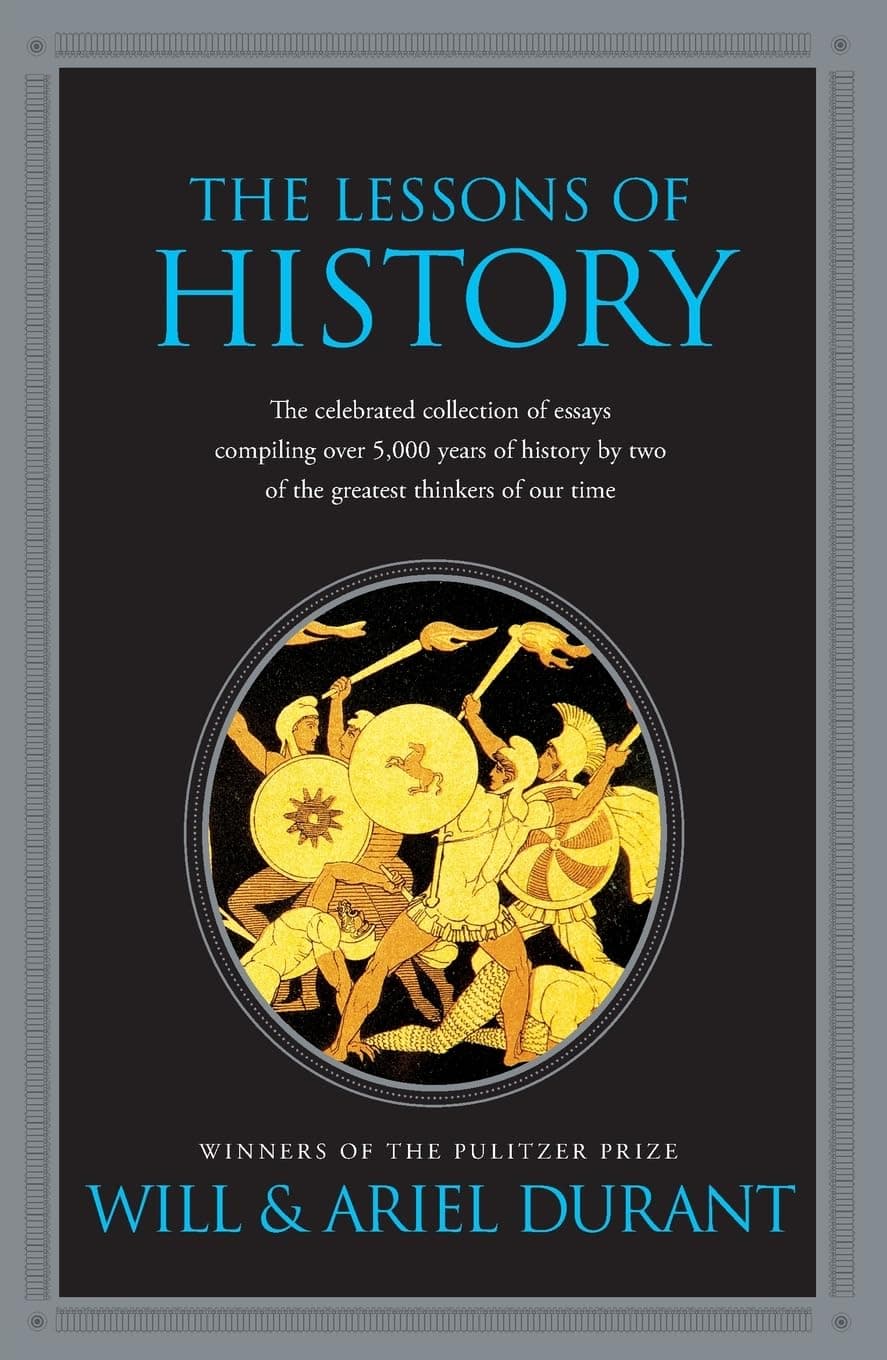
The Lessons of History
Will Durant, Ariel Durant
Free download · 500+ book summaries
What is The Lessons of History about?
The Lessons of History describes the recurring problems and improvement trends of the past 5,000 years – all from 12 different perspectives. The book’s aim is to explain the present, the future, human nature, and the internal workings of states.
Key ideas of The Lessons of History
History Repeats Its Patterns
Across 5,000 years, human behavior follows recurring cycles in wealth, war, morality, and governance that no generation successfully escapes.
Wealth Concentration and Reset
Inequality naturally grows in any society until redistribution happens through legislation or, when that fails, through revolution.
Civilization Must Be Earned
Each generation must actively transmit its inherited knowledge and culture, because civilization collapses whenever that transmission is interrupted.
Read an excerpt from the summary
Will and Ariel Durant spent forty years writing eleven volumes about civilization. When they were finally done, in their seventies, they sat down and tried to say what all of it meant in roughly a hundred pages. That book is The Lessons of History, and it reads like the closing argument of a brilliant lawyer who has stopped trying to impress anyone. The Durants are not building a system. They are not chasing originality. They wrote, in their own words, to offer a survey of human experience, not a personal revelation. What they produced is the rarest thing in nonfiction: an old couple's hard-won, slightly disenchanted view of what people actually do, told in prose so clean you can hear it.
The promise of the book is modest and enormous at the same time. If you take 5,000 years of behavior and look at it through the right lenses, certain patterns repeat. Trade, war, religious revival, sexual revolution, the rise and fall of wealthy classes, the swing between freedom and equality — none of it is new, and very little of it is accidental. The Durants will not tell you the future. They will tell you that the future will rhyme with what has already happened, because the creature making the future has not changed much. The book's quiet warning is that any generation which believes itself unprecedented is about to repeat something old.
I. Hesitations
The book opens with a confession that most readers skip. Most history, the Durants say, is guessing, and the rest is prejudice. The historian always oversimplifies, hastily selecting a manageable minority of facts and faces out of a crowd of souls and events whose complexity he can never quite embrace. This is the chapter where the Durants kick the legs out from under their own project before anyone else can. Before they will offer a single lesson, they want you to know what kind of statement a lesson of history can be.
Like it?
Continue in the appWho is it for?
- Anyone who wants historical context for the political and economic tensions playing out today.
- Anyone who feels that current events are unprecedented and wants a longer, calmer perspective.
- Anyone who studies leadership, government, or social change and wants to understand the forces underneath.
- Anyone who reads widely and wants a short, honest synthesis from two scholars who spent forty years on the subject.
About the author: Will Durant, Ariel Durant
Will Durant (1885-1981) was an American historian and philosopher best known for the eleven-volume series The Story of Civilization, which he wrote together with his wife Ariel Durant over four decades. The series won the Pulitzer Prize for General Nonfiction in 1968.
Ariel Durant (1898-1981) co-authored the series from Volume 7 onward and was formally credited as co-author from that point. Will and Ariel worked as genuine intellectual partners, and The Lessons of History reflects the combined perspective of two lifetimes spent reading and arguing about human civilization.
Read it in 45 minutes
The summary of The Lessons of History and 500+ more books await in the BookBase app.