 English
 Magyar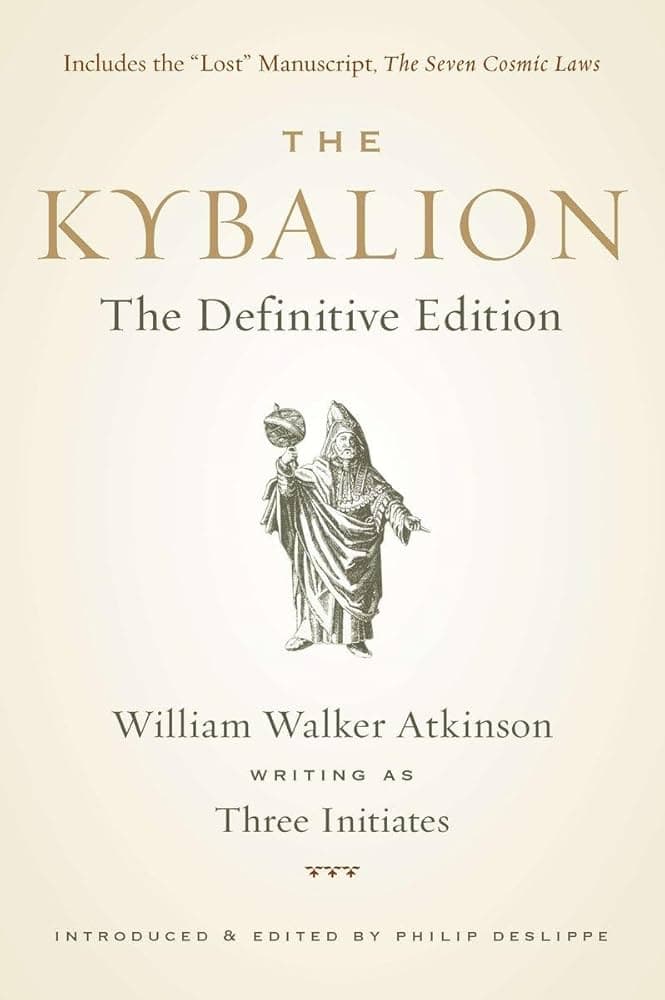
The Kybalion
William Walker Atkinson
Free download · 500+ book summaries
What is The Kybalion about?
The Kybalion is one of the classics of the New Thought movement, claiming that the mind and thought are the ultimate forces of the universe, and that people can harness these ancient forces — such as thought, rhythm, and polarities — for health, wealth, and influence.
Key ideas of The Kybalion
Mental Transmutation as Craft
Deliberately changing your mental state through polarity and vibration is a learnable skill, not a passive wish.
Polarity and Inner Conversion
Fear and courage are two poles on the same line, so you can rotate one into the other without waiting for the feeling to disappear.
Mastering Rhythm, Not Fighting It
Moods and circumstances swing like a pendulum, and the trained mind learns to witness the swings rather than be carried by them.
Read an excerpt from the summary
A Borrowed Temple That Still Holds Something Real
The Kybalion is a small book that walks into the room dressed as a much older one. Published in 1908 under the byline of "Three Initiates," it presents itself as a faithful distillation of ancient Hermetic teaching, the lineage that traces back to Hermes Trismegistus, the legendary thrice-great Egyptian sage credited with founding alchemy, astrology, and the whole esoteric river that runs through Western mysticism. The real author was almost certainly William Walker Atkinson, a Chicago lawyer who reinvented himself as one of the most prolific writers of the early American New Thought movement. He wrote on yoga, on magnetism, on memory, on prosperity, and on what he called practical occultism, and somewhere in the middle of that output he produced this book. Slim enough to read in an afternoon. Dense enough to spawn a hundred years of imitators.
Strip away the pseudo-Egyptian packaging and you are left with a focused argument. Reality has a structure. That structure can be described as Seven Principles. Once you understand the principles, you can stop being a passenger in your own life and start operating the controls. The book calls this Mental Transmutation, and it treats the practice the way a physics textbook treats mechanics: as a craft you learn by understanding the underlying laws and then drilling the applications.
Most modern readers come to The Kybalion because someone else cited it. Napoleon Hill drew from it. Wallace Wattles' The Science of Getting Rich shares its DNA. Florence Scovel Shinn echoes it. Rhonda Byrne's The Secret is essentially a popularized retelling. So whether or not you trust the book's claim to ancient lineage, the ideas inside it have shaped self-help, prosperity teaching, and pop spirituality for over a century. Reading the original is like reading the source code for a long line of derivative products. Some of it has aged poorly. Some of it still cuts. The point of this summary is to lay out what is actually in the book, what the book actually claims, and what is worth keeping when you put it down.
Like it?
Continue in the appWho is it for?
- Anyone who wants to understand the philosophical roots behind a century of self-help and prosperity writing.
- Anyone who feels more like a passenger than a driver in their own emotional and mental life.
- Anyone curious about Hermetic philosophy and how ancient esoteric frameworks apply to modern practice.
- Anyone interested in the psychology of inner-state change, focus, and deliberate action.
About the author: William Walker Atkinson
William Walker Atkinson was a Chicago lawyer who, after a professional and personal collapse in the 1890s, reinvented himself as one of the most prolific writers of the early American New Thought movement. He wrote dozens of books on topics ranging from memory and concentration to yoga and practical occultism, often under pen names.
The Kybalion was published in 1908 under the byline "Three Initiates," though scholars widely attribute authorship to Atkinson. His influence on later self-help and prosperity writing, including works by Napoleon Hill and Wallace Wattles, is significant and well-documented.
Read it in 40 minutes
The summary of The Kybalion and 500+ more books await in the BookBase app.