 English
 Magyar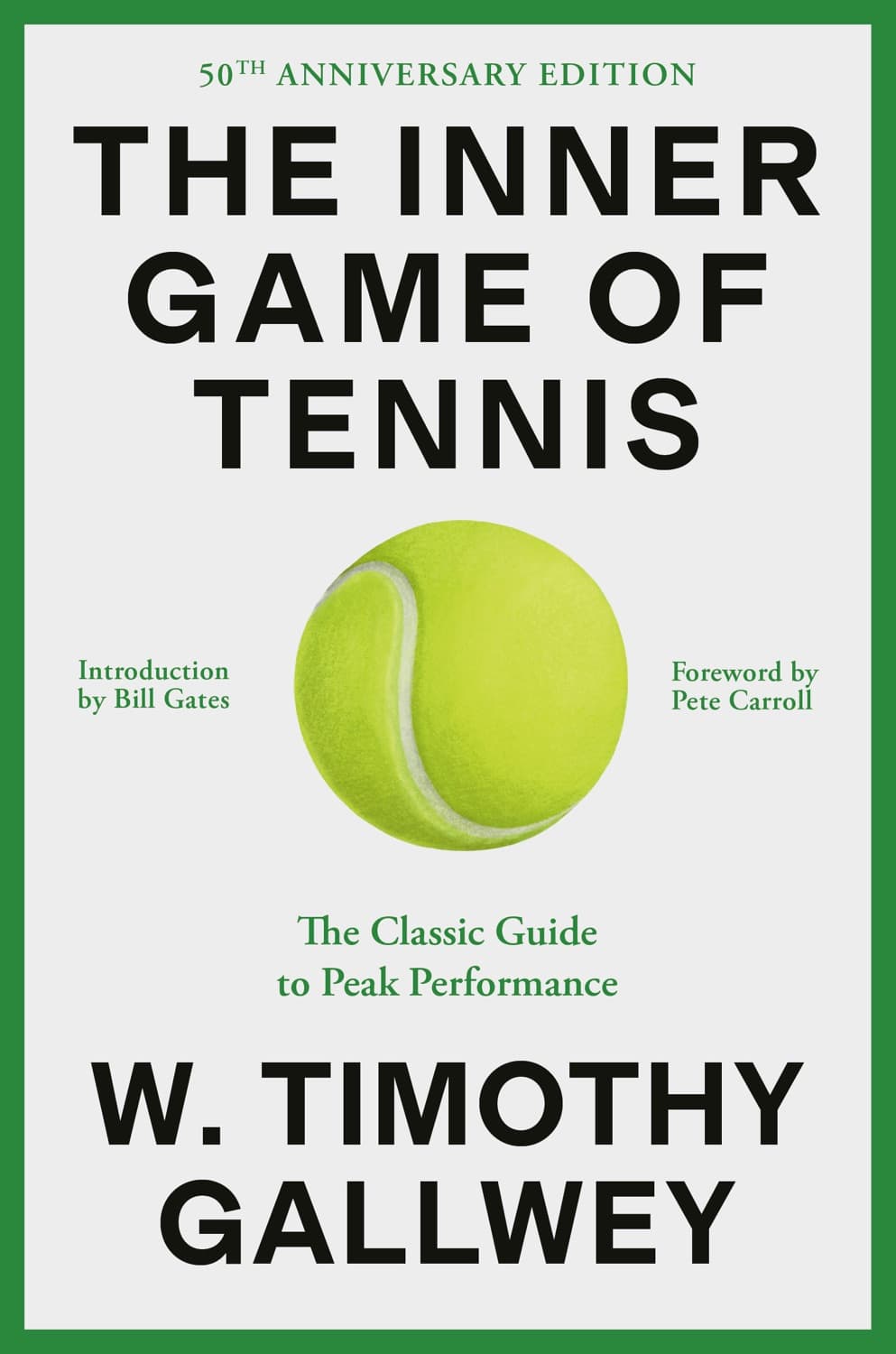
The Inner Game of Tennis
W Timothy Gallwey
Free download · 500+ book summaries
What is The Inner Game of Tennis about?
The book about tennis that has nothing to do with tennis. W. Timothy Gallwey introduced the concept of Self 1 and Self 2, and showed how the loudest internal voice is usually the one sabotaging your performance. The 1974 classic that quietly built modern coaching, mindfulness, and flow research.
Key ideas of The Inner Game of Tennis
Self 1 vs. Self 2
The conscious, critical mind (Self 1) undermines the body's natural intelligence (Self 2) by talking, judging, and interfering mid-performance.
Performance Minus Interference
Your output equals your actual potential minus the noise from self-criticism and anxiety, not a lack of skill or effort.
Non-judgmental Observation
Replacing evaluation of every shot with neutral, curious attention quiets Self 1 and lets the body perform as it already knows how.
Read an excerpt from the summary
The Inner Game of Tennis
The woman's name was Dorothy, and she had been gripping the racket like it owed her money for six years.
Tim Gallwey had seen the grip a hundred times on the clay courts of the Meadow Club in Mill Valley, California -- knuckles pale, forearm locked, the whole right side of her body braced for combat. Dorothy was a retired schoolteacher, sixty-one years old, and she wanted, more than anything, to stop shanking her backhand into the net. She had tried lessons before. She had memorized the checklist: knees bent, racket back early, contact point in front, follow through high. The checklist was not working. When she thought about the checklist, the ball arrived while she was still consulting it. Then she swung, and the ball went sideways into the fence, and she muttered something she would not have said in her classroom, and her jaw went tight.
Gallwey watched for a moment. Then he said something her previous coaches had never said. He said: stop trying to fix it. Instead, just watch where the ball is when your racket makes contact. Call it out loud. Early. Middle. Late. That is all.
Dorothy hit the next ball. "Late," she said, almost surprised. Hit another. "Middle." Hit another. "Late again." Within four minutes -- four minutes of doing nothing except observing, without correcting, without judging, without trying -- her backhand had completely transformed. She was making contact in front, with a loose arm, following through naturally. Nobody had told her to do those things. Her body had figured it out on its own, simply because her mind had gotten out of the way.
Like it?
Continue in the appWho is it for?
- Anyone who overthinks under pressure and finds their performance collapses exactly when it matters most.
- Anyone who coaches or teaches and wants to help people learn faster by getting out of their own way.
- Anyone interested in flow states, mindfulness, or the psychology of peak performance.
- Anyone who suspects they are performing well below their actual ability in sport, music, or work.
About the author: W Timothy Gallwey
W. Timothy Gallwey was a Harvard-educated tennis player and coach who developed his ideas about the inner game while teaching at courts in California in the early 1970s. His work drew on both competitive tennis experience and a meditation practice he developed during time in the Peace Corps.
After the 1974 publication of The Inner Game of Tennis, Gallwey went on to write companion books applying the same framework to golf, music, and the workplace. His methods were later adopted by coaches, executives, and sports organizations worldwide, and his core concepts became foundational to the field of performance coaching.
Read it in 44 minutes
The summary of The Inner Game of Tennis and 500+ more books await in the BookBase app.