 English
 Magyar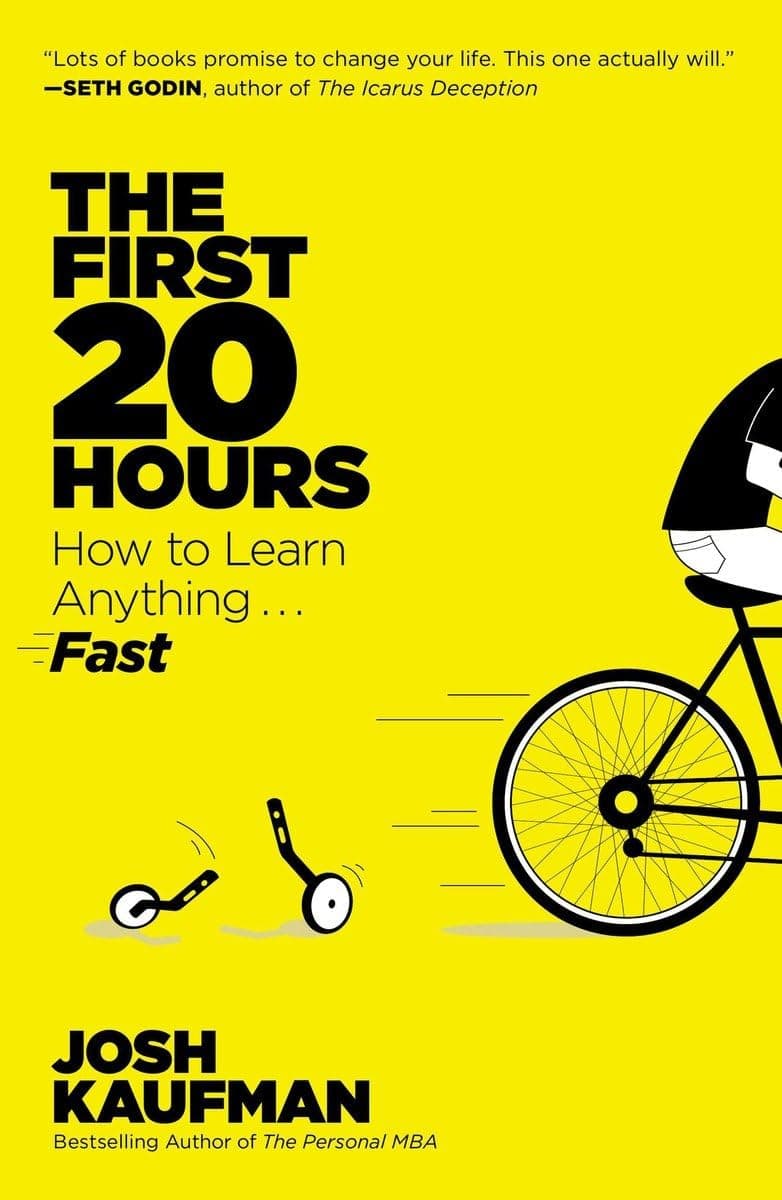
The First 20 Hours
Josh Kaufman
Free download · 500+ book summaries
What is The First 20 Hours about?
The first 20 hours are about quickly mastering new skills. Thanks to the book, you can forget the "it's too late to start" monologue for good. Whether you want to learn a foreign language or fly a helicopter, the book provides ten simple steps to help you get started.
Key ideas of The First 20 Hours
Competence, Not Mastery
Most people want to hold a conversation or play a recognizable song, not perform at world-class level, and twenty focused hours is enough to get there.
Deconstruct Before You Practice
Breaking any skill into its smallest sub-skills and drilling only the critical ones is what makes twenty hours actually produce results.
Remove Barriers First
Using willpower once to eliminate distractions and friction is far more effective than fighting those obstacles every single practice session.
Read an excerpt from the summary
Josh Kaufman had a nine-month-old daughter, a wife running her own business, and about twenty-five working hours a week. That was the entire window in which he was supposed to write books, run a company, and still learn the things he kept telling himself he wanted to learn. The list was long. Yoga. Web programming. Touch typing on a layout other than QWERTY. The ancient board game Go. The ukulele. Windsurfing. None of it was going to happen in ten thousand hours, because ten thousand hours did not exist in his life. They did not exist in the life of anyone with a real job and a kid.
So Kaufman did something quietly heretical. He asked whether the famous ten-thousand-hour rule, the one Malcolm Gladwell turned into a generation's mental wallpaper, was answering the right question. And he discovered that, for the vast majority of skills most people want, it wasn't.
The First 20 Hours is the book that came out of that question. It is short on theory and long on field notes, because Kaufman ran the experiment on himself. Six skills, roughly twenty hours each, all within about a year. The result is not a guide to becoming the next Tiger Woods. It is the much more useful thing: a guide to going from terrible at something to genuinely competent, in about the time most of us spend deciding whether to start.
What Gladwell Got Almost Right
The ten-thousand-hour idea did not originate with Gladwell. It came from Anders Ericsson, a Florida State University psychologist who studied what separates world-class performers from merely good ones across chess, violin, surgery, and sport. Ericsson's finding was that elite performance requires roughly ten thousand hours of a very specific kind of work he called deliberate practice. Eight hours a day, with no breaks, for about three and a half years. Five working years if you take weekends off. And nobody actually does eight hours a day, because deliberate practice is so cognitively brutal that even world-class performers cap out around three and a half hours of it before their brains refuse to cooperate. The real timeline to expert performance is closer to a decade.
Like it?
Continue in the appWho is it for?
- Anyone who keeps telling themselves they do not have time to learn something new.
- Anyone who assumed the ten-thousand-hour rule applied to the hobbies and skills they actually want to pick up.
- Anyone who wants a concrete, tested method for going from total beginner to genuinely competent in roughly a month.
- Anyone who has started learning something, hit an early frustration wall, and quit before the breakthrough arrived.
About the author: Josh Kaufman
Josh Kaufman is the author of The Personal MBA, a self-directed business education program that became a bestselling book. He writes and speaks about skill acquisition, business, and self-directed learning.
Kaufman ran the experiments described in this book on himself over roughly a year, testing his own four-step method across six different skills while managing a full work schedule and a newborn daughter.
Read it in 42 minutes
The summary of The First 20 Hours and 500+ more books await in the BookBase app.