 English
 Magyar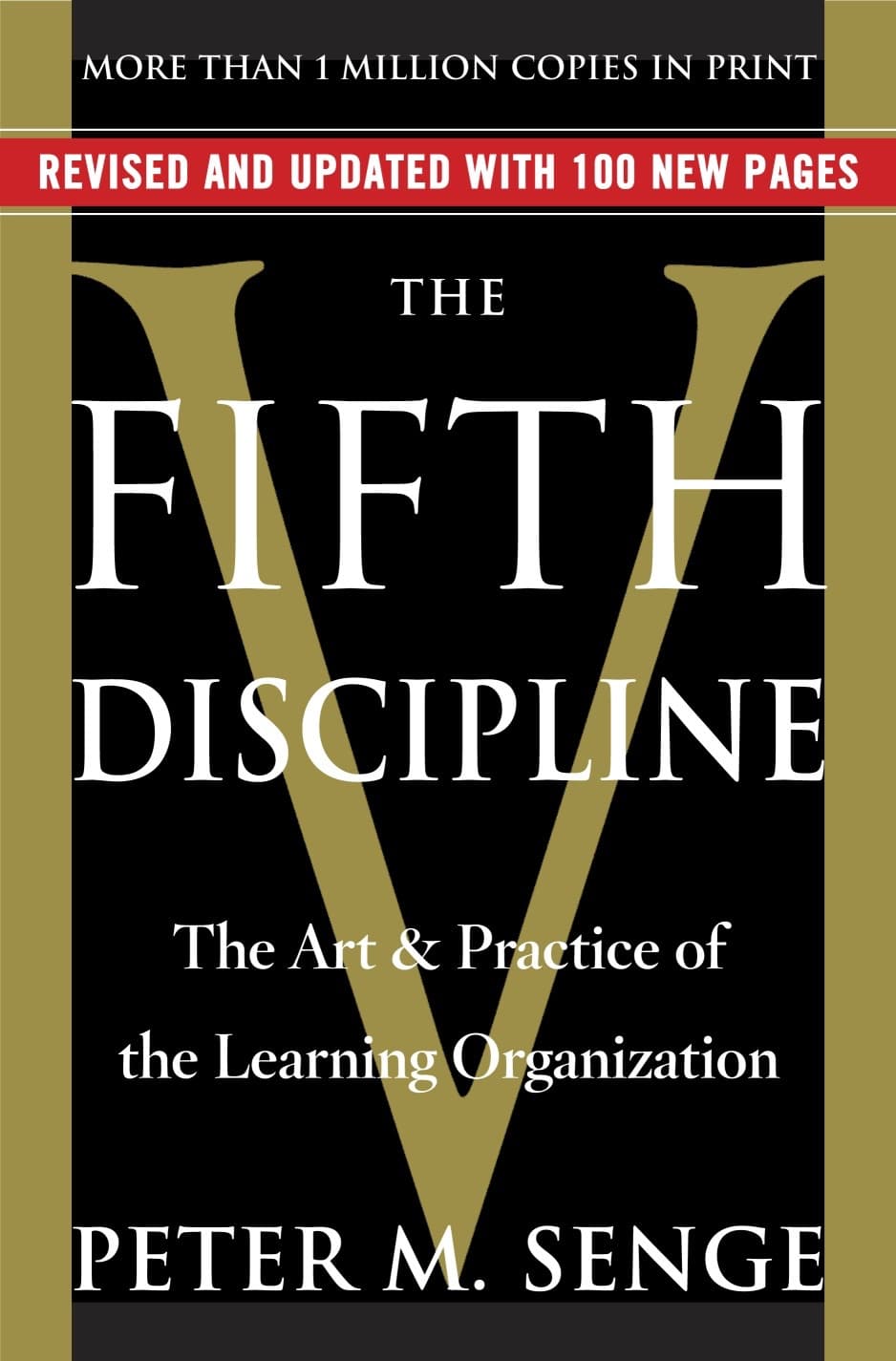
The Fifth Discipline
Peter M. Senge
Free download · 500+ book summaries
What is The Fifth Discipline about?
The foundational text on learning organizations. Peter Senge, MIT Sloan lecturer, lays out five disciplines: personal mastery, mental models, shared vision, team learning, and the systems thinking discipline that integrates them all. A defining management book of the 1990s, and still the best systems-thinking introduction to how organizations actually work.
Key ideas of The Fifth Discipline
Systems Thinking as Integration
Systems thinking ties together the other four disciplines by revealing the feedback loops and time delays that cause recurring organizational problems.
Learning Disabilities in Organizations
Structural patterns like siloed thinking, event fixation, and skilled incompetence prevent organizations from seeing and adapting to the systems they operate inside.
Mental Models Shape Reality
The largely unconscious frameworks people use to interpret experience determine what problems get seen, what evidence counts, and what solutions seem possible.
Read an excerpt from the summary
The Fifth Discipline
In the autumn of 1973, a young Shell planning analyst named Pierre Wack sat in a quiet office in London and tried to convince his colleagues that the world was about to change in a way no one was ready for. He had been running scenarios -- careful, story-based projections of alternative futures -- since the late 1960s, and what he kept seeing disturbed him. The global oil system was fragile. Arab nations controlled the supply. Western governments had built no serious reserves. The price mechanisms were rigid. He could construct a future in which a single political event would break all of it at once.
In October 1973, the Arab members of OPEC imposed an oil embargo on nations that had supported Israel during the Yom Kippur War. Oil prices quadrupled in weeks. Every major oil company in the world scrambled, cutting budgets, abandoning projects, repricing assumptions built over decades. Every major oil company except one: Royal Dutch Shell. Shell had lived through Pierre Wack's scenarios in their heads. They had already argued about what they would do. They had already confronted the uncomfortable possibility that the world they had built their strategy around might simply cease to exist. When the crisis hit, they moved faster and with more confidence than any competitor. Within a decade, Shell rose from one of the weakest of the Seven Sisters oil companies to one of the strongest. They had not predicted the future. They had learned to think about it differently.
This story sits near the heart of Peter Senge's argument in The Fifth Discipline, published in 1990 and revised substantially in 2006. Senge, a researcher and lecturer at MIT's Sloan School of Management and later the founding chair of the Society for Organizational Learning, spent years studying why some organizations learn and adapt while others, despite enormous intelligence and resources, keep making the same mistakes in the same ways, decade after decade. His conclusion: the problem is not the people. The problem is the way we think. More precisely, it is our inability to see the systems we live inside -- the feedback loops, the time delays, the structural dynamics that generate the behavior we then blame on individuals and external forces.
Like it?
Continue in the appWho is it for?
- Anyone who leads a team and keeps encountering the same problems no matter how many times they are resolved.
- Anyone who wants to understand why smart, well-intentioned people inside organizations consistently produce outcomes nobody wanted.
- Anyone who is responsible for strategy and needs a rigorous way to think about complexity and unintended consequences.
- Anyone who believes organizations can learn and wants a practical framework for making that actually happen.
About the author: Peter M. Senge
Peter M. Senge is a researcher and senior lecturer at MIT's Sloan School of Management and the founding chair of the Society for Organizational Learning. He spent years studying why some organizations learn and adapt while others, despite considerable intelligence and resources, repeat the same mistakes decade after decade.
The Fifth Discipline, first published in 1990, draws on Senge's work with Jay Forrester's System Dynamics group at MIT and his close collaboration with executives and researchers across industries. He revised the book substantially in 2006 and has continued applying its ideas in education, health systems, and global supply chains.
Read it in 49 minutes
The summary of The Fifth Discipline and 500+ more books await in the BookBase app.