 English
 Magyar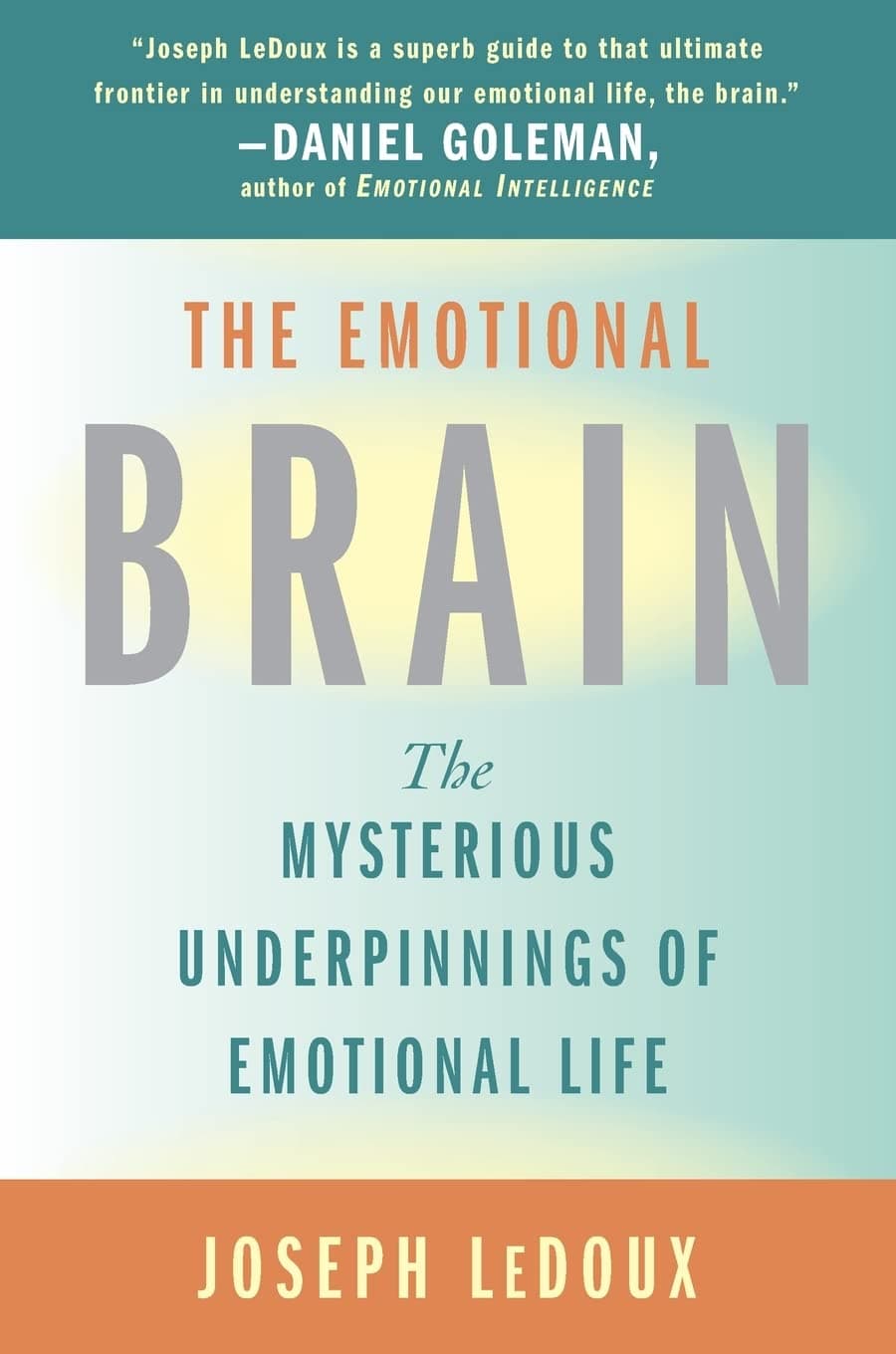
The Emotional Brain
Joseph LeDoux
Free download · 500+ book summaries
What is The Emotional Brain about?
This book is recommended by the author to patient readers who want to gain a solid foundation on how the brain processes emotions. It will be especially useful for human resource managers and others who want to understand how people feel and react.
Key ideas of The Emotional Brain
The Amygdala Fear Circuit
A fast subcortical pathway routes sensory signals directly to the amygdala, triggering fear responses before conscious awareness can intervene.
Dual Memory Systems
Emotional memories stored in the amygdala operate separately from conscious memories, explaining why people feel fear without remembering its source.
Emotion Overrides Cognition
Neural wiring runs more densely from emotional systems into cognitive ones than the reverse, so feelings hijack thinking far more easily than reason calms emotion.
Read an excerpt from the summary
The Question Underneath Everything
Joseph LeDoux likes to tell Charles Darwin's puff adder story, and once you have read the book it tells you, you cannot stop hearing it. Darwin is standing at the Zoological Gardens in London, in front of a thick glass plate, with a puff adder coiled on the other side. He has resolved, before the visit, that he will not flinch when the snake strikes. He is a scientist. He understands glass. The snake strikes. Darwin jumps back a full yard. His will, as he later wrote, was powerless against the imagination of a danger he had never experienced.
This is the question that animates the book. Who was driving when Darwin jumped? It cannot have been the conscious decider, because the conscious decider had explicitly agreed not to jump. Something else, faster and older and indifferent to Darwin's resolutions, took the controls and used them. LeDoux spent two decades in the laboratory chasing down exactly what that something else is, where it lives, and how it works. His answer is the most thoroughly mapped fear circuit in neuroscience, anchored on an almond-shaped clump of tissue called the amygdala, operating on a timescale your awareness cannot touch. The feeling of being afraid is real. It is just not the cause of anything. It is the memo your conscious mind receives about a decision that was already made.
That is the argument. The book is the receipts.
What's Love Got to Do with It?
The opening chapter is partly autobiographical. LeDoux's father was a butcher in Louisiana, and the young LeDoux spent his childhood handling cow brains. Other neuroscientists romanticize the moment they first saw a synapse under a microscope. LeDoux saw thousands of brains before he ever read a textbook, and that bias matters, because the book's central commitment is biological. Emotions are not stories we tell ourselves about our lives. They are functions of the nervous system. The only emotional architecture worth studying is the one evolution actually built, not the one philosophers wish we had.
Like it?
Continue in the appWho is it for?
- Anyone who wants to understand why willpower often fails against instinctive fear and anxiety.
- Anyone who is curious about the neuroscience behind post-traumatic stress, phobias, and anxiety disorders.
- Anyone who works in psychology, therapy, or coaching and wants a biological grounding for emotional behavior.
- Anyone who has wondered why emotional reactions so often feel faster and stronger than rational thought.
About the author: Joseph LeDoux
Joseph LeDoux is a neuroscientist at New York University, where he has directed a laboratory studying the neural basis of memory and emotion for several decades. He is best known for his research on the amygdala and fear conditioning, work that identified the specific brain circuits underlying threat detection and emotional learning.
LeDoux grew up in Louisiana and came to neuroscience through early work with split-brain patients alongside Michael Gazzaniga. His research helped establish that emotional and cognitive memory systems operate through distinct brain structures, a finding that has shaped both basic neuroscience and clinical approaches to anxiety disorders.
Read it in 45 minutes
The summary of The Emotional Brain and 500+ more books await in the BookBase app.