 English
 Magyar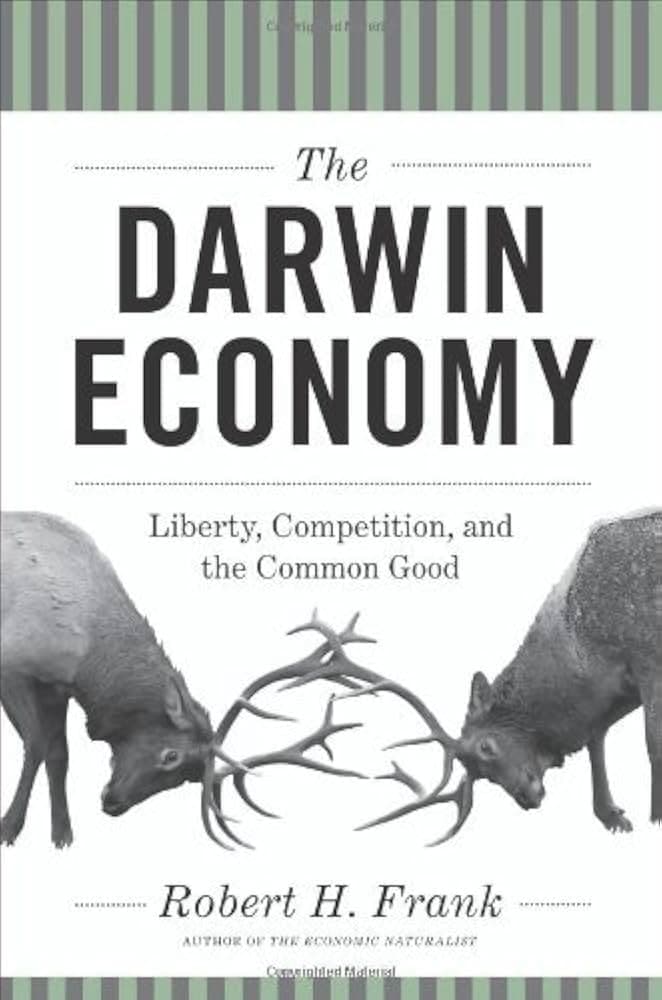
The Darwin Economy
Robert H. Frank
Free download · 500+ book summaries
What is The Darwin Economy about?
Who was the greater economist—Adam Smith or Charles Darwin? The question may seem absurd. This is because Darwin’s concept of competition describes economic reality much more accurately than Smith's. This fact has profound consequences. If we don’t recognize that we live in Darwin’s world, not Smith’s, it could put all of us in danger, as we fail to realize that competition alone doesn’t solve our problems.
Key ideas of The Darwin Economy
Darwin Over Smith
Individual competition often harms the group, making Charles Darwin's model of rivalry a more accurate guide to markets than Adam Smith's invisible hand.
Positional Spending Trap
People waste resources on status-signaling goods that raise relative standing without making anyone better off, while underfunding shared public goods.
Role of Luck in Success
Success depends far more on chance than effort or talent, which undermines the moral case against redistribution and progressive taxation.
Read an excerpt from the summary
The book in 3 sentences: People want to gain advantages over others, but the government must fight for everyone.
Success in life is often due to luck and chance, not talent and hard work.
People waste money on "positional" expenditures that increase their relative status. However, "non-positional" expenditures on things like security and clean air would benefit everyone. Favorite quotes: “Ignorance more often breeds confidence than knowledge.” “The essence of instincts is precisely that they are followed regardless of reason.” “It is not the strongest species that survive, nor the most intelligent. It is the one that is most adaptable to change.”
Key points:
Summary + notes: Stagnation.
In recent decades, the standard of living in the United States has steadily declined. Stagnating wages, growing inequality between the rich and poor, deteriorating infrastructure, climate change denial, and the lack of investment willingness to alleviate unemployment and revive the economy are all social issues in the United States. The situation is exacerbated by the widespread but false belief that the source of all problems lies with the government, which hinders action and solutions. This inaction stems from a fundamental misunderstanding of the true nature of competition.
> We need good governance because individual and social goals are often in direct conflict with each other. >
Individual and collective interests do not always align, as those who oppose all laws, such as libertarians, fail to recognize. A completely free market cannot be equally profitable and beneficial for everyone. Certain restrictions are useful, but the government can more effectively avoid harm through revenues than through regulation.
Like it?
Continue in the appWho is it for?
- Anyone who wants to understand why free markets alone cannot solve collective-action problems.
- Anyone who is curious about how evolutionary biology explains economic behavior and competition.
- Anyone who wonders why wealthy societies chronically underinvest in infrastructure and public goods.
- Anyone who questions trickle-down economics and wants evidence-based alternatives to current tax policy.
About the author: Robert H. Frank
Robert H. Frank is a professor of economics at Cornell University's Johnson Graduate School of Management. He has written widely on behavioral economics, inequality, and the gap between individual incentives and social welfare.
Frank is known for applying evolutionary thinking to economic questions, arguing that many market failures stem from the same competitive dynamics Darwin observed in nature. His work draws on decades of research into consumption, taxation, and the structure of modern labor markets.
Read it in 22 minutes
The summary of The Darwin Economy and 500+ more books await in the BookBase app.