 English
 Magyar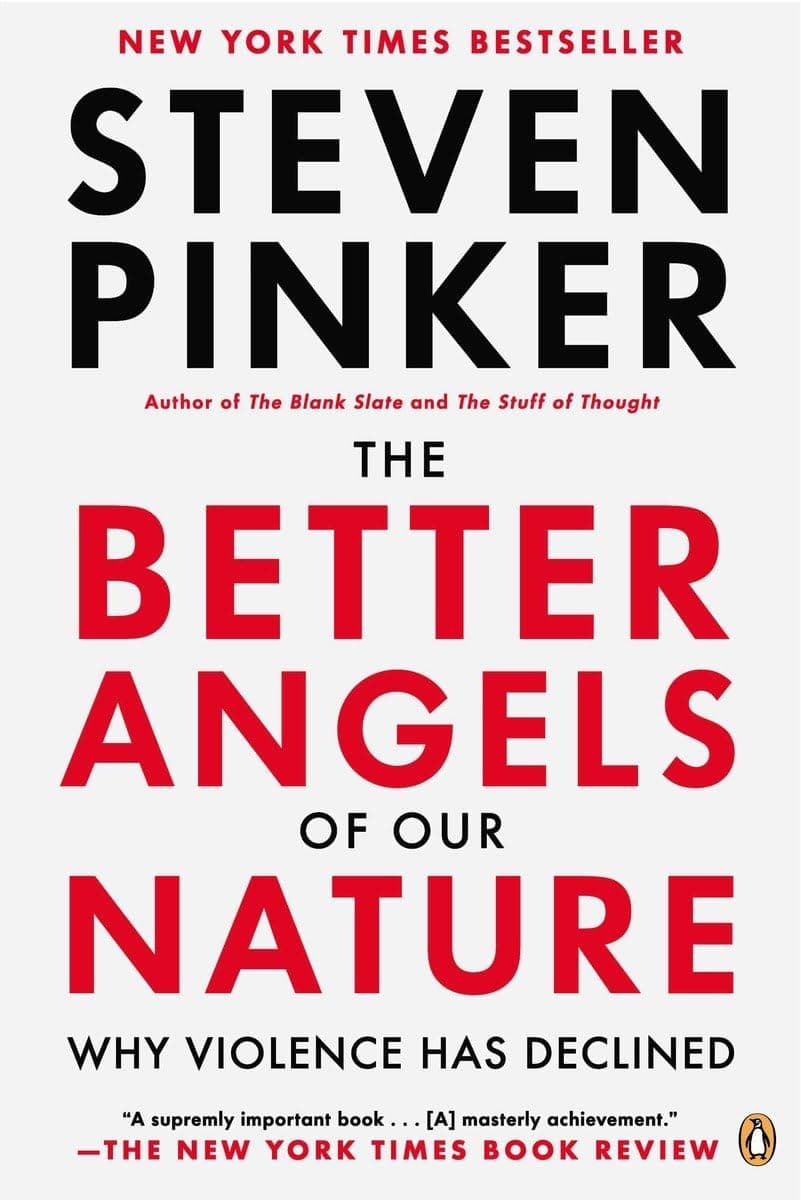
The Better Angels of Our Nature
Steven Pinker
Free download · 500+ book summaries
What is The Better Angels of Our Nature about?
The Better Angels of Our Nature demonstrates why we are living in the most peaceful period in history, examining what motivates us toward violent behavior, how our tendencies toward peaceful living counterbalance these motivations, and which significant changes in history have led to the global decline in crime.
Key ideas of The Better Angels of Our Nature
Violence Has Declined Dramatically
Across every timescale and almost every region, rates of killing and organized violence have fallen to historic lows, despite how the news feels.
Institutions Shape Human Behavior
The Leviathan state, commerce, and rule of law suppress the conditions that make violence rational, explaining most of the long decline.
Reason Expands the Moral Circle
Applied consistently, reason and empathy have extended moral concern to ever-wider groups, driving the rights revolutions of the past two centuries.
Read an excerpt from the summary
The Better Angels of Our Nature
Open a newspaper, scroll your feed, watch the evening news, and you will leave convinced the world is on fire. School shootings, foreign wars, viral footage of beatings, the threat of nuclear escalation — every signal modern media sends trains us to believe we are living through an unusually cruel chapter of human history. We are wired to remember the worst, and the worst is what gets broadcast.
Steven Pinker spent roughly a decade assembling the data to argue the exact opposite. Across seven hundred pages, *The Better Angels of Our Nature* makes a claim so contrary to gut instinct that most readers reject it before they reach the evidence: violence has declined, dramatically and almost everywhere, on almost every timescale you care to measure. We are most likely living through the most peaceful era of our species. The argument is not that violence has vanished, not that progress is automatic, not that any particular year cannot reverse the trend. The argument is that the data, honestly read, points in one direction, and the direction is down.
The Argument Nobody Wants To Hear
Pinker opens with a confession about why this book will annoy almost everyone. Telling people that things are getting better is bad for activists, bad for moralists, and bad for intellectuals who have built careers on the depravity of modernity. The civil rights organizer who announces the world is improving has trouble keeping the donor base awake. The cleric who tells his congregation that human beings have grown gentler cannot easily sell salvation. The progressive professor who concedes that Western institutions have reduced cruelty contradicts a hundred lectures he has already given.
Like it?
Continue in the appWho is it for?
- Anyone who wants a data-grounded counter to the feeling that the modern world is uniquely dangerous.
- Anyone who is curious why war, torture, and public cruelty were once ordinary and what actually changed.
- Anyone interested in the psychology of violence and the cognitive systems that restrain or enable it.
- Anyone who wants to understand which institutions and habits have historically driven peace and why they still matter.
About the author: Steven Pinker
Steven Pinker is a cognitive psychologist and linguist at Harvard University. He is known for applying evolutionary psychology and cognitive science to questions about language, the mind, and human behavior.
He has written several influential books on language and the human mind, and is recognized for bringing together large bodies of empirical research to challenge conventional assumptions about human nature and historical progress.
Read it in 39 minutes
The summary of The Better Angels of Our Nature and 500+ more books await in the BookBase app.