 English
 Magyar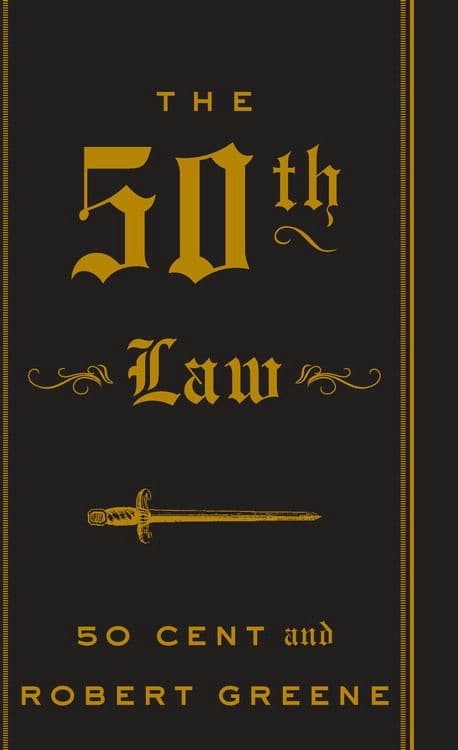
The 50th Law
Robert Greene, 50 Cent
Free download · 500+ book summaries
What is The 50th Law about?
What changes when you make fearlessness a habit. Robert Greene and 50 Cent decode the strategies that took Curtis Jackson from the streets of Queens to mogul status. Ten attitudes that strip away fear, plus the historical case studies that show those same attitudes in action across centuries. Greene at his sharpest.
Key ideas of The 50th Law
Intense Realism as Foundation
Seeing circumstances without wishful thinking or self-deception is the first and most essential component of fearlessness.
Owning Your Work and Perspective
Lasting power comes from refusing to hand creative or financial control to institutions that extract value while offering security.
Confronting Mortality Directly
Those who have faced the worst and survived gain a clarity about risk that simplifies priorities and removes the need for false courage.
Read an excerpt from the summary
The 50th Law
On the morning of May 24, 2000, Curtis Jackson walked out of his grandmother's house on Elmhurst Avenue in South Jamaica, Queens, and got into a car. He was twenty-four years old, unsigned, and about to release his first major-label album for Columbia Records. Before the car left the block, a man approached the driver's window and opened fire. Nine bullets from a 9mm handgun. One through his hand. One through his arm. One through his hip. Two through his legs. One through his chest. One through his left cheek, which shattered a wisdom tooth, swelled his tongue, and gave him the slightly slurred cadence that would become one of the most recognizable voices in music. Jackson spent thirteen days in the hospital. Columbia, spooked by the violence surrounding him, dropped him from the label. The album was shelved. His deal was gone. By any conventional logic, the story was over.
He went back to the street corner.
Not because he had no options. Because the corner had taught him something that the record label had started to undo. On the corner, there was no safety net, no contract, no advance payment. The only thing that kept you alive -- literally alive -- was your ability to see reality without flinching, to move faster than circumstances, and to be afraid of nothing. The shooting had not broken Curtis Jackson. It had clarified him. The bullet that grazed his cheek and chipped his tooth had removed the last piece of illusion. He emerged from the hospital with a name -- 50 Cent, borrowed from a Brooklyn robber known for "changing the value of things" -- and a philosophy that would carry him from the corner of Southside Jamaica to a $100 million Vitamin Water exit, a debut album that sold 872,000 copies in its first week, and a collaboration with one of the most influential writers of the twenty-first century.
Like it?
Continue in the appWho is it for?
- Anyone who wants to understand how street-level survival thinking maps onto business and creative strategy.
- Anyone who feels held back by fear of judgment, failure, or losing social approval.
- Anyone drawn to the overlap between historical figures like Malcolm X, Miles Davis, and Frederick Douglass and modern entrepreneurial thinking.
- Anyone looking for a grounded, unsentimental take on self-reliance and independence.
About the author: Robert Greene, 50 Cent
Robert Greene is the author of The 48 Laws of Power, published in 1998, which became a widely read handbook on strategy and influence, passing through prisons, boardrooms, and music industry circles with almost no traditional marketing. He has written several books on power, seduction, and mastery, drawing on historical case studies across centuries.
Curtis Jackson, known as 50 Cent, is a rapper and entrepreneur from South Jamaica, Queens, whose debut album Get Rich or Die Tryin' sold 872,000 copies in its first week in 2003. He built G-Unit Records, negotiated an equity stake in Glaceau that yielded approximately $100 million when Coca-Cola acquired the company in 2007, and collaborated with Greene to write The 50th Law.
Read it in 44 minutes
The summary of The 50th Law and 500+ more books await in the BookBase app.