 English
 Magyar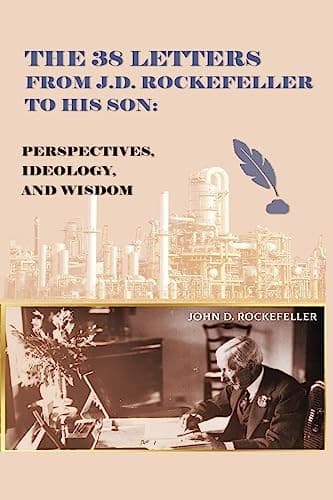
The 38 Letters from J.D. Rockefeller to His Son
J.D. Rockefeller
Free download · 500+ book summaries
What is The 38 Letters from J.D. Rockefeller to His Son about?
Inside the private letters of America's first billionaire to his only son. Rockefeller's hard-won lessons on wealth, work, character, and family, distilled into 38 unsentimental notes that built one of history's most enduring fortunes. Timeless advice from the man who wrote the rules of modern American capitalism.
Key ideas of The 38 Letters from J.D. Rockefeller to His Son
Financial Tracking as Foundation
Rockefeller recorded every cent from his first paycheck, and that discipline of honest self-accounting shaped every major decision he ever made.
Patience as Competitive Advantage
Lasting wealth comes from thinking in longer time horizons than your competitors, not from winning any single deal or quarter.
Giving Before You Can Afford It
Rockefeller gave a fixed portion of his income from his very first paycheck, and that habit built discipline around all his money, not just the portion given away.
Read an excerpt from the summary
The 38 Letters from J.D. Rockefeller to His Son
In January 2025, CNBC's financial desk noticed something strange on Amazon's best-selling list for economic history. A slim paperback titled "The 38 Letters from J.D. Rockefeller to His Son" was sitting at number 22, outselling biographies and textbooks that had been on shelves for decades. The book promised something irresistible: private correspondence from the world's first billionaire to his only son, raw wisdom passed down across a writing desk in the early twentieth century. The listed publisher was OpenStax, the nonprofit academic press at Rice University. Reporters called OpenStax. A spokesperson replied that the organization had never heard of the book. They had not published it. They were not aware of it until the journalist reached out. The Rockefeller Archive Center, which holds more than 150,000 documents tied to the family, said it could find no letters in its entire collection that match anything inside those pages. One version names a "G. Ng" as compiler and an "M. Tan" as translator -- neither person can be identified or located. Another version credits a Chinese author named Luo Fei or a compiler named Fan Yiran, depending on which edition you pick up.
The mystery around this book is not a footnote. It is the starting point for understanding what is actually valuable inside it.
Because here is what is true: John D. Rockefeller Sr. was real. His discipline was real. His fortune, his methods, his contradictions, his piety, his ruthlessness -- all of it is documented in thousands of verified letters, ledgers, and memoir pages. He started his working life in September 1855 at age sixteen, bookkeeping for a small Cleveland produce firm called Hewitt and Tuttle for $3.57 per week. He kept a personal account book he called Ledger A, recording every cent he earned and every cent he gave away, beginning from his first paycheck. He gave away 6 percent of his income that first year and spent the rest of his life increasing the percentage. He founded Standard Oil of Ohio in January 1870 with a vision of eliminating the chaotic boom-and-bust cycles that were destroying the oil refining industry. By 1880 Standard Oil controlled roughly 90 percent of US refining capacity. By the time he died in 1937 at age 97, adjusted for the size of the economy, he was the wealthiest private individual in recorded American history -- roughly $340 billion in today's terms.
Like it?
Continue in the appWho is it for?
- Anyone who wants to understand how Rockefeller built and sustained one of history's greatest fortunes.
- Anyone who struggles to connect daily financial habits with long-term wealth outcomes.
- Anyone who is drawn to the idea that patience and preparation matter more than raw ambition.
- Anyone who wants a concrete framework for thinking about work, money, and giving all at once.
About the author: J.D. Rockefeller
John D. Rockefeller Sr. (1839 to 1937) was an American industrialist who founded Standard Oil of Ohio in 1870 and became the wealthiest private individual in American history by most measures. He started his working life at sixteen as a bookkeeper, kept meticulous personal accounts from his first paycheck, and gave to charity from the very beginning of his earning life. By 1880 Standard Oil controlled roughly 90 percent of US oil refining capacity.
This book is a modern compilation, assembled from documented Rockefeller biography and attributed to him in letter form. The letters themselves are not verified primary sources. Readers interested in his actual correspondence can consult the Rockefeller Archive Center or Ron Chernow's biography Titan.
Read it in 45 minutes
The summary of The 38 Letters from J.D. Rockefeller to His Son and 500+ more books await in the BookBase app.