 English
 Magyar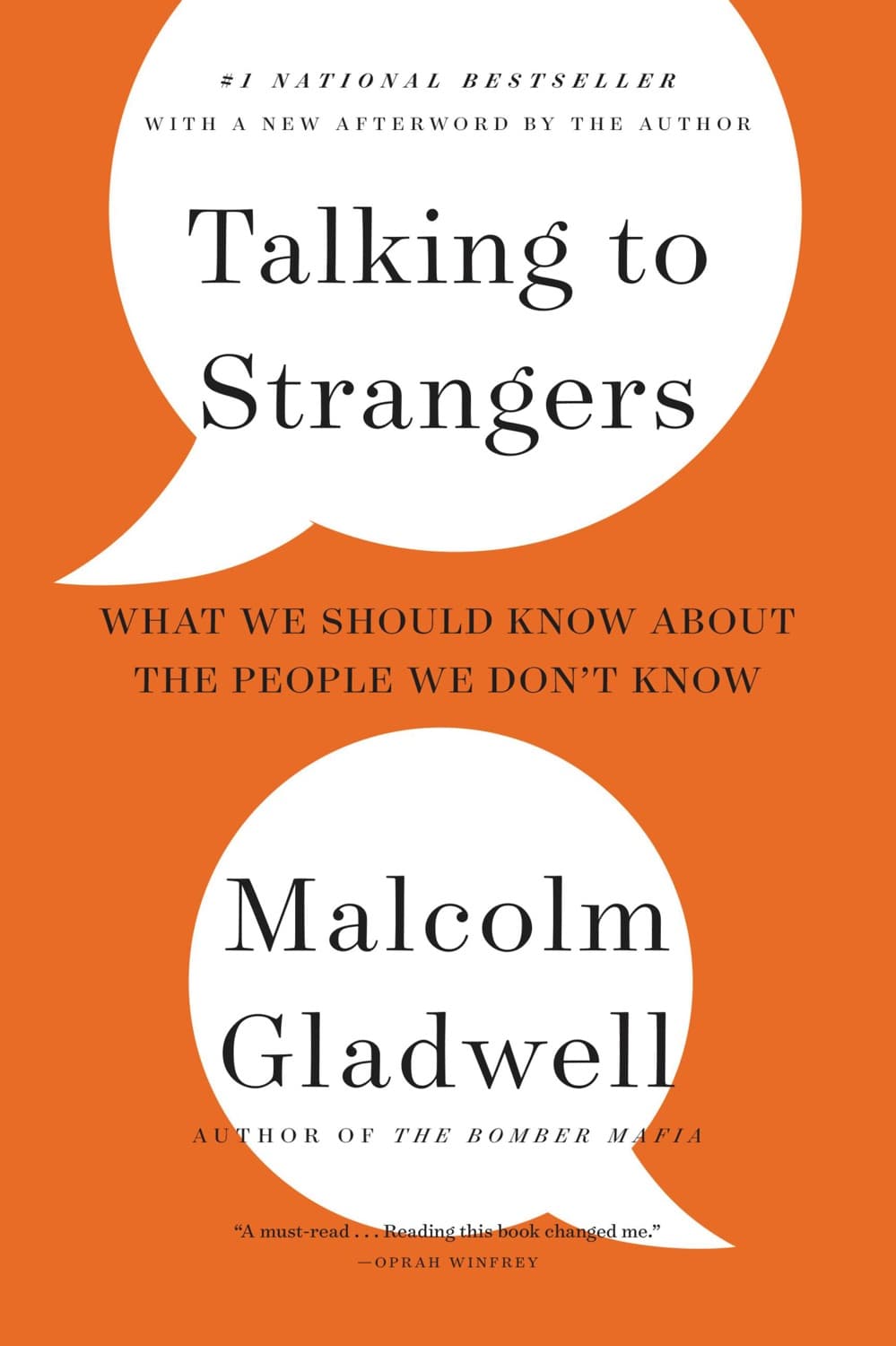
Talking to Strangers
Malcolm Gladwell
Free download · 500+ book summaries
What is Talking to Strangers about?
Why we are catastrophically bad at reading people we don't know. Malcolm Gladwell unpacks the high-stakes failures behind cases like Sandra Bland and Bernie Madoff, and the cognitive defaults that produce them. A sobering, brilliantly written look at how human assumptions about strangers go wrong, and what to do about it.
Key ideas of Talking to Strangers
Default to Truth
The brain trusts by default and demands overwhelming evidence before suspecting a lie, which is why trained investigators and ordinary people fail equally at detecting deception.
The Transparency Illusion
We assume a person's face reveals their inner state, but mismatched individuals and cross-cultural differences make facial reading systematically unreliable.
Behavior Is Coupled to Place
Human actions are tightly bound to specific contexts and available means, so changing an environment often prevents harmful behavior more effectively than changing the person.
Read an excerpt from the summary
Talking to Strangers — Malcolm Gladwell
On July 10, 2015, Sandra Bland drove out of a Prairie View, Texas side street with a new life packed into her car. She was 28, tall, charismatic, and had just moved back from Chicago. Her alma mater, Prairie View A&M University, had offered her a new position. She was planning to pursue a master's in political science. On her YouTube channel, "Sandy Speaks," she posted motivational videos, opening each one with the same line: "Good morning, beautiful kings and queens!"
On the road, a police cruiser lit up behind her. She had failed to signal a lane change.
Brian Encinia was a 30-year-old trooper with short dark hair. The first minutes were routine. Documents, a few questions. Bland lit a cigarette.
"Put it out," Encinia said.
"I'm in my own car. Why do I have to put it out?"
From that moment, everything changed. Encinia's voice hardened. "Step out of the vehicle." Bland didn't move. "You don't have the right." Encinia reached through the window. "I will yank you out of here." Bland: "Don't touch me. I'm not under arrest." Encinia drew his Taser, pointed it at her. "I will light you up. Get out, now." Bland stepped out. She repeated one sentence, over and over: "For a failure to signal? You're doing all of this for a failure to signal?"
Three days later, Sandra Bland was dead. She had hanged herself in her jail cell.
Malcolm Gladwell has been turning that sentence over in his mind for years. Not because the case was unusual, but because between 2014 and 2015 the world was full of similar cases. Michael Brown in Ferguson. Freddie Gray in Baltimore. Philando Castile outside Minneapolis. Eric Garner in New York. Walter Scott in South Carolina. The same pattern, again and again: a routine traffic stop, a few minutes, someone dead.
Like it?
Continue in the appWho is it for?
- Anyone who makes hiring, investing, or negotiating decisions based on face-to-face impressions.
- Anyone who wants to understand why smart, experienced people repeatedly fail to detect fraud or deception.
- Anyone trying to make sense of high-profile cases where routine encounters turned fatal.
- Anyone interested in how cognitive defaults shape trust, conflict, and institutional failure.
About the author: Malcolm Gladwell
Malcolm Gladwell was born in England in 1963 and raised in Canada. He became widely known as a staff writer for The New Yorker, where he explored sociological and psychological phenomena through narrative-driven journalism.
He is the author of several bestselling books including The Tipping Point, Blink, and Outliers. Talking to Strangers, published in 2019, is the book Gladwell has described as his most important, arguing that predictable errors in judging strangers carry a cost that is sometimes lethal.
Read it in 48 minutes
The summary of Talking to Strangers and 500+ more books await in the BookBase app.