 English
 Magyar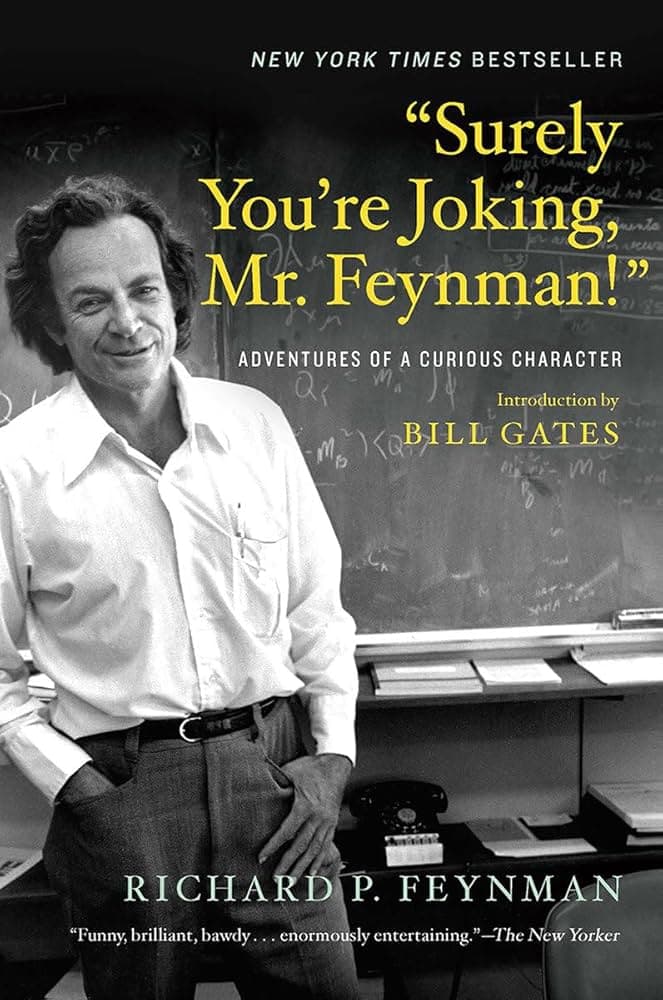
Surely You are Joking Mr. Feynman
Richard P. Feynman
Free download · 500+ book summaries
What is Surely You are Joking Mr. Feynman about?
Here is Feynman’s life in all its eccentricity – a volatile mix of high intelligence, boundless curiosity, and raging chutzpah.
Key ideas of Surely You are Joking Mr. Feynman
Curiosity as a Working Method
Feynman's most celebrated physics came from playing with a wobbling plate in a cafeteria, not from chasing prestige or structured goals.
Knowing versus Reciting
Throughout his career Feynman distinguished people who could pass tests from people who could actually use what they knew, finding the gap almost universal.
Cargo Cult Integrity
Real scientific honesty means actively looking for ways you might be wrong, not just avoiding outright lies, because you are the easiest person to fool.
Read an excerpt from the summary
The Tea Saucer
A woman ladling tea at the Princeton dean's reception in 1939 hands a saucer to a nervous twenty-one-year-old in a too-stiff jacket. The student, just down from MIT and unsure how this whole faculty thing works, asks for both cream and lemon. She laughs at him. "Surely you're joking, Mr. Feynman!" That sentence will follow him for the next fifty years and end up as a book title. It captures something the book spends three hundred pages arguing without ever saying directly. Feynman has not broken a rule. He has stumbled into a rule he didn't know existed, because nobody told him cream curdles in citric acid, and he'd been thinking about something more interesting than tea.
The gap between what everyone assumes you already know and what you can work out by looking — that is the entire memoir. Compiled in 1985 from taped conversations between Richard Feynman and his bongo partner Ralph Leighton, the book sells itself as the chuckling adventures of a curious character. Feynman won the Nobel Prize in 1965, and you'd hardly know it from these pages. What you get instead is a man who fixed radios at eleven, cracked safes at Los Alamos, taught himself trigonometry from scratch, played samba on a toy frying pan in Rio, and refused, again and again, to be impressed by his own reputation. The book is a quiet argument that genuine curiosity is rarer than genius and more useful.
The Boy Who Fixed Radios by Thinking
Feynman was eleven or twelve when he set up a lab in an old wooden packing box on the porch of the house in Far Rockaway, on the edge of New York near the sea. The equipment was the sort of thing a kid scavenges: a storage battery, a Ford spark coil, a Raytheon argon tube that glowed purple, foil-wrapped fuses he made himself, a five-watt bulb wired as a fuse indicator with brown candy paper turning the light red. He invented a burglar alarm out of a battery, a bell, and a wire on the door. He set a piece of paper on fire by accident, smothered it with a magazine, watched the wind reignite it through the window, hauled the burning paper back inside, and shook the coals out into the alley. Then he told his mother he was going out to play.
Like it?
Continue in the appWho is it for?
- Anyone who wants to understand what genuine curiosity looks like in practice, not just in theory.
- Anyone who suspects that their education taught them to perform knowledge rather than develop it.
- Anyone working in science, engineering, or research who wants a sharper sense of what intellectual honesty actually demands.
- Anyone who enjoys memoir told through sharp, funny stories rather than linear biography.
About the author: Richard P. Feynman
Richard P. Feynman was an American theoretical physicist who won the Nobel Prize in Physics in 1965 for his work on quantum electrodynamics, including the development of the Feynman diagrams that now appear in textbooks worldwide. He worked on the Manhattan Project at Los Alamos during World War II and spent most of his career as a professor at Caltech. He was also a member of the Rogers Commission that investigated the Space Shuttle Challenger disaster. He died in 1988.
Feynman was widely regarded as one of the great physics teachers of the twentieth century. His lecture series at Caltech became the basis of a foundational set of textbooks still in use today. This memoir, compiled from taped conversations with his friend Ralph Leighton, was first published in 1985.
Read it in 41 minutes
The summary of Surely You are Joking Mr. Feynman and 500+ more books await in the BookBase app.