 English
 Magyar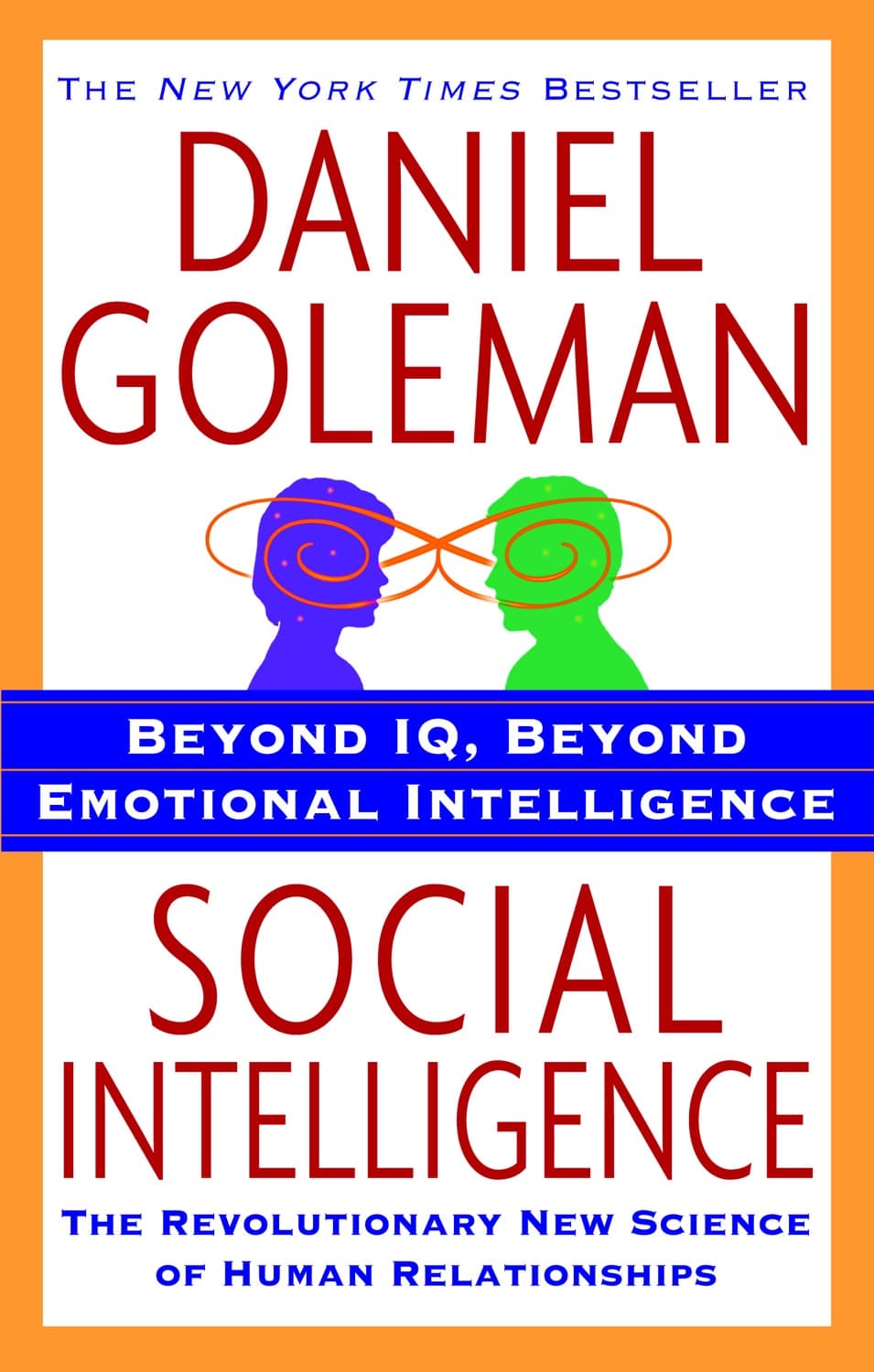
Social Intelligence
Daniel Goleman
Free download · 500+ book summaries
What is Social Intelligence about?
Daniel Goleman extends his emotional intelligence work into the territory between brains, showing how every conversation literally tunes the nervous systems of the people in the room. Drawing on mirror neurons, attachment research, and workplace data, he argues that the quality of our daily encounters shapes our health, our productivity, and our sense of self. The takeaway is that being good with people is a skill, and a measurable one.
Key ideas of Social Intelligence
The Two-Road Social Brain
A fast, unconscious low road and a slower, reflective high road constantly negotiate every social reaction, and growing up means giving the high road time to weigh in.
Mirror Neurons and Neural WiFi
Specialized brain cells silently rehearse what others do and feel, making moods, stress, and calm contagious between people without conscious awareness.
Three Layers of Empathy
Sensing, attunement, and empathic concern are distinct skills, and without the third layer the first two can be used to manipulate rather than connect.
Read an excerpt from the summary
Social Intelligence — summary
The accident in a Parma laboratory that rewired what we know about people
In the early 1990s, a team of Italian neuroscientists in Parma sat watching a rhesus monkey reach for a peanut. The monkey wore a cap of microelectrodes so thin they could eavesdrop on a single brain cell. Each time the monkey moved, a tiny pop sounded on the equipment. Then the researchers took a break. One assistant came back into the lab still licking an ice cream cone. The monkey did not move. He sat perfectly still, watching. But the meter went off anyway. The very same neuron that fired when the monkey lifted food to his own mouth was firing now, just from watching another animal do it.
At first the team assumed something was wrong with the wires. It took weeks to accept what their data was actually telling them. The brain does not draw a sharp line between "I am doing this" and "I am watching someone else do this." It runs the same circuit in both cases, only quieter when the body stays still. We do not understand each other from the outside. We rehearse each other from the inside.
That accident in Parma is where Daniel Goleman opens *Social Intelligence*, his follow-up to *Emotional Intelligence*. His earlier book was about you alone, learning to manage what happens inside your own head. This one moves the camera back. It is a two-person book. It asks what happens in the few inches of air between you and the person across the table, and what kind of biological tracks each of you leaves on the other.
The book answers three big questions. Why do moods spread between people without anyone noticing. What does the brain actually do when two people connect or fail to. And how should a normal person live differently once they realize that toxic relationships shorten lives and good ones lengthen them. The science is heavy in places, but the takeaway is light enough to carry into your next conversation. You are not a sealed container that occasionally bumps into other sealed containers. You are a node in a network, and every encounter is a slow drip of biology going one way or the other.
Like it?
Continue in the appWho is it for?
- Anyone who wants to understand why the people around them affect their mood, health, and thinking so deeply.
- Anyone who leads a team and wants to know what their daily emotional state is actually doing to the people in the room.
- Anyone who has struggled to leave a relationship that felt draining and wants the biological reason why that choice matters.
- Anyone who finds human interaction exhausting and wants a clearer map of what is happening beneath the surface of every conversation.
About the author: Daniel Goleman
Daniel Goleman is a psychologist and science journalist best known for popularizing the concept of emotional intelligence. His earlier book, Emotional Intelligence, introduced a wide audience to the idea that self-awareness and self-regulation matter as much as IQ, and became one of the best-selling psychology books of the 1990s.
Social Intelligence extends that work by shifting focus from the individual to the space between people. Goleman draws on neuroscience, attachment research, and social psychology to argue that the quality of our relationships is not just a personal concern but a biological one.
Read it in 44 minutes
The summary of Social Intelligence and 500+ more books await in the BookBase app.