 English
 Magyar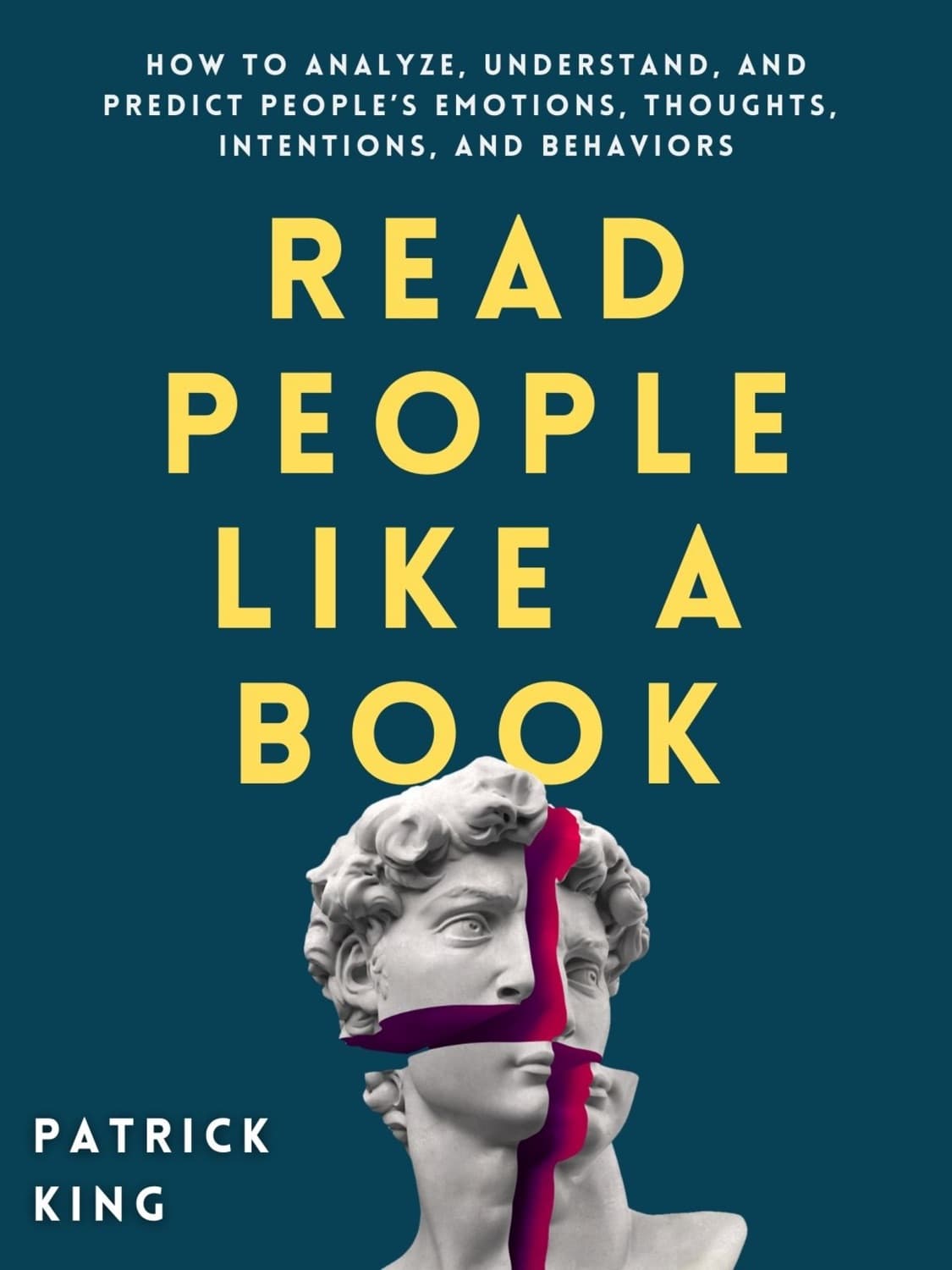
Read People Like a Book
Patrick King
Free download · 500+ book summaries
What is Read People Like a Book about?
How to read people, fast. Patrick King combines body language research, micro-expressions, and conversational psychology into a practical field guide. Spot when someone is lying, fishing, hiding, or signaling interest. Sharpens the social intuition most of us are running on without thinking.
Key ideas of Read People Like a Book
Baseline Before Deviation
You can only spot meaningful behavioral signals by first establishing what is normal for a specific person in a specific context.
Cluster Reading Over Single Signals
Three or more congruent signals pointing in the same direction form a reliable pattern, any single signal alone is nearly meaningless.
Motivation Drives Behavior
Understanding whether someone needs safety, respect, competence, connection, or autonomy explains behavioral signals that observation alone cannot.
Read an excerpt from the summary
Read People Like a Book
A detective sits across a table from a suspect. The man has not said anything incriminating. His alibi sounds clean. His voice is steady. But something is off. The detective cannot name it yet -- until he notices that every time the word "victim" comes up, the man's upper lip pulls back for a fraction of a second on the left side. It disappears before most people would register it. The detective does. That curl is contempt, one of the seven universal facial expressions catalogued by psychologist Paul Ekman after decades of cross-cultural research in the 1960s and 70s. It does not mean the man is guilty. But it means something about this conversation is activating a very specific emotional state -- the one that says: I am superior to this situation, and to you.
That micro-moment is the subject of Patrick King's 2020 book, Read People Like a Book. King is a self-published social skills coach based in San Francisco who has written roughly forty books on communication, emotional intelligence, and interpersonal behavior. Most of them sell quietly and consistently to readers who want practical tools, not academic theory. This one broke through. It became one of his most-read titles, landing on bestseller charts and generating hundreds of thousands of copies sold -- because the question it answers is one almost everyone has asked at one point or another: what is this person actually thinking?
The answer King offers is both more and less satisfying than people expect. More, because the science he draws on is real, rich, and surprisingly learnable. Less, because the book is honest enough to say, from the first chapter, that you cannot read minds. What you can do is dramatically increase the quality of information you gather from another person -- through their body, their face, their words, their silences, and the cluster of signals that, taken together, stop looking like noise and start looking like data. That shift, from surface impression to structured observation, is what the book is built to teach.
Like it?
Continue in the appWho is it for?
- Anyone who wants to understand what people are really communicating beneath their words.
- Anyone who negotiates, interviews, or manages people and wants to read the room more accurately.
- Anyone who has left conversations with a nagging feeling something was off but could not name why.
- Anyone who wants a practical, science-backed alternative to guessing at others' intentions.
About the author: Patrick King
Patrick King is a self-published social skills coach and author based in San Francisco. He has written roughly forty books on communication, emotional intelligence, and interpersonal behavior, most aimed at readers who want actionable tools rather than academic theory.
Read People Like a Book, published in 2020, became one of his most widely read titles, selling hundreds of thousands of copies. King draws on research from figures such as Paul Ekman, Joe Navarro, and Chris Voss to build practical frameworks for everyday social situations.
Read it in 45 minutes
The summary of Read People Like a Book and 500+ more books await in the BookBase app.