 English
 Magyar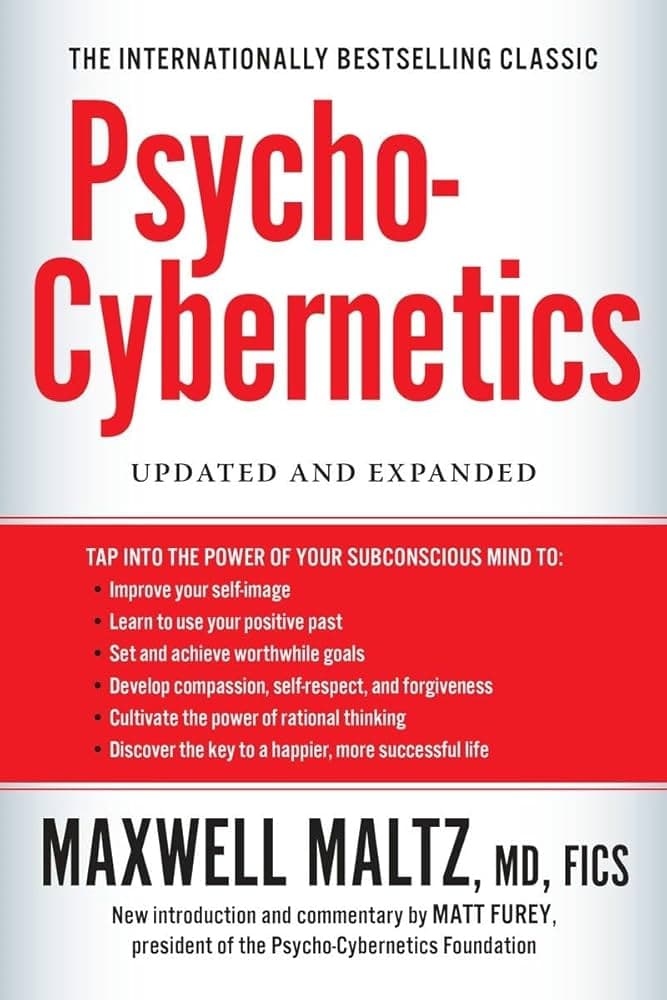
Psycho-Cybernetics
Maxwell Maltz
Free download · 500+ book summaries
What is Psycho-Cybernetics about?
Psycho-Cybernetics helps us overcome our self-doubt, maintain our mental and emotional independence, find solutions to our problems, and make happiness our "habit.”
Key ideas of Psycho-Cybernetics
The Self-Image as Autopilot
Your inner picture of who you are shapes every action and feeling automatically, overriding even conscious willpower.
Mental Rehearsal Rewires the Brain
The nervous system cannot distinguish vivid imagination from real experience, so deliberate mental practice produces the same gains as physical practice.
The Success Mechanism
The brain is a goal-seeking servo-mechanism that steers toward whatever target you give it, reliably producing failure or success depending on the image it holds.
Read an excerpt from the summary
Why a Plastic Surgeon Wrote a Book About Your Mind
In 1960, a New York plastic surgeon published a book that would go on to sell more than thirty-five million copies and quietly become the source code for almost every self-help book that came after. Maxwell Maltz had spent decades reshaping noses, smoothing scars, and pinning back ears. He kept noticing something that bothered him. Some patients walked in with a real disfigurement, left with a beautiful new face, and within weeks blossomed into confident, sociable, completely different people. Others walked in with the same kind of defect, got the same surgical result, and stayed exactly as miserable as they had been before. The face was new. The person was not.
Maltz, who was trained as a surgeon and not a psychologist, decided that meant the real face was on the inside. He called it the self-image, and the book he wrote about it was Psycho-Cybernetics. The title is unwieldy. The argument is not. We each carry a mental picture of who we are and what we are capable of, and our lives bend to match that picture the way a self-steering torpedo bends toward its target. Change the picture, Maltz said, and the life follows. Leave the picture alone, and no amount of effort, willpower, or even cosmetic surgery will move the needle. The book is part 1950s engineering manual, part case file from a surgical practice, part pulpit, and the strange genius of it is that those parts fit together.
The Self-Image, the Hidden Operating System
Maltz opens with a claim that, in 1960, was nearly radical. All your actions, feelings, behaviors, even your abilities, are always consistent with your self-image. You literally cannot act otherwise, no matter how hard you push with conscious effort. If your self-image says you are bad at math, you will fail math tests in ways your conscious mind cannot override. If your self-image says nobody likes you, your body language and tone will go on a quiet campaign to make sure nobody does.
Like it?
Continue in the appWho is it for?
- Anyone who feels held back by self-doubt or a persistent sense of not being good enough.
- Anyone who wants to use proven visualization techniques to improve performance at work or in sport.
- Anyone who has tried willpower or positive thinking and found those methods do not stick.
- Anyone who wants to understand the psychological roots of confidence, habit, and lasting personal change.
About the author: Maxwell Maltz
Maxwell Maltz (1899-1975) was an American plastic surgeon who practiced in New York for several decades. His direct observation of patients whose lives transformed after surgery, and of others who remained unhappy despite successful operations, led him to study the psychology of self-image.
Maltz drew on cybernetics, experimental psychology, and thousands of clinical cases to develop the ideas in Psycho-Cybernetics, first published in 1960. The book became one of the best-selling self-help titles of the twentieth century and influenced coaches, athletes, and performers across many fields.
Read it in 47 minutes
The summary of Psycho-Cybernetics and 500+ more books await in the BookBase app.