 English
 Magyar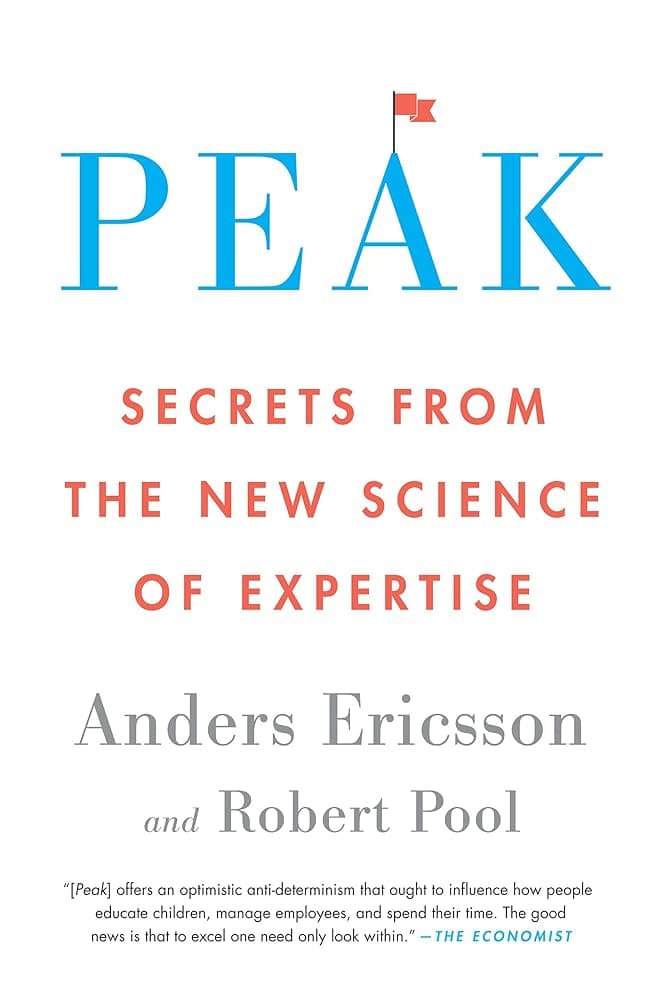
Peak
Anders Ericsson
Free download · 500+ book summaries
What is Peak about?
Throughout his career, Anders Ericsson studied chess champions, violin virtuosos, star athletes, and memory masters. Peak condenses three decades of myth-busting research into a powerful learning strategy that fundamentally differs from traditional ways of thinking about acquiring new skills. Whether you want to excel at work, improve your athletic or musical performance, or help your child achieve their academic goals, Ericsson's revolutionary methods show you how to develop virtually any skill that matters to you.
Key ideas of Peak
Deliberate Practice vs. Naive Practice
Reaching expert performance requires targeted, feedback-driven practice that pushes past current limits, not mere repetition of what you already know.
Brain Plasticity and Adaptation
The adult brain physically rewires itself in response to sustained, focused training, building new structures that make previously impossible feats routine.
Mental Representations Drive Expertise
Experts build rich internal patterns that let them perceive and respond to complex situations instantly, and these patterns are constructed through practice, not innate gift.
Read an excerpt from the summary
Mozart's Ear Was Trained, Not Born
In 1763, a seven-year-old Mozart astonished Europe by naming any note he heard. A violin, a clock chime, even a sneeze — he could pin down the pitch. The Augsburg newspaper reported it, aristocrats whispered about a child touched by God, and for two and a half centuries that story has done what such stories always do, which is to settle a stubborn question with a tidy answer. Some people are simply born this way. The rest of us, the implication runs, should sit down.
Anders Ericsson spent thirty years quietly dismantling that answer. He was a Swedish psychologist who became the world's foremost authority on what he called expert performance, and his patient verdict, gathered from violinists and surgeons and chess masters and people who memorize digits for sport, is that the gift Mozart had was not a sense of pitch. The gift was something far more interesting, and we all have it.
Here is how we know. In 2014, a Japanese researcher named Ayako Sakakibara published the results of an experiment at the Ichionkai Music School in Tokyo. She took twenty-four children, ages two to six, and ran them through a structured program of chord identification — four or five short sessions a day, the difficulty creeping upward. Some children finished in under a year. Others took eighteen months. Every single one of them developed perfect pitch. Not most of them. All of them. The ability that occurs in roughly one person in ten thousand — and that Beethoven had but Brahms did not, that Sinatra had but Miles Davis did not — turned out to be a thing you could teach to ordinary kids if you caught the brain at the right age and trained it correctly.
Like it?
Continue in the appWho is it for?
- Anyone who wants to improve a skill at work or in a hobby and feels stuck on a plateau.
- Anyone who believes talent is fixed and wants evidence-based reasons to think differently.
- Anyone who manages or coaches others and needs a framework for designing effective training.
- Anyone who is skeptical of the ten-thousand-hour rule and wants to understand what the research actually says.
About the author: Anders Ericsson
Anders Ericsson was a Swedish cognitive psychologist and professor at Florida State University. He spent more than three decades studying expert performers across fields including music, chess, medicine, and sports, and he became the world's leading researcher on the science of expertise and peak human performance.
His academic work on deliberate practice influenced popular writing on skill development, including Malcolm Gladwell's "Outliers", though Ericsson consistently clarified and corrected the ways his findings were simplified in that book. Peak, written with science journalist Robert Pool, is his definitive account of that research for a general audience.
Read it in 49 minutes
The summary of Peak and 500+ more books await in the BookBase app.