 English
 Magyar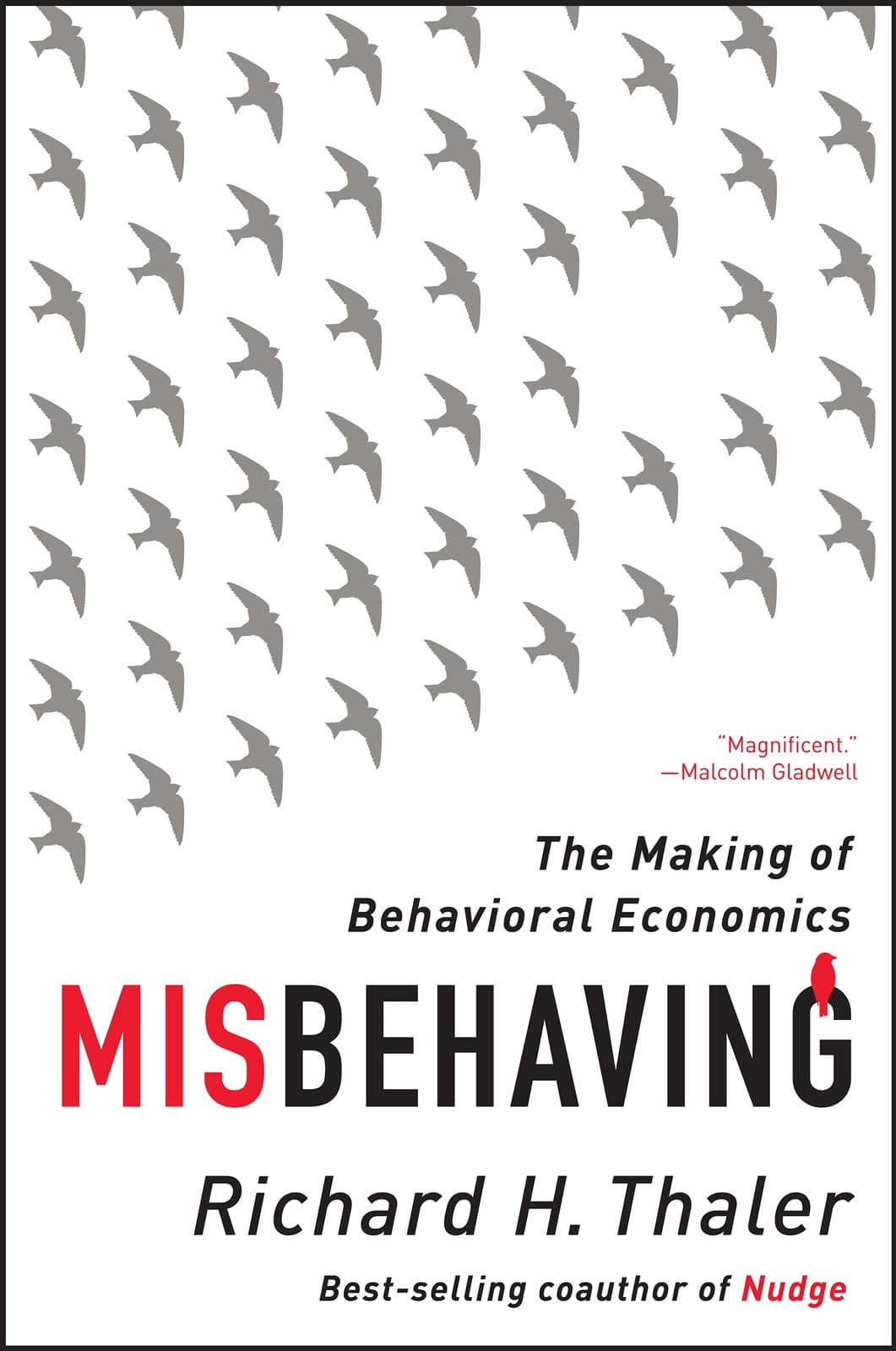
Misbehaving
Richard H. Thaler
Free download · 500+ book summaries
What is Misbehaving about?
We're not irrational because people are flawed, but because the theories about us are wrong. Richard Thaler reveals why we consistently make decisions against our own interests and how to design systems that nudge us in the right direction without forcing anything. You'll discover the two voices inside your head, why losing hurts twice as much as winning feels good, and how to become a better version of yourself simply by changing the environment around you.
Key ideas of Misbehaving
Loss Aversion and Reference Points
Losses hurt roughly twice as much as equivalent gains feel good, causing people to make decisions anchored to their current situation rather than actual value.
Bounded Self-Control
A planner self and a doer self compete in every decision, and the present-focused doer wins at the moment of temptation unless the option is removed in advance.
Choice Architecture and Nudging
Designing the environment so the good default is also the easy one changes behavior dramatically without banning or mandating anything.
Read an excerpt from the summary
Misbehaving: Summary
The exam that started everything
Picture this. You are a university professor, and your students are furious with you. Not because your exam is hard. The distribution of scores is exactly what it should be: some people do well, some do less well, and the average lands somewhere in the middle. The only problem is that this average is seventy-two points out of a possible hundred. And the students experience that as a catastrophe. Seventy-two? That is barely more than halfway. And they had worked so hard for it.
The young professor was named Richard Thaler, and he did something that would have made every economist colleague wince. On the next exam he did not make the questions easier. He did not improve anyone's grade. He changed exactly one thing: he raised the maximum possible score from a hundred to a hundred and thirty-seven. Same difficulty, same distribution, same final grades. The average just suddenly became ninety-six. And the result? The students were delighted. They never complained again. Thaler even printed it in bold in his syllabus: the new scoring system has no effect on the grade you get in the course, but it seems to make you happier.
Here is where the truth is buried. Seventy-two and ninety-six represented the exact same performance. By common sense the number itself is completely meaningless. Yet it changed how people felt. Thaler later called this a supposedly irrelevant factor: something that, according to classical economics, should have no role whatsoever, yet keeps tugging at our behavior again and again. This book is about how he built an entire discipline out of small, stubborn observations like that one. And about how he fought for it against a profession that for decades refused to even listen.
Like it?
Continue in the appWho is it for?
- Anyone who wants to understand why smart people make predictably bad financial decisions.
- Anyone who manages a team and wants to build systems that bring out better judgment from colleagues.
- Anyone designing products, policies, or public programs and needs to account for how people actually behave.
- Anyone who saves too little, spends impulsively, or holds on to sunk costs longer than they should.
About the author: Richard H. Thaler
Richard H. Thaler is a professor of behavioral science and economics at the University of Chicago Booth School of Business. He is one of the founders of behavioral economics, and his decades of research demonstrated that human decision-making systematically departs from the predictions of classical economic theory.
Thaler was awarded the Nobel Memorial Prize in Economic Sciences in 2017 for his contributions to behavioral economics. He is also the co-author of Nudge, written with Cass Sunstein, which brought the concept of choice architecture into public policy debates worldwide.
Read it in 50 minutes
The summary of Misbehaving and 500+ more books await in the BookBase app.