 English
 Magyar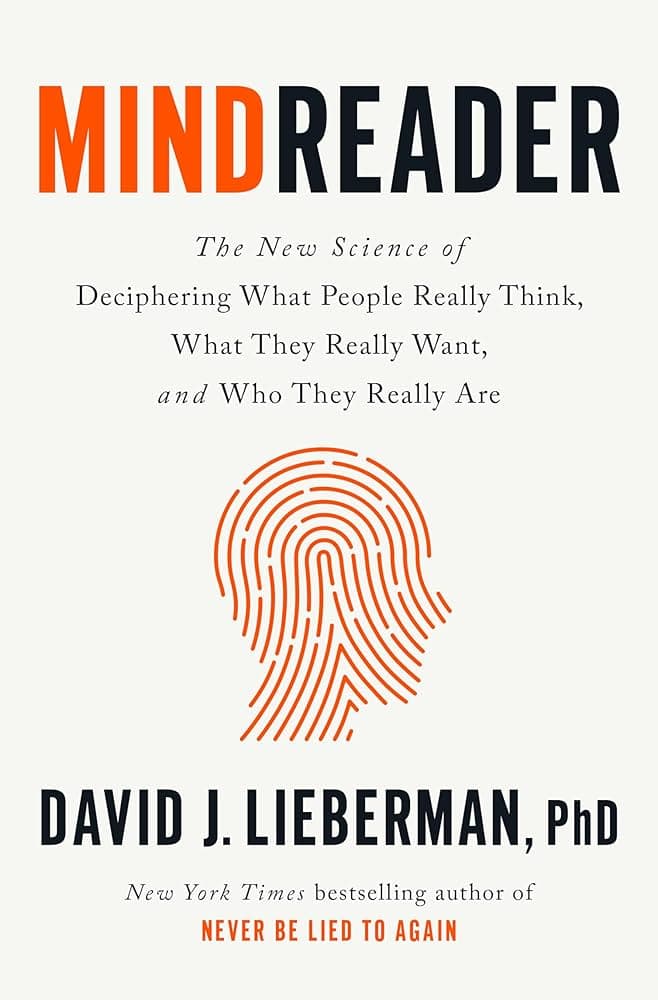
Mindreader
David J. Lieberman
Free download · 500+ book summaries
What is Mindreader about?
In the book The Mindreader, we learn how to read others, recognize what they are truly thinking and feeling.
Key ideas of Mindreader
Pronouns Reveal Hidden Truth
The small function words people use without thinking, like 'my' versus 'the', expose emotional ownership, deception, and psychological distance more reliably than body language.
Patterns Trump Single Signals
No single cue proves anything, only a consistent cluster of linguistic choices, pronoun shifts, passive voice, and emotional incongruence forms a reliable read.
Language Reflects Character Over Time
How people describe their past, their relationships, and their own setbacks reveals resilience, self-esteem, and personality far more accurately than what they say they believe.
Read an excerpt from the summary
When Language Says What People Won't
A woman tells a police officer her car has been stolen. She is calm, articulate, even helpful. She describes the make, the color, the parking spot. She uses the word "the." That single article is the reason the officer suspects her of lying. People who genuinely love their cars say "my car." People filing false reports almost always say "the car." It happens so often that detectives now look for the missing pronoun the way a doctor looks for a rash. The pronoun is the rash.
David J. Lieberman's Mindreader is built on hundreds of small observations like that one. Lieberman is a behavioral analyst whose techniques are used by the FBI, the CIA, the NSA, the U.S. military, and law enforcement agencies in around twenty-five countries. His earlier book, Never Be Lied to Again, helped popularize the idea that liars give themselves away through speech rather than fidgets. Mindreader, published by Rodale in 2022, is his attempt to retire body language entirely. He argues that the old cues — crossed arms, broken eye contact, nervous hands — produce so many false positives that they are nearly useless. A trained liar can hold your gaze without blinking. An innocent person can fidget because the chair is hard. A person wearing a religious pendant may be wearing it precisely because they feel guilty, not because they are devout. A person who is always late may be passive-aggressive, or anxious, or grandiose, or simply bad at math. One signal, Lieberman repeats throughout the book, is just noise. A consistent pattern of syntax is the signal.
What Mindreader promises is a quiet, almost intimate power. Once you start hearing pronouns, prepositions, articles, and the small connective tissue of speech, you cannot stop. You begin to notice that your friend says "the marriage" instead of "our marriage." You notice that your boss says "the company" instead of "our company." You notice that the person across the table from you on a first date has begun to say "we" when describing the parking lot. Each of these is a tiny window. Twenty windows, taken together, make a room. The book moves through that room in four parts, beginning with what people accidentally reveal about themselves and ending with how to spot the warning signs of someone who is genuinely unwell.
Like it?
Continue in the appWho is it for?
- Anyone who wants to become a sharper, more attentive listener in personal and professional conversations.
- Anyone who has been misled and wants practical tools for spotting deception through speech patterns rather than body language.
- Anyone who manages, hires, or leads people and needs to read motivation, commitment, and honesty more accurately.
- Anyone who wants to understand what their own language habits quietly reveal about their fears, values, and relationships.
About the author: David J. Lieberman
David J. Lieberman is an American behavioral analyst and therapist whose work has been used by the FBI, CIA, NSA, U.S. military, and law enforcement agencies in roughly twenty-five countries. He is the author of several books on human behavior, including Never Be Lied to Again, which popularized the idea that deception shows up in speech patterns more reliably than in physical gestures.
Lieberman focuses on the practical application of psychology to everyday communication, negotiation, and lie detection. His approach draws on linguistics research, clinical observation, and real interrogation techniques, aiming to give ordinary readers the same reading skills used by professional investigators.
Read it in 44 minutes
The summary of Mindreader and 500+ more books await in the BookBase app.