 English
 Magyar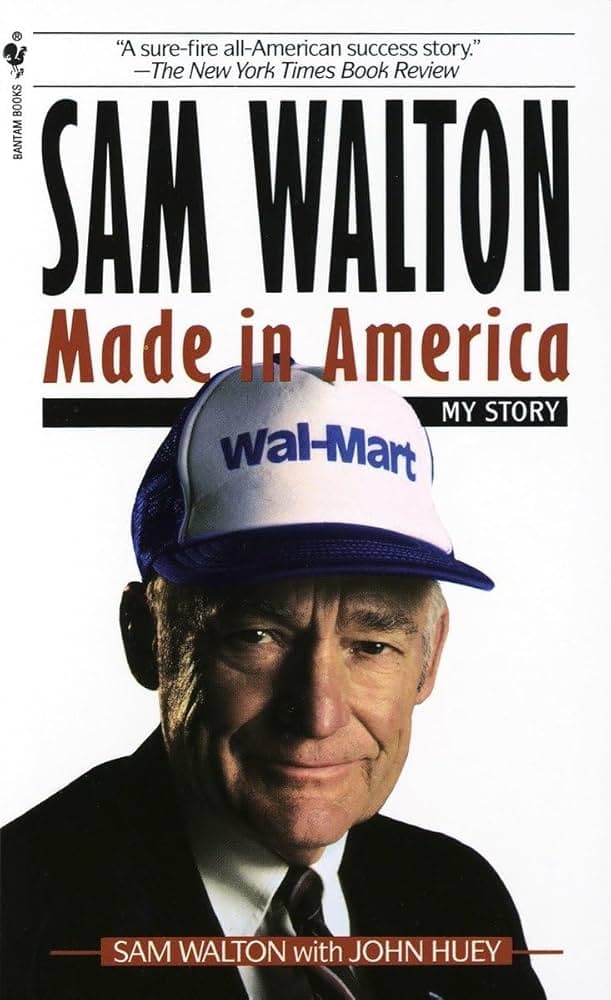
Made In America
Sam Walton
Free download · 500+ book summaries
What is Made In America about?
Sam Walton's book Made in America sheds light on the people behind the greatest business fortunes of all time and explains how he built Walmart into a billion-dollar empire through hard work, continuous learning, and unparalleled determination, all while aiming to make every single customer as happy as possible.
Key ideas of Made In America
Volume Over Margin
Cutting prices to drive higher sales volume produces more total profit than holding prices high for fatter margins on fewer sales.
Swimming Upstream
Starting in remote, underserved small towns forced Walmart to build distribution and cost discipline that well-funded rivals never had to develop.
Partners, Not Employees
Sharing profits and information with every associate, including hourly workers, directly tied their behavior to the company's success and the customer's experience.
Read an excerpt from the summary
The Richest Man Who Hated Being Rich
In October 1985, Forbes magazine put Sam Walton at the top of its list and called him the richest man in America. Most people would have framed the article. Walton was annoyed. The way he saw it, the magazine had taken a number off a stock table, multiplied his family's shares by the share price, and handed strangers a reason to camp outside his house. Television crews showed up in Bentonville, Arkansas, a town of a few thousand people, hunting for the billionaire hillbilly who supposedly hid his fortune under the mattress and drove a beat-up pickup truck.
The truck part was true. So was the haircut at the local barbershop and the breakfast at the same diner he'd eaten at for years. What the reporters got wrong was the assumption that any of it was an act. "Money never has meant that much to me," Walton wrote, "not even in the sense of keeping score." He measured himself against competitors, not against other rich men. When the 1987 market crash wiped out something like half a billion dollars of his family's paper wealth in a single stretch, he shrugged and said, "It's only paper." The reaction that genuinely moved him came from his own store workers, who told him they felt proud, because they figured they'd helped him get there.
That gap between the myth and the man is the whole story. *Made in America* is Walton telling it himself, near the end of his life, while fighting the cancer that would kill him in 1992. He admits up front that he was never a reflective fellow. The one thing he could point to that set him apart was simple: a passion to compete. Everything else in the book grows out of that, and out of a conviction he repeats until you can't forget it. There is only one boss, the customer, and that customer can fire everyone in the company from the chairman down just by spending money somewhere else.
Like it?
Continue in the appWho is it for?
- Anyone who wants to understand how America's largest retailer was built from a single store in rural Arkansas.
- Anyone who runs a small business and needs a practical framework for competing against larger, better-funded rivals.
- Anyone interested in how company culture, employee ownership, and frugality compound into a durable competitive advantage.
- Anyone studying retail, operations, or entrepreneurship and looking for a first-hand account from the founder himself.
About the author: Sam Walton
Sam Walton founded Walmart in 1962 in Rogers, Arkansas, and built it into the largest retailer in the world by the time he died in 1992. He started in retail as a JC Penney management trainee, opened his first store in 1945, and spent the following decades developing the discount retailing model that would reshape American commerce.
Walton was named America's richest person by Forbes in 1985, a distinction he found more annoying than flattering. He wrote Made in America near the end of his life while fighting cancer, intending it as a plain account of how the company actually got built.
Read it in 45 minutes
The summary of Made In America and 500+ more books await in the BookBase app.