 English
 Magyar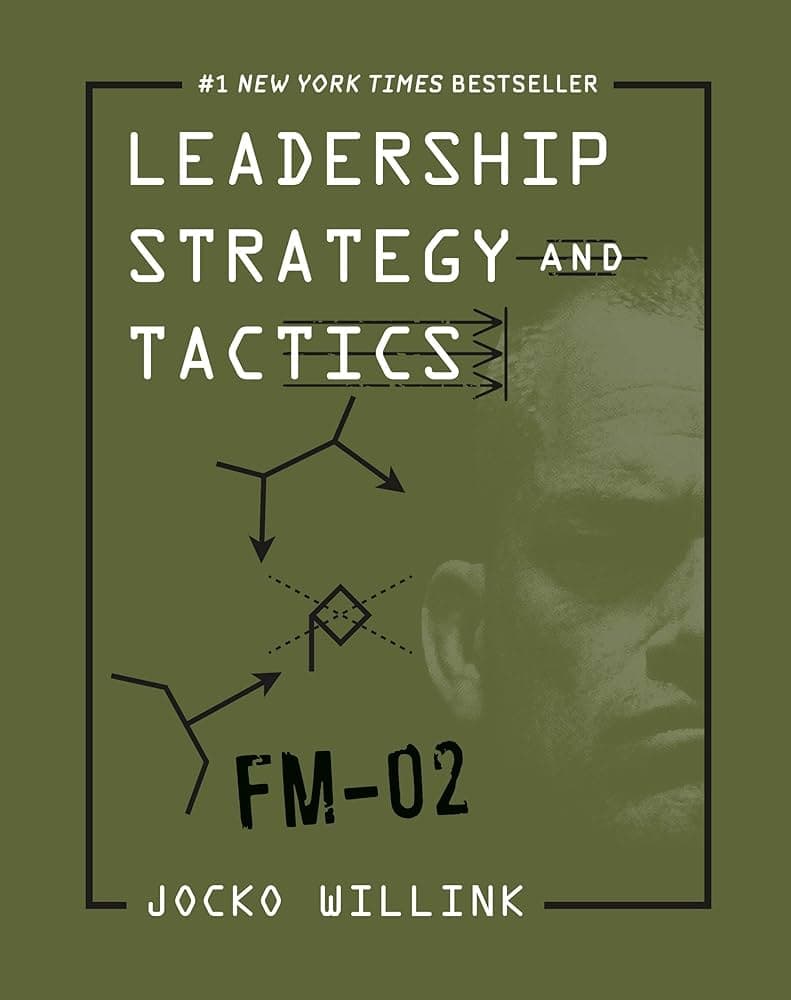
Leadership Strategy and Tactics
Jocko Willink
Free download · 500+ book summaries
What is Leadership Strategy and Tactics about?
Leadership Strategy and Tactics teaches you how to apply the high-performing Navy SEAL team skills in your workplace. You will learn practices such as extreme ownership and understand why humility is better than arrogance. These tips will help you leave your ego at the door and remember that your team's success always comes before your personal success.
Key ideas of Leadership Strategy and Tactics
Detachment as a Leadership Tool
Stepping physically and mentally back from a situation gives leaders the perspective to make clear decisions when their team cannot.
Extreme Ownership Without Exceptions
Effective leaders accept full responsibility for every outcome, including problems caused by poor weather, bad equipment, or team members' mistakes.
Decentralized Command Requires Trust
Leaders who share intent instead of dictating details empower subordinates to act fast and take ownership of their plans.
Read an excerpt from the summary
The Field Manual That Won't Sit on a Shelf
Most leadership books talk like consultants. Jocko Willink talks like a man who has carried other men's lives in his decisions. He spent twenty years in the United States Navy SEALs, commanded Task Unit Bruiser through the Battle of Ramadi in the summer of 2006, and came out with a way of thinking about leadership that doesn't sound like anyone else in the genre. Leadership Strategy and Tactics is the third book in his trilogy, after Extreme Ownership and The Dichotomy of Leadership. Where the first two laid down the philosophy, this one is meant to be opened in the field, in the middle of a problem, when you don't know what to do next.
The book is structured as a working manual. Part one walks through leadership strategies, the foundational concepts a leader has to internalize. Part two walks through tactics, the actual moves you make in specific situations. It is unapologetically built on military experience, and that bothers some readers, but the lessons translate cleanly once you strip the camouflage off them. The deeper claim underneath every story is that leadership has a structure to it, and that structure is teachable.
Willink keeps returning to one idea: the hardest part of leading is dealing with people, and the craziest person you have to deal with is yourself. Once that lands, the book starts making more sense. Everything in it is an attempt to keep your own ego, fear, fatigue, and pride from sinking the team. Let's walk through the field manual the way he wrote it.
The Day He Stepped Back
Willink joined the navy in 1989, went through BUD/S, and reported to SEAL Team One around 1991. There was no leadership curriculum at the time. The Gulf War ground fight had lasted seventy-two hours, and the SEAL Teams had been in a peacetime posture since Vietnam. Bad leaders were promoted alongside good ones, because peacetime didn't create the pressure that exposes either. He describes himself as average across the board, not the fastest or the strongest or the smartest, but driven to leave a mark and aware that he could only do it through others. There was a rebellious streak too, the kind that turned him into an outsider as a kid and gave him the habit of watching social dynamics from the edge of them rather than from inside them.
Like it?
Continue in the appWho is it for?
- Anyone who manages a team and struggles to let go of control over every decision.
- Anyone who wants a practical, scenario-based guide to leadership rather than abstract theory.
- Anyone who is stepping into a new leadership role and needs concrete tactics for the first weeks.
- Anyone who finds themselves blaming others when projects fail and wants to break that habit.
About the author: Jocko Willink
Jocko Willink is a retired United States Navy SEAL officer who spent twenty years in the special operations community. He commanded Task Unit Bruiser during the Battle of Ramadi in 2006, one of the most heavily contested urban combat operations of the Iraq War.
After retiring from the military, Willink co-founded Echelon Front, a leadership consulting firm, and co-authored the bestselling books Extreme Ownership and The Dichotomy of Leadership with Leif Babin. He also hosts a long-running podcast focused on discipline, leadership, and military history.
Read it in 42 minutes
The summary of Leadership Strategy and Tactics and 500+ more books await in the BookBase app.