 English
 Magyar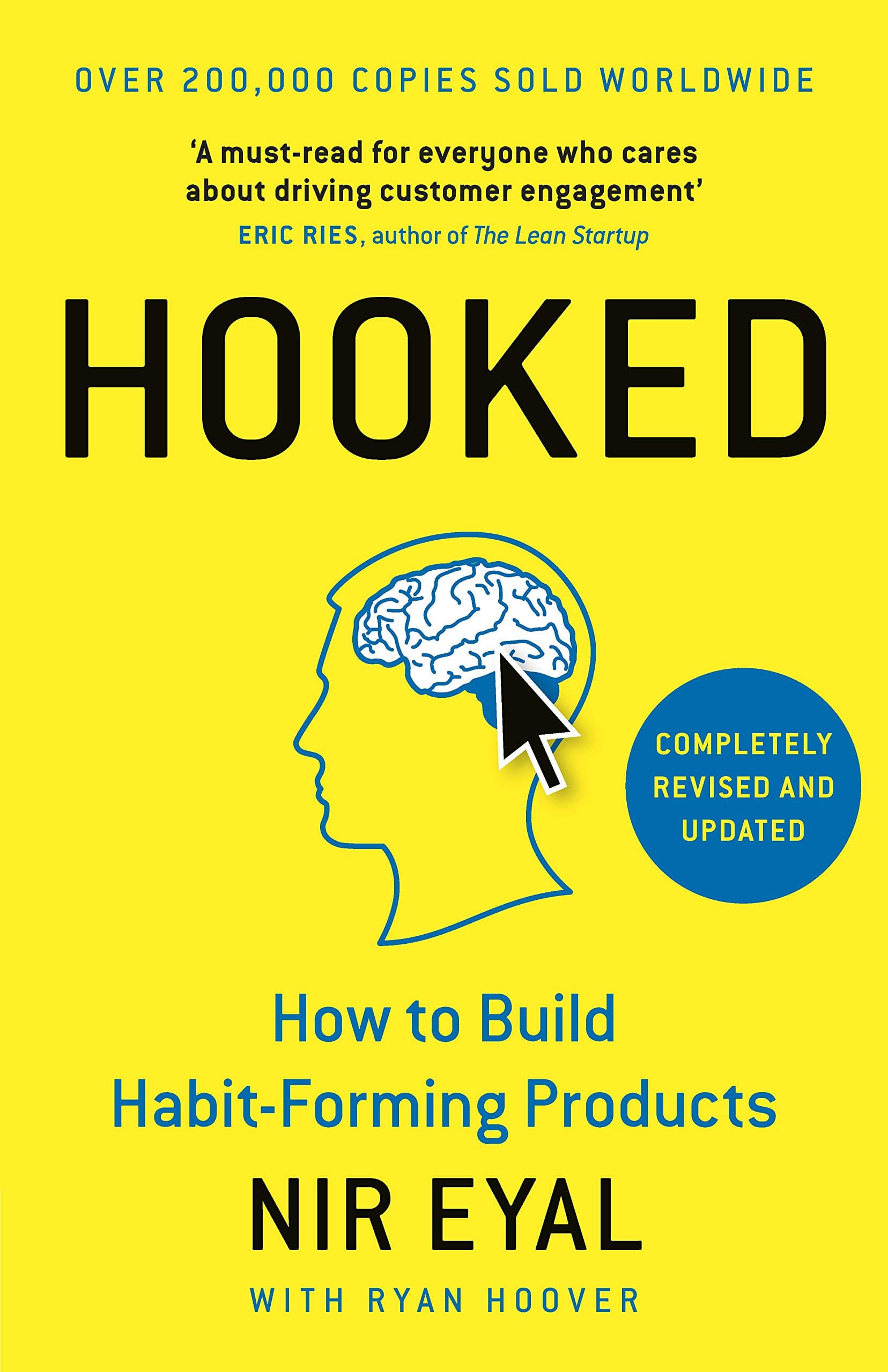
What is Hooked about?
Hooked explains, through anecdotes and scientific studies, how and why we integrate certain products into our daily routines. Hooked offers specific advice on how companies can make their products 'habits,' while also exploring the moral questions involved.
Key ideas of Hooked
The Four-Step Hook Model
Every habit-forming product runs a loop of trigger, action, variable reward, and investment that trains users to return without prompting.
Variable Rewards Drive Compulsion
Unpredictable payoffs spike dopamine more than fixed rewards, making users repeat behaviors far more obsessively than consistent rewards ever could.
Investment Builds Switching Costs
When users store data, followers, reputation, or skill inside a product, the accumulated value makes leaving feel like a genuine loss.
Read an excerpt from the summary
A Pocket That Won't Stay Quiet
Within fifteen minutes of waking, nearly four out of five smartphone owners have already reached for their phone. Roughly a third of Americans, when forced to choose, say they would give up sex before they would give up their device. A 2011 study tracked university students at around thirty-four phone checks per day; industry insiders put the real number closer to a hundred and fifty. None of this happened by accident.
Nir Eyal, who spent years inside the Silicon Valley advertising machine before he started teaching behavior design at Stanford, wrote *Hooked* to explain what those numbers actually mean. The book is short, blunt, and slightly uncomfortable. Its premise is that the products winning our attention are not winning it through magic or charm. They are winning it through a repeating four-step loop that hijacks the same neural machinery that once kept our ancestors alive. Eyal calls that loop the Hook Model, and once you see it you cannot un-see it.
The Hook Model in One Sentence
A hook is a trigger that prompts an action, the action delivers a variable reward, and the user makes some kind of investment that loads the next trigger. Run the loop enough times and the behavior stops needing the original push. The product becomes its own cue. You no longer open Instagram because a notification told you to; you open it because you felt a flicker of boredom in a checkout line and your thumb already knew where to go.
That is the entire framework. Trigger, action, variable reward, investment. Eyal spends most of the book unpacking what each step requires, where it goes wrong, and which mistakes kill otherwise promising products. He is unusual among writers in this space because he refuses to pretend the framework is benign. The same loop that gets a person to drink more water can get a person to lose a paycheck at a slot machine. Both run on the same wiring.
Like it?
Continue in the appWho is it for?
- Anyone who builds consumer software and wants to understand why some products become daily habits while others are deleted after a week.
- Anyone who works in product management or growth and needs a practical framework for increasing user retention and lifetime value.
- Anyone who is curious about the psychology behind their own screen-time habits and wants to see the mechanics laid bare.
- Anyone who thinks about the ethics of persuasive design and wants a framework for deciding when engagement tips into manipulation.
About the author: Nir Eyal
Nir Eyal spent years working in the advertising and gaming industries in Silicon Valley before turning to writing and teaching. He has lectured on behavioral design at the Stanford Graduate School of Business and the Hasso Plattner Institute of Design.
Eyal writes and consults on the intersection of psychology, technology, and business. He later wrote a follow-up book, Indistractable, examining how individuals can resist the very hooks he describes in Hooked.
Read it in 45 minutes
The summary of Hooked and 500+ more books await in the BookBase app.