 English
 Magyar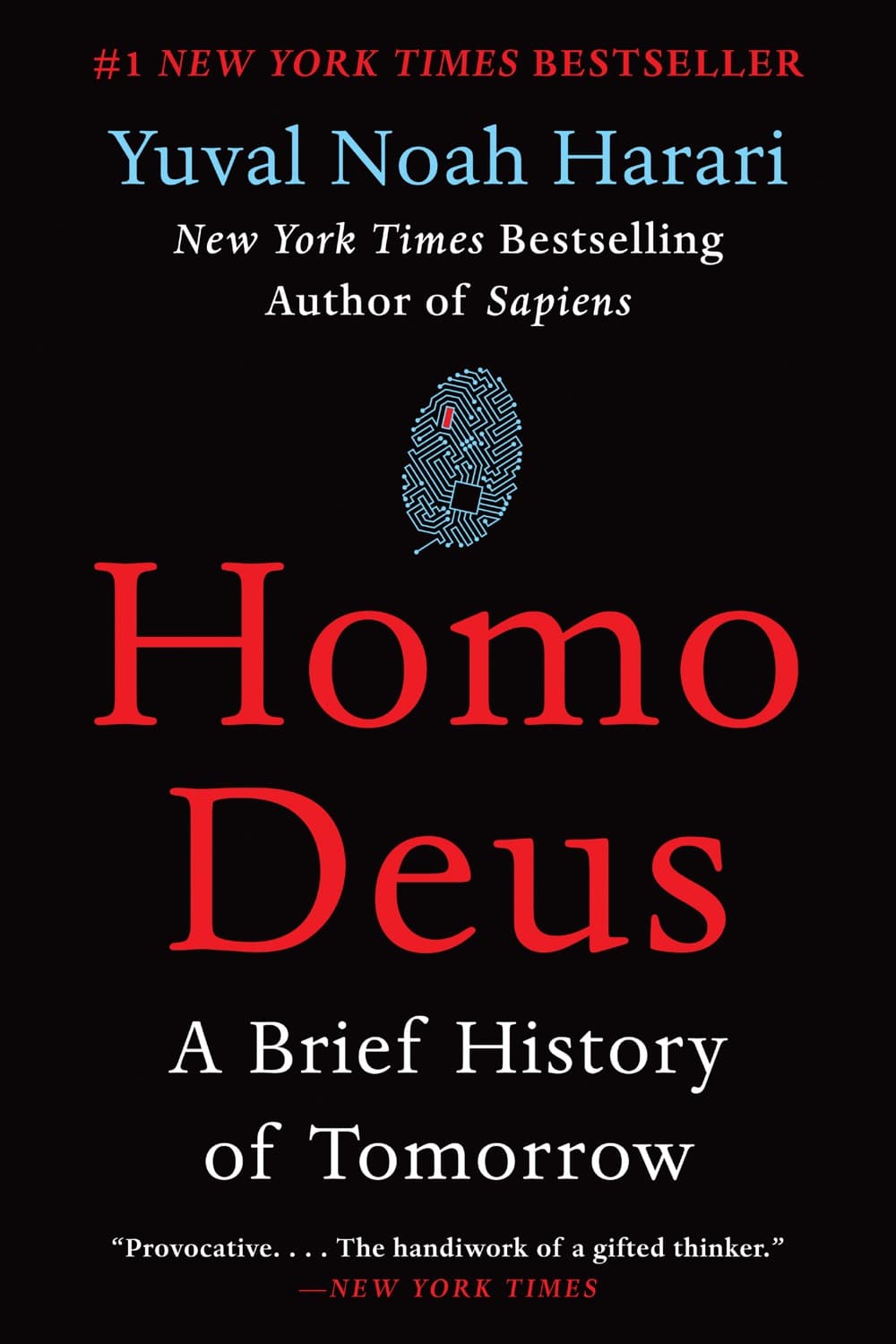
Homo Deus
Yuval Noah Harari
Free download · 500+ book summaries
What is Homo Deus about?
Now that we've mostly conquered famine, plague, and war, what comes next? Yuval Noah Harari's sweeping follow-up to Sapiens argues humanity will turn its tools toward immortality, happiness, and the upgrade of Homo sapiens itself. A provocative, expansive look at the next century of human ambition.
Key ideas of Homo Deus
Humanity's Three New Goals
With famine, plague, and war largely tamed, humanity is now directing its tools toward immortality, engineered happiness, and biological self-upgrade.
Intelligence Without Consciousness
AI can solve problems brilliantly without feeling anything, threatening the economic value of human labor and forcing a separation between what we do and what we experience.
Data as the New Religion
Dataism treats organisms as algorithms and defines human worth by contribution to information flows, gradually replacing liberal individualism with algorithmic authority.
Read an excerpt from the summary
Homo Deus: A Brief History of Tomorrow
Somewhere around the year 1800, a French mother had roughly a one-in-three chance of watching at least one of her children die before the age of five. Famine wiped out entire provinces on a schedule as predictable as the seasons. A single wave of plague could erase a third of a continent's population in under four years. War was so ordinary that most kingdoms budgeted for it the way you budget for groceries.
Now consider this: for the first time in human history, more people die from eating too much than from eating too little. More people die from old age than from infectious disease. More people commit suicide than are killed by soldiers, terrorists, and criminals combined. The ancient enemies that terrorized humanity for thousands of years -- famine, plague, and war -- have not vanished entirely. But they have been demoted from incomprehensible forces of nature to manageable challenges. We know how to fix them, even if we sometimes lack the political will.
So what happens when a species that evolved to survive suddenly has nothing urgent left to survive? It sets new goals. And according to Yuval Noah Harari, those goals are staggering: immortality, permanent happiness, and god-like powers over life itself. Homo Deus is the story of where those ambitions lead -- and why the answer might terrify you more than any plague ever could.
The Old Enemies Are Beaten (Mostly)
Harari does not rush past humanity's victories. He lingers on them, and for good reason. Understanding how we conquered the old threats reveals the tools -- and the mindset -- that will shape what comes next.
Like it?
Continue in the appWho is it for?
- Anyone who wants to understand where artificial intelligence and biotechnology are taking human civilization.
- Anyone who is curious about why liberal democracy and individual freedom may be losing their grip on the modern world.
- Anyone who thinks about the long-term consequences of sharing personal data with platforms and algorithms.
- Anyone who enjoyed Sapiens and wants Harari's equally sweeping look at the century ahead.
About the author: Yuval Noah Harari
Yuval Noah Harari is an Israeli historian and professor at the Hebrew University of Jerusalem. He rose to global prominence with Sapiens: A Brief History of Humankind, which became one of the best-selling nonfiction books of the twenty-first century and was recommended by leaders including Barack Obama and Bill Gates.
Harari specializes in world history and macro-historical processes. His work draws on evolutionary biology, anthropology, economics, and philosophy to trace large patterns across human history. Homo Deus, his follow-up to Sapiens, applies the same broad lens to the future rather than the past.
Read it in 48 minutes
The summary of Homo Deus and 500+ more books await in the BookBase app.