 English
 Magyar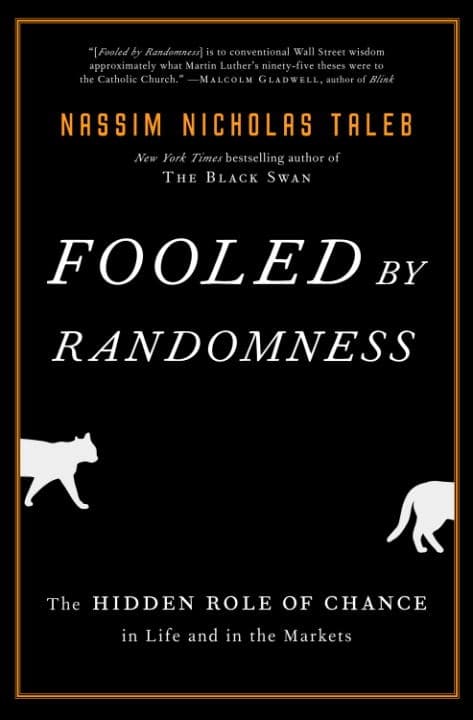
Fooled by Randomness
Nassim Nicholas Taleb
Free download · 500+ book summaries
What is Fooled by Randomness about?
We mistake luck for skill, noise for signal, and randomness for genius. Nassim Taleb's first major work shows how markets, careers, and entire reputations are built on patterns that don't actually exist. Sharp, contrarian, and necessary reading for anyone who makes decisions under uncertainty.
Key ideas of Fooled by Randomness
Survivorship Bias and Silent Evidence
We judge success by studying survivors and never see the far larger population who failed using identical strategies and judgments.
Randomness Mistaken for Skill
Human cognition cannot reliably separate genuine skill from a long lucky streak, causing us to reward and imitate luck rather than competence.
Robustness Over Maximization
Capping catastrophic downside and surviving tail events beats chasing peak returns in a world where rare, devastating outcomes are routinely underestimated.
Read an excerpt from the summary
Fooled by Randomness
The year is 1999. In a downtown Manhattan trading floor, a man named John is the star of the desk. He has been the star for four years running. His trades have not failed. His returns have not disappointed. His confidence, the particular velocity of it, fills the room. Colleagues watch how he talks to salespeople. They study how he positions himself relative to the screen. He drives a Ferrari. He has a second apartment in Tribeca. He believes, with absolute sincerity, that he has figured out how markets work.
He has not. He has just been lucky for long enough to believe otherwise.
In the same building, occupying a different corner of the same floor, a man named Nero Tulip is doing something that looks, from the outside, like almost nothing. He is cautious. He caps his upside deliberately. He reads philosophy in the slow hours. He does not drive a Ferrari. He does not discuss his system with colleagues. He is not the star of anything. He makes modest returns year after year and quietly refuses to take positions that could blow up his account. His colleagues consider him overly timid. A few feel sorry for him.
Then the market breaks. John loses everything -- not slowly, not partially, but completely, in the specific catastrophic style of someone who had borrowed heavily against a position that moved against him. The Ferrari gets sold. The apartment in Tribeca gets sold. John gets reassigned and eventually terminated. He spends years afterward trying to explain what happened, but the explanation keeps sliding toward bad luck, bad timing, forces beyond any reasonable anticipation.
Like it?
Continue in the appWho is it for?
- Anyone who wants to understand why past success is a poor predictor of future results in uncertain environments.
- Anyone who makes investment or business decisions and wants a sharper grasp of probability, risk, and cognitive bias.
- Anyone who reads business success narratives and suspects the causal stories are too neat and too simple.
- Anyone who is drawn to Stoic philosophy and wants to apply its lessons to modern decision-making under uncertainty.
About the author: Nassim Nicholas Taleb
Nassim Nicholas Taleb is a former derivatives trader and risk analyst who spent decades on trading floors in New York and elsewhere before turning to writing and research. His direct experience with financial markets, combined with a deep grounding in probability theory and classical philosophy, shaped the contrarian perspective that runs through all his work.
He is the author of the five-volume Incerto series on uncertainty, chance, and human knowledge. Fooled by Randomness, first published in 2001, was the opening volume. It was followed by The Black Swan, Antifragile, and other books that built on the same core ideas. Taleb grew up in Lebanon and witnessed the collapse of Beirut during the civil war, an experience that gave him a lifelong, concrete sense of what tail risk means outside of financial models.
Read it in 46 minutes
The summary of Fooled by Randomness and 500+ more books await in the BookBase app.