 English
 Magyar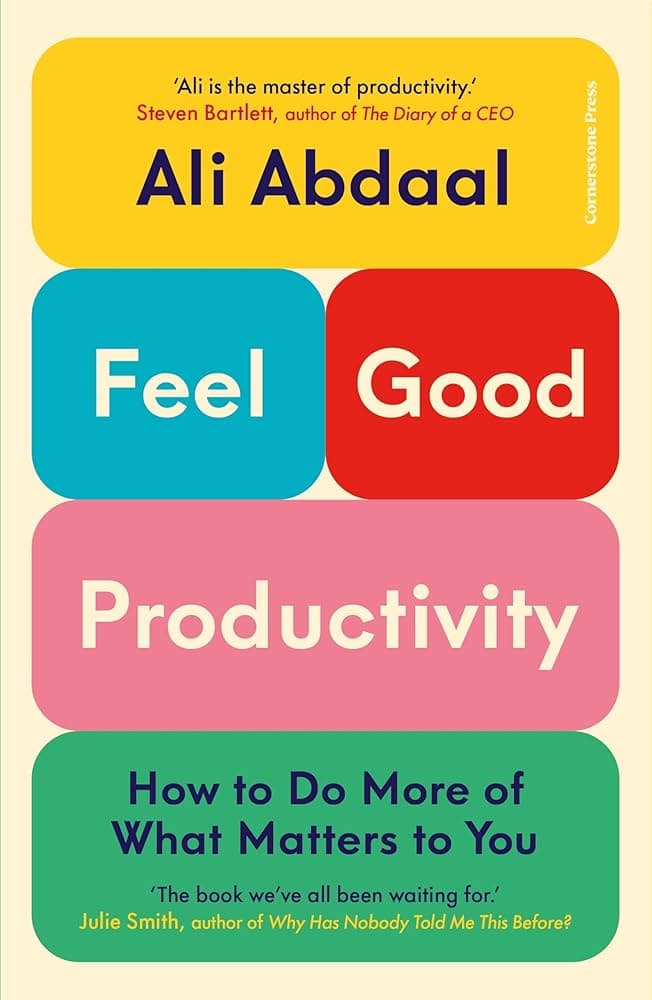
Feel good productivity
Ali Abdaal
Free download · 500+ book summaries
What is Feel good productivity about?
"Feel-Good Productivity" presents an unconventional approach to enhancing work efficiency by prioritizing enjoyment and well-being. It examines why individuals often struggle with low energy, procrastination, and burnout through the lenses of science and philosophy. The book offers a series of engaging mini-experiments designed to boost mood, performance, and ultimately, success.
Key ideas of Feel good productivity
Happiness Drives Productivity
Positive emotions broaden attention and build resilience, making good moods a precondition for output rather than a reward for it.
Three Sources of Energy
Play, a sense of personal power over your work, and supportive people each generate the positive emotion that fuels sustained performance.
Remove Friction Before Pushing Harder
Procrastination, fear, and inertia are mood problems that require removing emotional obstacles, not more willpower or discipline.
Read an excerpt from the summary
The Christmas Day That Broke His Theory
Ali Abdaal was the kind of person who treated suffering as a credential. He had grown up on Muhammad Ali's old line about hating every minute of training and pushing through anyway, telling himself the discomfort was a down payment on a champion's life. The strategy had worked. It got him into medical school at Cambridge. It got him through clinical training. He launched a business while studying and published academic papers on the side. By the time he was a junior doctor, he had built a personality around the conviction that productivity was a function of willingness to grind.
Then came Christmas Day on a solo shift, when a patient went into cardiac arrest. He performed a manual evacuation in the chaos, dropped a tray of medical supplies, and stood there in damp scrubs realizing that the harder he worked, the worse he was getting. His tutor Dr. Barclay had once told him that if the treatment is not working, you have to question the diagnosis. Abdaal questioned his diagnosis of himself. Maybe the grind was not the medicine. Maybe it was the disease.
The book that grew out of that moment makes one big claim, and everything else hangs from it. Success does not produce happiness. Happiness produces success. Feeling good is not a reward you collect at the end of a productive week. It is the precondition for productive weeks. Most of what we have been taught about productivity gets the arrow of causation backwards.
The argument is not a vibe. Abdaal grounds it in a 1945 puzzle invented by Karl Duncker. Participants are given a candle, a box of thumbtacks, and a book of matches and told to attach the candle to a corkboard so no wax drips on the floor. The solution requires you to empty the thumbtack box and use the box itself as a holder. Most people fail because they see the box as just a container for tacks. In the late 1970s, Alice Isen ran a version where one group was handed a small bag of candy before being given the puzzle. The gift group solved the problem far more often than the control. A flicker of good mood was enough to widen what they could see.
Like it?
Continue in the appWho is it for?
- Anyone who feels burned out from grinding through work and wants a science-backed alternative.
- Anyone who struggles with procrastination and suspects motivation tactics alone are not the fix.
- Anyone who wants to build a sustainable creative or professional practice without sacrificing well-being.
- Anyone who has hit a productivity ceiling and is open to rethinking what drives their best work.
About the author: Ali Abdaal
Ali Abdaal is a British doctor, YouTuber, and entrepreneur who studied medicine at the University of Cambridge. He built one of the largest educational YouTube channels while completing his medical training, covering productivity, learning, and personal development.
His work draws on behavioral science, psychology research, and his own experience as a junior doctor who burned out following a grind-first approach to performance. Feel-Good Productivity is his first book.
Read it in 48 minutes
The summary of Feel good productivity and 500+ more books await in the BookBase app.