 English
 Magyar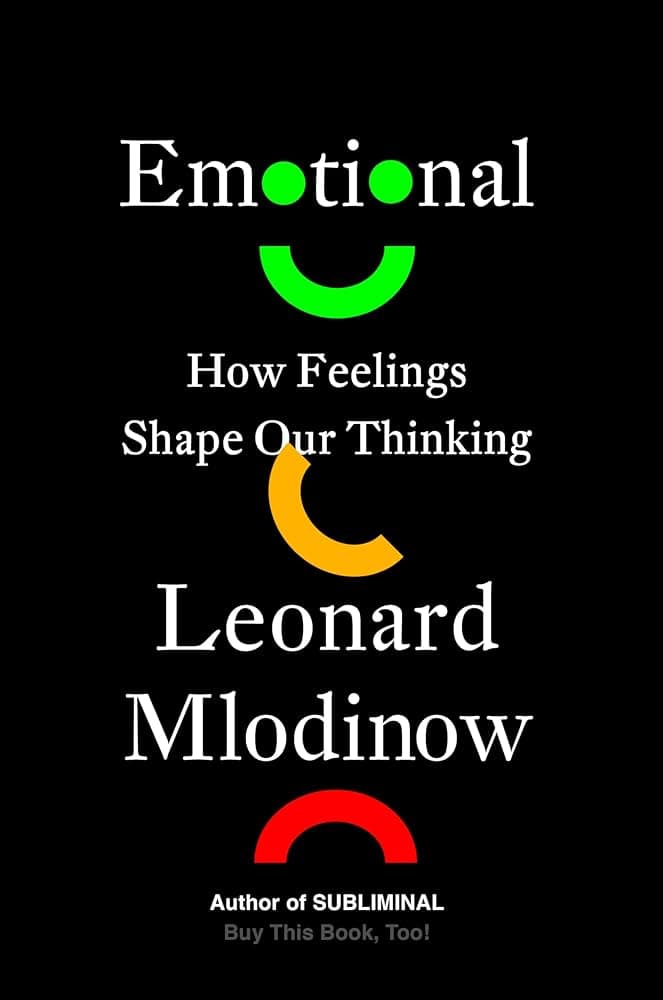
Emotional: How Feelings Shape Our Thinking
Leonard Mlodinow
Free download · 500+ book summaries
What is Emotional: How Feelings Shape Our Thinking about?
Emotional shows how you can build closer relationships. How can you improve your relationship with fear and anxiety? What can you do to live a happier life? The answers lie in understanding emotions. Mlodinow takes us on a journey from the labs of pioneering scientists to real-life situations flirting with disaster, showing how our emotions help us, why they sometimes harm us, and how we can change our lives.
Key ideas of Emotional: How Feelings Shape Our Thinking
Emotion Drives Every Decision
Without emotional weighting, the brain cannot assign value to goals or evidence, making rational-only thinking a fiction.
Body and Mind Are One System
Core affect, gut bacteria, hunger, and sleep all shape thought and judgment in ways the conscious mind never notices.
Emotional Profiles Can Be Changed
Acceptance, reappraisal, and expression are validated strategies that measurably retune how strongly and how long emotions affect you.
Read an excerpt from the summary
Two Sons of Survivors
Leonard Mlodinow grew up watching his mother fling herself onto the kitchen floor and wail, "Why didn't Hitler kill me?" — usually because someone had spilled milk. He assumed every mother was like this. His father, who had also survived Buchenwald, responded to the exact same history with relentless cheer and the kind of self-confidence that strangers found magnetic. Same camps, same losses, same nightmares. Two completely different humans walked out the other side.
That puzzle is the seed of this book. How could two people who endured something so close emerge so far apart? And what does the answer say about the rest of us, who feel and think our way through every ordinary day without any idea what's actually running the show?
For a hundred years the answer would have started with a familiar division: the cold rational mind, which decides things, and the hot emotional mind, which gets in the way. Plato drew it as a charioteer driving two horses, one noble and one wild. Darwin agreed in his own fashion — emotions, he thought, were leftovers from our animal past, like the appendix. By the time Daniel Goleman popularized "emotional intelligence" in 1995, the metaphor was still essentially Plato's: feelings need to be managed by the smarter part of you.
Mlodinow's book is a careful argument that this is wrong. Not partly wrong — fundamentally wrong. Connectome mapping, optogenetics, and transcranial stimulation have handed neuroscientists tools that didn't exist a generation ago, and the picture looks nothing like the chariot. Emotion isn't a separate horse. Emotion is the thing that decides which goals matter, which evidence counts, and how heavily to weight every piece of data you encounter. Without it, you can't decide what to eat for breakfast, never mind whether to leave your marriage. You'd just stand in the kitchen forever.
Like it?
Continue in the appWho is it for?
- Anyone who wants to understand why feelings, not logic, are the actual engine behind their choices and habits.
- Anyone who struggles with anxiety, anger, or shame and wants a science-backed map of what those states actually do in the brain.
- Anyone curious about neuroscience and how discoveries in optogenetics, epigenetics, and connectome mapping are rewriting the emotion textbooks.
- Anyone who wants practical, research-tested techniques for managing their own emotional responses under pressure.
About the author: Leonard Mlodinow
Leonard Mlodinow is a physicist and science writer who has spent his career translating cutting-edge science for general audiences. He has a background in theoretical physics and has taught at Caltech.
He is the author of several widely read books on science and human behavior, and has collaborated with Stephen Hawking. His writing combines rigorous research with personal storytelling, a style on full display in Emotional.
Read it in 49 minutes
The summary of Emotional: How Feelings Shape Our Thinking and 500+ more books await in the BookBase app.