 English
 Magyar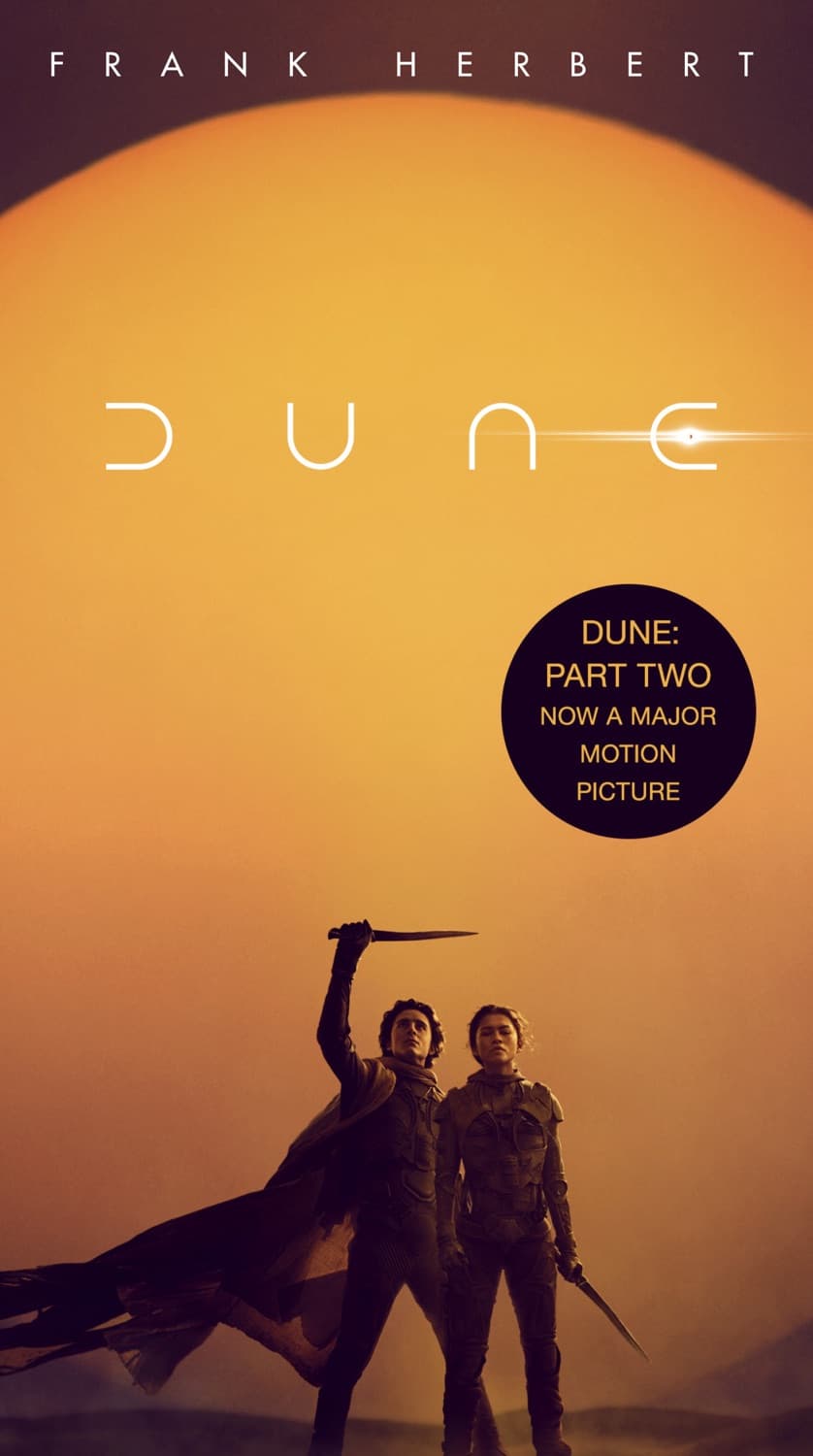
Dune
Frank Herbert
Free download · 500+ book summaries
What is Dune about?
On the desert planet Arrakis, the spice melange controls the universe. Young Paul Atreides arrives with his noble family only to be drawn into a brutal struggle for power, prophecy, and survival. Frank Herbert's masterpiece blends ecology, religion, and politics into one of the most ambitious novels ever written.
Key ideas of Dune
Ecology as Political Argument
The desert planet Arrakis and its spice cycle show how a colonial power can extract a resource for generations without understanding the living system that produces it.
The Messiah as Warning
Paul's rise to prophetic power is not a triumph but a tragedy, as his leadership sets in motion a religious war that will kill billions regardless of his intentions.
Manufactured Prophecy and Control
The Bene Gesserit seeded messiah myths across the galaxy as a manipulation tool, only to lose control when their own breeding program produced someone beyond their design.
Read an excerpt from the summary
Dune
A fifteen-year-old boy sits across from a very old woman in a dim room aboard a heighliner. She places a small black box on the table between them. She tells him to put his hand inside it. He feels nothing at first -- just a faint warmth -- and then the pain begins. It starts at his fingertips and spreads upward through his wrist, his elbow, his shoulder, burning as though every nerve is dissolving in acid. He screams inside his own skull. He does not move his hand. Against his neck he feels the tip of a needle -- the Gom Jabbar, dipped in a poison so fast-acting that it would stop his heart before he finished falling. She tells him, quietly, that she will kill him if he withdraws his hand before she permits it.
This is how Frank Herbert opens his universe. Not with spaceships. Not with battle. With a question: what is a human being, really? Paul Atreides, heir to House Atreides, sits in that box while the Bene Gesserit Reverend Mother Gaius Helen Mohiam measures the boundary between animal reflex and conscious will. Animals, she explains, would yank the hand free and accept death over pain. A human being -- a true human being -- can override the body. Can hold still. Can choose.
Paul holds still.
He passes the test. He has no idea what it will cost him.
Dune was published in 1965 by Chilton Books, a Philadelphia house best known for automotive repair manuals. The manuscript had been rejected by roughly twenty publishers before Chilton's editor Sterling Lanier took a chance on it, initially publishing it in two hardcover volumes. Herbert had spent six years writing it after it was serialized in Analog Science Fiction magazine in two parts -- "Dune World" in 1963 and "The Prophet of Dune" in 1965 -- and the research behind it stretched further back than that. To 1957, when he traveled to Florence, Oregon, to write an article about a government project attempting to stabilize coastal sand dunes with poverty grass. The dunes fascinated him. The way a single ecological intervention -- planting grass to catch windblown sand -- could set in motion a cascade of changes that would eventually transform the entire system: that concept became the seed of a novel. He never finished the article. Instead he spent the next several years reading ecology, desert survival, the history of Islamic prophecy, the mechanics of colonial resource extraction, and the psychology of charismatic leadership. What emerged was not a simple adventure story. It was an ecosystem of interlocking ideas held together by one of the most fully realized imaginary worlds in literary history. The novel won the inaugural Nebula Award and the Hugo Award in 1966. It has never gone out of print.
Like it?
Continue in the appWho is it for?
- Anyone who wants science fiction that argues as hard as it entertains, built on ecology, politics, and religion rather than technology alone.
- Anyone who is drawn to stories where power and competence lead to catastrophe rather than salvation.
- Anyone interested in how colonial resource extraction, indigenous knowledge, and political dependency interact across history.
- Anyone curious about the book that shaped decades of science fiction, fantasy, and popular storytelling that followed it.
About the author: Frank Herbert
Frank Herbert was an American science fiction writer who spent six years researching and writing Dune before its publication in 1965. His preparation drew on desert ecology, the history of Islamic prophecy, the sociology of T.E. Lawrence, post-colonial oil politics, and the emerging formal science of ecosystems. The research showed: Dune is one of the most thoroughly grounded imaginary worlds in the genre's history.
Herbert was openly critical of charismatic leadership and designed Dune as a warning against hero-worship rather than a celebration of it. The novel won both the inaugural Nebula Award and the Hugo Award in 1966 and has never gone out of print. Herbert wrote five sequels, though none matched the original's scope or influence.
Read it in 44 minutes
The summary of Dune and 500+ more books await in the BookBase app.