 English
 Magyar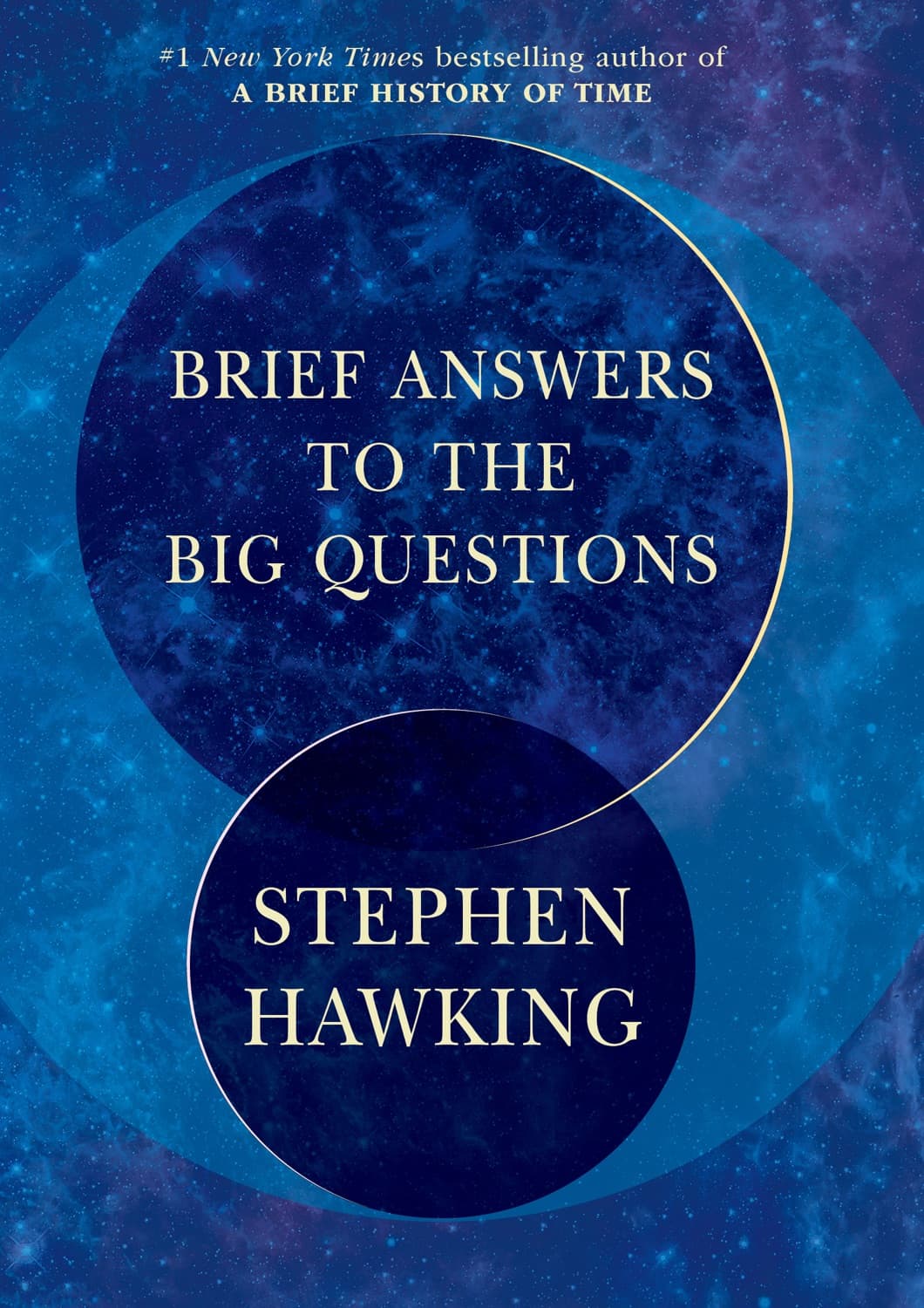
Brief Answers to the Big Questions
Stephen Hawking
Free download · 500+ book summaries
What is Brief Answers to the Big Questions about?
Stephen Hawking's final book takes on the questions humanity asks again and again. From the existence of God and the origin of the universe to time travel, AI, and our future on Earth, Hawking offers his most personal and accessible reflections on the fate of our species and the cosmos.
Key ideas of Brief Answers to the Big Questions
Universe from nothing
Hawking argues that because time began with the Big Bang, no creator is needed: a zero-energy universe can emerge spontaneously from quantum processes.
AI and existential risk
Artificial intelligence could be humanity's greatest tool, but a misaligned superintelligent AI poses an existential threat greater than any weapon yet built.
Space colonisation as survival
Spreading humans beyond Earth is basic risk management: keeping the species on a single planet means one catastrophe can end everything.
Read an excerpt from the summary
Brief Answers to the Big Questions — summary
A man who outlived his death sentence by fifty-four years
In the spring of 1963, a twenty-one-year-old graduate student in Cambridge was told he had two years to live. His muscles had begun to betray him on the ice rink. The doctors at St Bartholomew's never said the words out loud, but Stephen Hawking pieced it together himself: amyotrophic lateral sclerosis. The body was already shutting down. The mind, presumably, would have nothing left to do but watch.
He died on 14 March 2018, at the age of seventy-six. In the fifty-four bonus years between those two dates, he discovered that black holes glow, married twice, fathered three children, wrote one of the bestselling science books in history, opened the Paralympic Games in London, and quietly assembled the manuscript that would become this one. *Brief Answers to the Big Questions* was finished after his death by his family, students, and colleagues, working from an archive of speeches, essays, and interviews he had been refining for years. It is the closest thing we will ever get to his last word on the questions he chased his entire adult life.
The book is organised around ten of those questions, and they are not modest. Is there a God. How did the universe begin. Are we alone. Can we predict the future. What is inside a black hole. Is time travel possible. Will we survive on Earth. Should we colonise space. Will artificial intelligence outsmart us. How do we shape the future. What follows below is a tour through Hawking's answers, in plain English, with the stories and analogies he used to make these ideas land for people who never took a physics class.
Like it?
Continue in the appWho is it for?
- Anyone who wants to understand how a leading physicist thought about God, the universe, and humanity's future in plain, non-technical language.
- Anyone who is curious about black holes, the Big Bang, time travel, or alien life but finds most physics books too dense to finish.
- Anyone who wants a short, honest assessment of the biggest threats facing civilisation and what science says we should do about them.
- Anyone who feels overwhelmed by the pace of technological change and wants a framework for thinking about AI, climate, and nuclear risk.
About the author: Stephen Hawking
Stephen Hawking (1942-2018) was a theoretical physicist and cosmologist at the University of Cambridge, where he held the Lucasian Professorship of Mathematics for thirty years. His work on black holes and cosmology, including the discovery that black holes emit thermal radiation (now called Hawking radiation), placed him among the most influential physicists of the twentieth century.
He wrote several books for general audiences, most notably A Brief History of Time, which became one of the bestselling science books ever published. Hawking lived with motor neurone disease from the age of twenty-one and communicated in his later decades through a speech-generating device. He was buried in Westminster Abbey between Isaac Newton and Charles Darwin.
Read it in 45 minutes
The summary of Brief Answers to the Big Questions and 500+ more books await in the BookBase app.