 English
 Magyar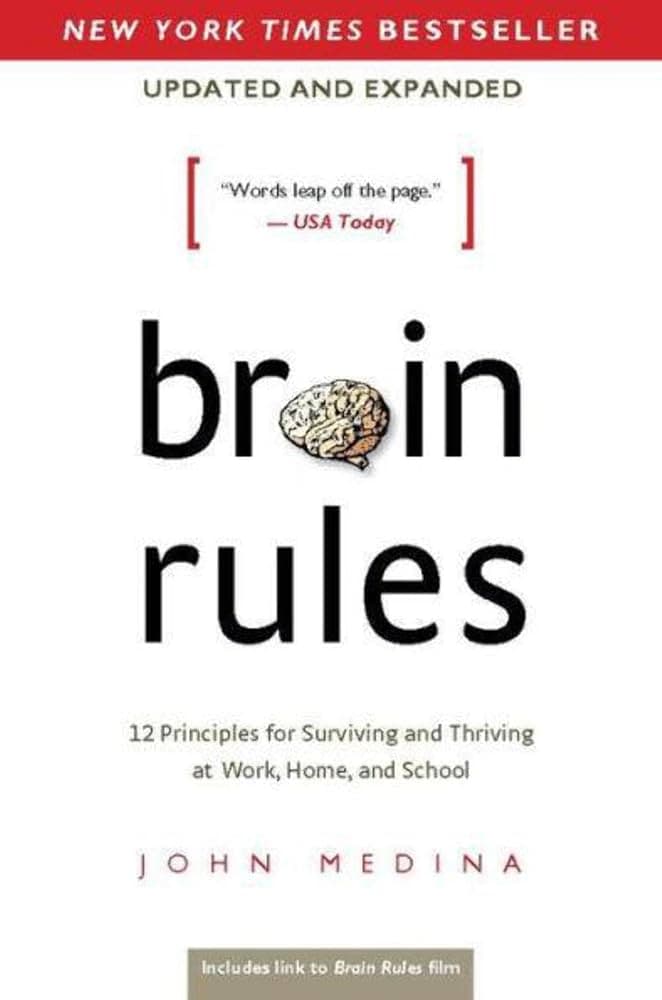
Brain Rules
John Medina
Free download · 500+ book summaries
What is Brain Rules about?
Most of us have no idea what is really going on in our heads. However, neuroscientists have discovered details that every business leader, parent, and teacher should know—such as the fact that the brain needs physical activity to function at its best.
How do we learn? What exactly do sleep and stress do to our brains? Why is multitasking a myth? Why is it so easy to forget—and why is repeating new information so important? Is it true that men and women have different brains? The book answers all of these questions.
Key ideas of Brain Rules
Exercise Powers the Brain
Regular aerobic exercise improves memory, attention, and problem-solving, and roughly halves the risk of dementia by boosting blood flow and neurotrophic proteins.
Spaced Repetition Beats Cramming
Memories are fragile and reconstructed each time they are recalled, so spacing out review sessions is far more effective than massed study.
Attention Has a Ten-Minute Limit
Audiences begin mentally disengaging around ten minutes into any presentation, and emotional hooks are the most reliable way to reset that clock.
Read an excerpt from the summary
Introduction: The Brain's Performance Envelope
There are children with an IQ of fifty or below who can do things most of us never could. One can multiply 8,388,628 by 24 in his head in seconds. Another can tell you the exact time of day at any moment, even while fast asleep. A third can judge the dimensions of a room from twenty feet away with a tape measure's accuracy. A fourth, at age six, draws well enough to hang in a gallery. And yet not one of these children can tie his own shoes. John Medina opens Brain Rules with this puzzle because it embarrasses everything we think we know about intelligence, and because it points to the real subject of his book: we have almost no idea how the brain works, and most of what we do in schools and offices actively fights against it.
Medina is a developmental molecular biologist, and he holds himself to a strict standard. He calls it, with characteristic humor, the Medina Grump Factor. To make it into this book, a finding had to be published in a peer-reviewed journal and then successfully replicated. No Mozart effect. No left-brain, right-brain personality types. No prenatal language tapes piped into a pregnant belly. What survives that filter is twelve rules, and a single organizing idea behind all of them.
The idea is the performance envelope. Your brain was built to solve problems, related to surviving, in an unstable outdoor environment, while in nearly constant motion. Every one of the twelve rules traces back to that one sentence. We grew up walking miles a day across the savannah, dodging predators, reading the intentions of other humans, and improvising when the weather, the food, and the threats kept changing. The brain is a survival organ, not a thinking organ that happens to keep us alive.
Like it?
Continue in the appWho is it for?
- Anyone who wants to understand what the science actually says about how the human brain learns and remembers.
- Anyone who teaches, trains, or manages people and suspects their current methods are working against human biology.
- Anyone who wants concrete, research-backed reasons to prioritize exercise, sleep, and stress reduction in their daily life.
- Anyone who is curious about why schools and offices are so poorly designed for the brains that inhabit them.
About the author: John Medina
John Medina is a developmental molecular biologist and affiliate professor of bioengineering at the University of Washington School of Medicine. He has spent his career studying the genes involved in human brain development and psychiatric disorders.
Medina applies a strict standard to every claim in his work, requiring findings to be peer-reviewed and independently replicated before he treats them as reliable. Brain Rules grew out of years of lectures to business executives and educators who wanted to know what neuroscience could offer them in practical terms.
Read it in 50 minutes
The summary of Brain Rules and 500+ more books await in the BookBase app.