 English
 Magyar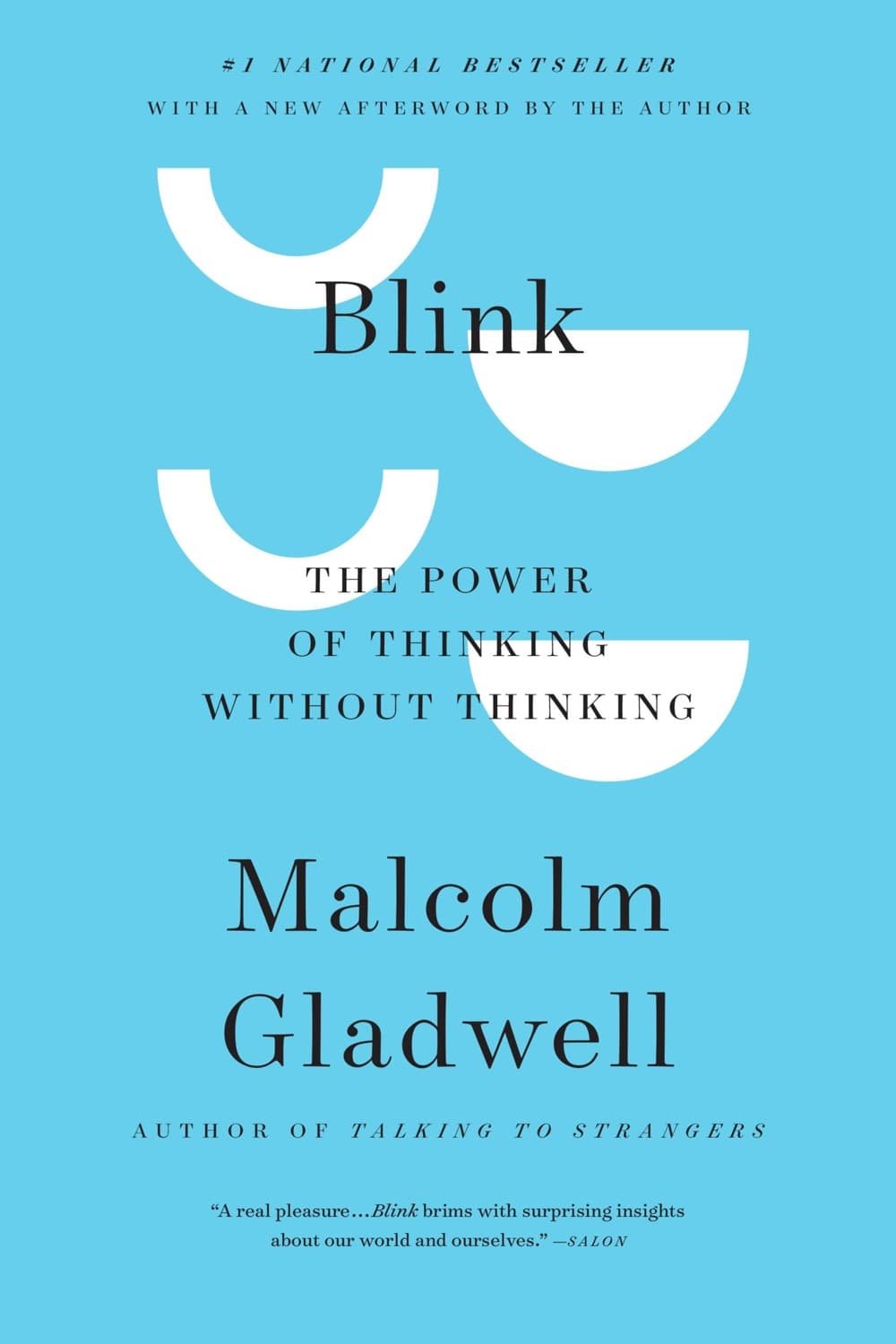
Blink
Malcolm Gladwell
Free download · 500+ book summaries
What is Blink about?
Why we make better decisions in two seconds than two months. Malcolm Gladwell explores the psychology of rapid cognition: thin-slicing, expert intuition, and the dangerous moments when snap judgments go wrong. From art forgery to military strategy to speed dating. The book that turned gut feel into a respected research field.
Key ideas of Blink
Expert Intuition Is Real
Specialists like art historians and marriage researchers make accurate predictions in seconds because deep experience trains a fast, unconscious pattern-matching system.
Thin-Slicing Goes Wrong
Snap judgments fail when they run on irrelevant cues, such as height predicting leadership, or when cultural bias corrupts the signals being read.
Curate the Conditions
Good rapid cognition depends on genuine expertise, filtered information, and organizations where people can voice concerns they cannot yet fully explain.
Read an excerpt from the summary
Blink
In the fall of 1983, a young kouros -- a Greek statue of a standing male youth -- arrived at the Getty Museum in California. The dealer was asking $10 million. Before anyone wrote a check, the Getty's lawyers and scientists spent fourteen months running tests. They brought in a geochemist from the University of California who analyzed the statue's surface using high-resolution electron microscopy. They carbon-dated organic residue. They traced provenance documents across three countries. Every test came back clean. The marble was ancient. The calcite had recrystallized in ways consistent with thousands of years of aging. The lawyers were satisfied. The scientists were satisfied. The Getty bought the statue.
Then they started showing it to people who actually knew kouros statues.
Thomas Hoving, former director of the Metropolitan Museum of Art in New York, took one look and felt what he later described as a single word rising in his mind: "fresh." Not fresh as in new art, fresh as in wrong. Something about the surface felt off -- too perfect, too consistent, the way a thing looks when it has been made to look old rather than actually aged. Federico Zeri, an Italian art historian who had spent decades cataloguing Greek and Roman antiquities, noticed that the fingernails looked somehow not right. Evelyn Harrison, one of the leading experts on Greek sculpture in the world, looked at the statue for a few seconds and said quietly, "I'm sorry to hear you paid so much for it." She had no specific reason. She could not point to a measurement or a chemical reading. She just knew.
Like it?
Continue in the appWho is it for?
- Anyone who wants to understand why first impressions are sometimes brilliant and sometimes catastrophically wrong.
- Anyone who makes high-stakes hiring, creative, or clinical decisions and relies partly on gut feeling.
- Anyone curious about how unconscious bias forms and quietly shapes behavior without awareness.
- Anyone leading a team who wants to build a culture where intuitive warnings can actually be heard.
About the author: Malcolm Gladwell
Malcolm Gladwell is a Canadian journalist and author known for translating social science research into accessible, story-driven books. He spent years as a staff writer at The New Yorker before publishing a series of bestsellers that shaped how general readers think about psychology, sociology, and decision-making.
His books consistently draw on peer-reviewed research and real-world cases to build broad arguments about human behavior. Blink was his second book, following The Tipping Point, and it established his signature method of anchoring large ideas in vivid, concrete examples.
Read it in 48 minutes
The summary of Blink and 500+ more books await in the BookBase app.