 English
 Magyar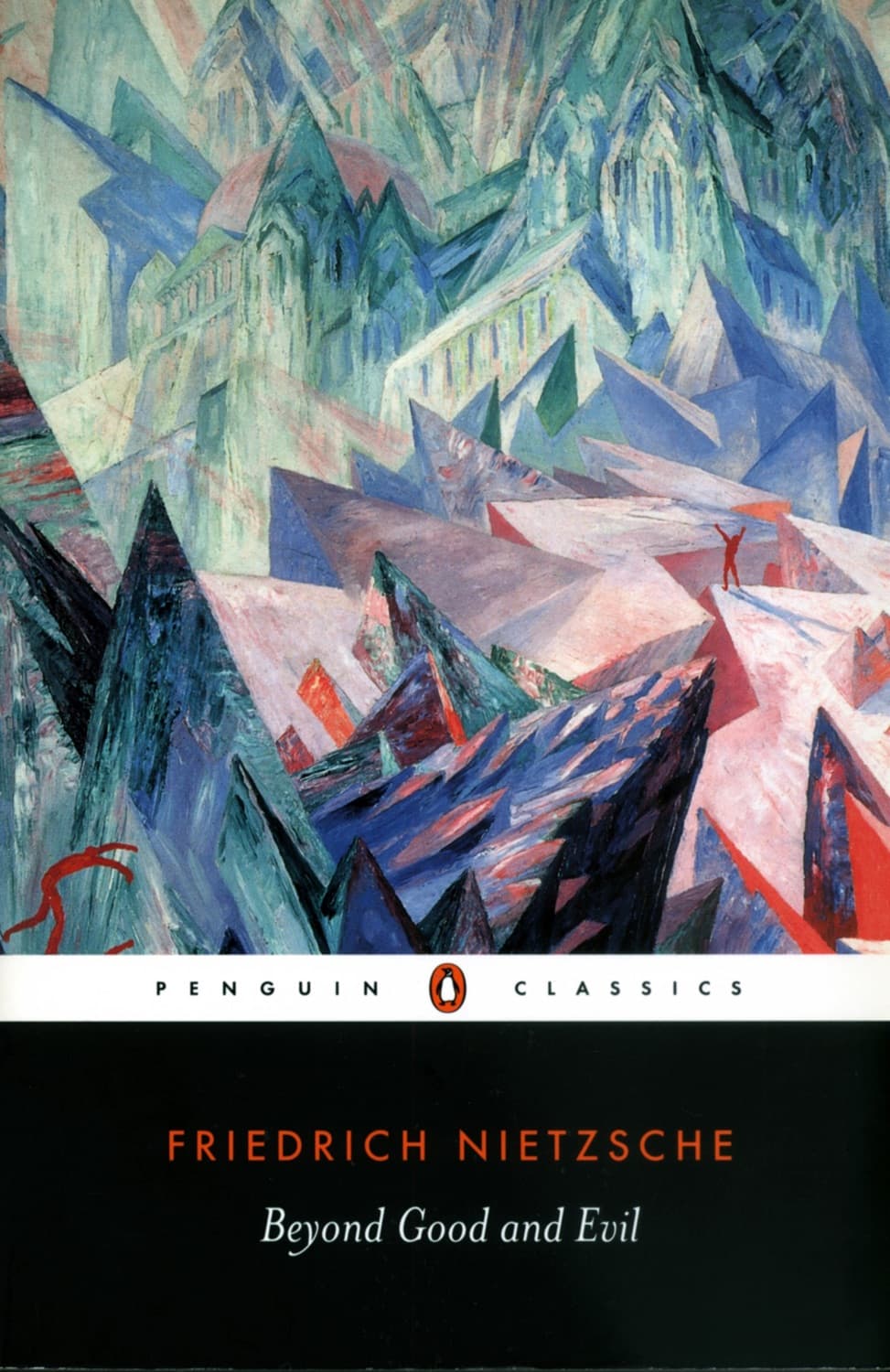
Beyond Good and Evil
Friedrich Nietzsche
Free download · 500+ book summaries
What is Beyond Good and Evil about?
Beyond Good and Evil is Nietzsche's frontal assault on the comfortable certainties of Western philosophy and morality. Truth, free will, the soul, the idea that good and evil are fixed categories — he tears each apart, then builds something stranger and more honest. A bracing read for anyone who suspects the conventional moral story doesn't quite hold and wants the language to say why.
Key ideas of Beyond Good and Evil
Philosophy as Disguised Advocacy
Philosophers have always been lawyers defending a pre-reached verdict, baptizing personal drives and prejudices as objective truths.
Will to Power as Life's Core Drive
The fundamental force in all living things is not self-preservation but the discharge and overflow of energy into growth and creation.
Master and Slave Morality
Two distinct moral systems exist: one rooted in self-affirmation and the other built on resentment of the strong, rebranded as virtue.
Read an excerpt from the summary
Beyond Good and Evil — summary
The Most Dangerous Book in Your Hands
In 1889, a forty-four-year-old man collapsed in a street in Turin, weeping, his arms thrown around the neck of a horse that had just been beaten by its driver. He was carried back to his boarding house and never recovered his mind. The man was Friedrich Nietzsche, and by then the book we are about to explore had been sitting in near-complete obscurity for three years, almost entirely ignored. Within a decade of that breakdown, his books would be on the nightstands of artists, generals, novelists, and revolutionaries across Europe. Within twenty years, people would be killing each other over misreadings of what he wrote.
That is the strange fate of *Beyond Good and Evil*: a book about how badly humans misread everything, itself catastrophically misread. Nietzsche wrote it in 1886 as a kind of prelude, a clearing of the ground, before saying something new about how human beings should think, live, and evaluate themselves. What he found when he looked closely at philosophy, religion, morality, and politics was that almost everything we are told is solid is actually a costume. Underneath every "truth" is a drive. Underneath every "virtue" is a strategy. Underneath every "free thinker" is often someone deeply chained.
This summary will follow the book's own logic: first the demolition, then the construction. We will ask the same questions Nietzsche asks. What are philosophers actually doing when they philosophize? What is the will to power, and why does it show up everywhere from saints to scientists? What separates a genuinely free mind from someone who just calls themselves open-minded? And what does it actually mean to live beyond good and evil: not as a villain, but as something rarer and harder?
Like it?
Continue in the appWho is it for?
- Anyone who suspects that their most cherished values were inherited rather than genuinely chosen.
- Anyone who wants a rigorous framework for tracing the hidden drives beneath ideas, beliefs, and moral systems.
- Anyone drawn to the history of Western philosophy and religion and willing to have comfortable assumptions challenged.
- Anyone interested in what intellectual honesty and genuine independence of mind actually demand in practice.
About the author: Friedrich Nietzsche
Friedrich Nietzsche (1844-1900) was a German philosopher, classical philologist, and cultural critic whose work upended the foundations of Western moral and philosophical thought. He held a professorship at the University of Basel before poor health forced his resignation, and he spent his later productive years writing in relative obscurity across Europe.
He published Beyond Good and Evil in 1886, one of his most systematic works, alongside The Gay Science, On the Genealogy of Morality, and Thus Spoke Zarathustra. His ideas gained enormous influence only after his mental collapse in 1889 and his death in 1900, shaping philosophy, literature, psychology, and political thought throughout the twentieth century.
Read it in 48 minutes
The summary of Beyond Good and Evil and 500+ more books await in the BookBase app.