 English
 Magyar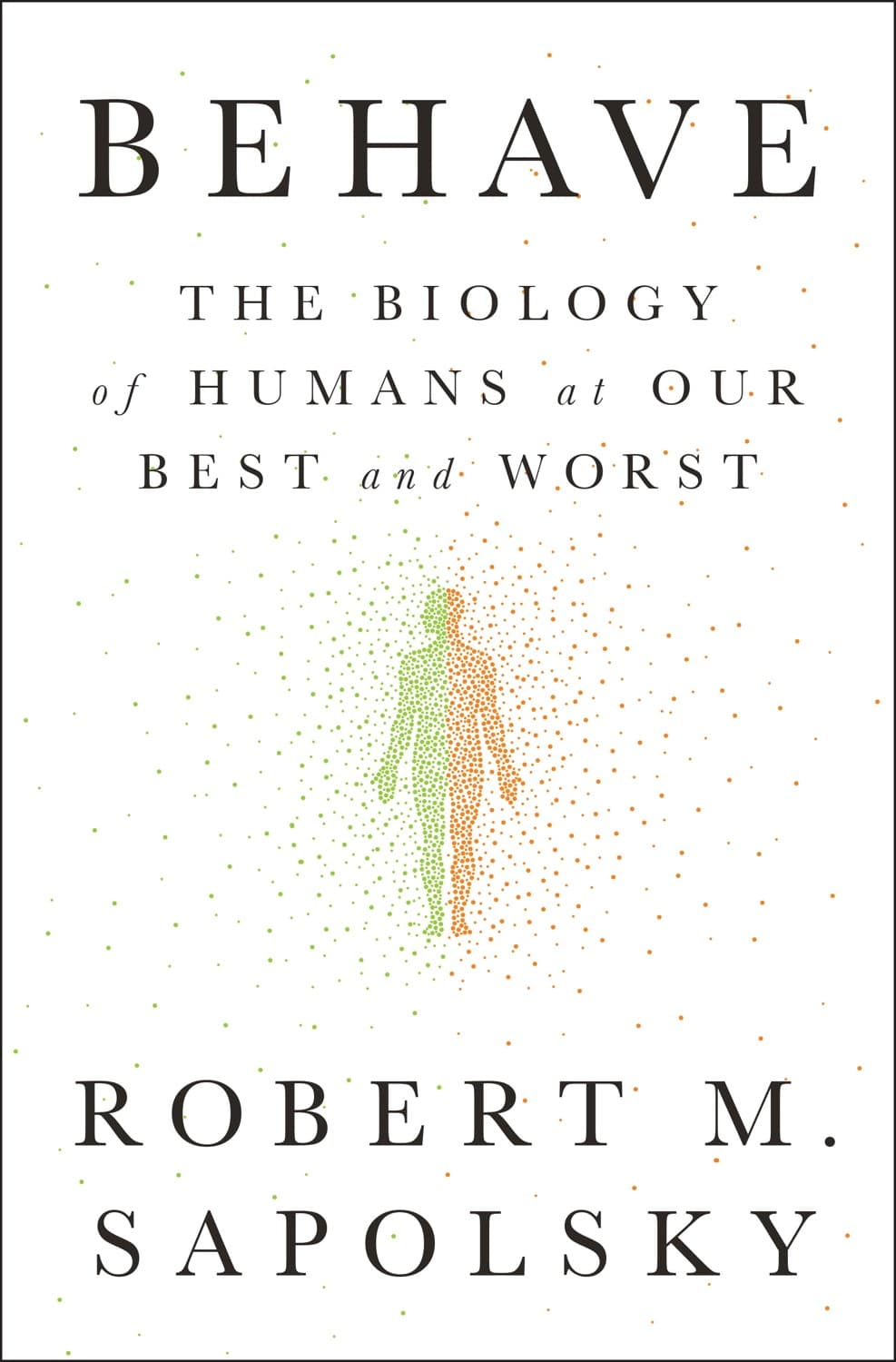
Behave
Robert Sapolsky
Free download · 500+ book summaries
What is Behave about?
Why do humans do what we do? Stanford neuroscientist Robert Sapolsky maps the biology of human behavior across every timescale, from the millisecond before an action to the millennia of evolution. A sweeping, witty exploration of hormones, brains, genes, and culture that shows why our worst and best moments are never as simple as they seem.
Key ideas of Behave
Biology Shapes Behavior
Every human action traces back through hormones, brain development, genes, and culture, with no single cause sufficient on its own.
Amygdala Versus Prefrontal Cortex
The amygdala drives instant threat responses while the prefrontal cortex provides deliberate control, and the balance between them determines our best and worst acts.
Situation Overrides Character
Context, group dynamics, and environmental conditions reliably push ordinary people toward heroism or atrocity, often overriding individual character and intention.
Read an excerpt from the summary
Behave: The Biology of Humans at Our Best and Worst
It is Christmas morning, 1914. The Western Front. Somewhere between the British trenches at Ploegsteert Wood and the German lines opposite, a young German soldier climbs out of his foxhole holding not a rifle but a small lantern. He walks into no man's land. A British soldier watches him from the parapet, finger still on the trigger. Then a second German emerges. And a third. And then, improbably, a British private stands up too. Within an hour, men who had been killing each other for four months are trading schnapps and cigarettes in a frozen field. They bury their dead together. Some play football in the mud. By nightfall they are back in their trenches, and within days most of them are shooting again.
Robert Sapolsky, neuroendocrinologist at Stanford, has spent a career asking why. Not why the truce happened, and not why the killing resumed -- but how a single human nervous system can produce both behaviors, sometimes within the same hour. The Christmas truce of 1914 is the kind of event that breaks every simple story about human nature. It fits neither the story that says we are fundamentally savage, nor the story that says we are fundamentally kind. It says instead that context does almost everything. That the distance between heroism and atrocity can be a matter of seconds, of who is standing next to you, of which brain region fires first.
Behave, published in 2017, is Sapolsky's attempt to explain the full chain of causation behind a single human act -- specifically, the act of one person doing something to another person, whether beautiful or terrible. The book runs to nearly eight hundred pages because Sapolsky refuses to accept short answers. Every time you think you have found the cause, he rewinds the tape further back. The neuroscience explains the brain at the moment of action. But the hormones explain the brain. And the developmental history explains the hormones. And the evolutionary pressures explain the developmental program. Pull on any thread and the whole tapestry unrolls.
Like it?
Continue in the appWho is it for?
- Anyone who wants to understand why good people do terrible things under social pressure.
- Anyone who is curious about how hormones, stress, and brain structure quietly shape everyday decisions.
- Anyone who works in policy, law, or education and wants a rigorous biological grounding for thinking about punishment and reform.
- Anyone who has wondered whether human nature is fundamentally violent, cooperative, or something far more complicated than either.
About the author: Robert Sapolsky
Robert Sapolsky is a professor of biology, neurology, and neurosurgery at Stanford University, where he has taught for decades. He is also a research associate with the Institute of Primate Research at the National Museums of Kenya, and has spent much of his career studying wild baboon populations in the Masai Mara.
He is known for translating dense neuroscience and behavioral biology into writing accessible to general readers. His earlier books include "Why Zebras Don't Get Ulcers," a widely read account of stress and health, and "A Primate's Memoir," drawn from his fieldwork in Kenya.
Read it in 47 minutes
The summary of Behave and 500+ more books await in the BookBase app.