 English
 Magyar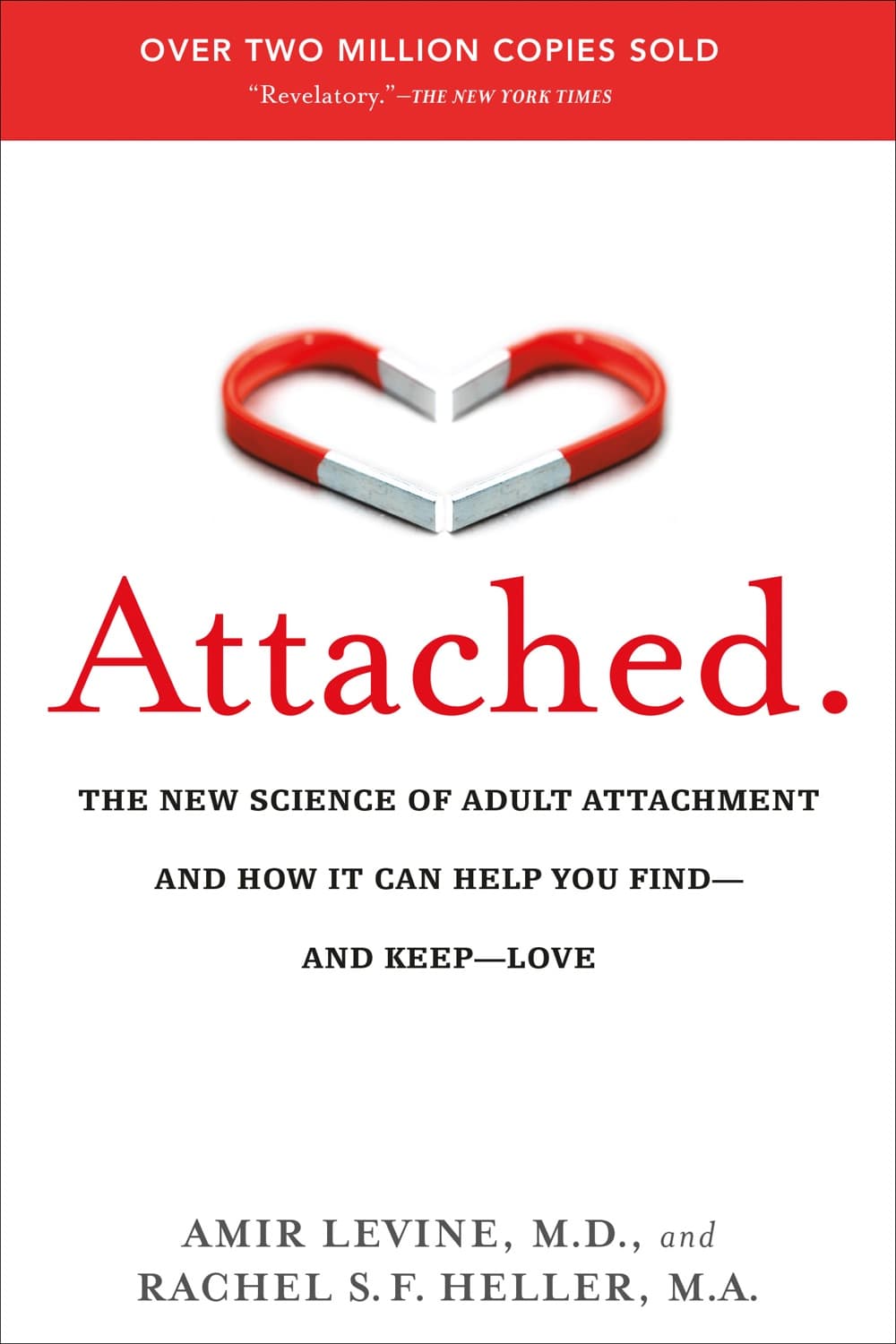
Attached
Amir Levine
Free download · 500+ book summaries
What is Attached about?
The science of adult attachment. Psychiatrist Amir Levine and Rachel Heller explain why some people seem effortlessly secure in love and others swing between anxious and avoidant. A research-backed framework for understanding your patterns and building relationships that actually work. The book that put attachment theory in mainstream relationship advice.
Key ideas of Attached
Three Attachment Styles
Adults fall into secure, anxious, or avoidant patterns rooted in biology, and those patterns shape nearly every behavior in close relationships.
Dependency Is a Strength
Relying on a trusted partner lowers stress and threat responses in the brain, making people more capable and adventurous, not less.
The Anxious-Avoidant Trap
Anxious and avoidant partners pull in opposite directions, creating a self-reinforcing cycle of protest and withdrawal that erodes the relationship over time.
Read an excerpt from the summary
Attached
*Amir Levine & Rachel Heller*
Karen and Tim are competing in a reality TV race. The cameras are rolling, the pressure is mounting, and they are standing at the edge of a difficult challenge. Karen reaches toward Tim, wanting to hold his hand -- the way humans have reached for each other since the beginning, when something big and frightening stands right in front of them. Tim pulls back. "Focus," he says quietly, and Karen returns her hands to her lap.
They lose the race.
Afterward, on camera, Karen reflects with a quiet kind of shame. "I think I ruined it," she says. "I was too needy. I asked for too much." She blames herself the way people do when they have absorbed a particular cultural lesson so completely that it has become invisible: the lesson that needing someone is weakness. That reaching out is a burden. That the strong, self-possessed person stands alone.
Amir Levine, a psychiatrist and neuroscientist, and Rachel Heller, a psychologist, begin their book with Karen and Tim for a very specific reason. Because Karen was not the problem. What happened in that moment was not a character flaw or a childhood wound expressing itself on national television. It was biology. Karen's brain, under stress, did exactly what human brains are designed to do: it sought proximity to her attachment figure. Tim's withdrawal was the problem. More precisely, their mismatch was the problem. And the culture that taught Karen to call herself needy was the biggest problem of all.
Attached is not a soft book. It does not offer reassurances or platitudes about love conquering all. It offers something more useful: a framework, rigorously grounded in decades of research, that explains why people behave the way they do in relationships -- and what to do about it. The science is real. The patterns are universal. And for most people who read it, the experience is something close to recognition: finally, a language for what has been happening all along.
Like it?
Continue in the appWho is it for?
- Anyone who repeatedly finds themselves in relationships that feel emotionally unavailable or exhausting.
- Anyone who wants a science-backed explanation for why they behave the way they do when a relationship feels uncertain.
- Anyone who is actively dating and wants to identify a compatible partner before investing months or years.
- Anyone who recognizes anxious or avoidant tendencies in themselves and wants practical tools to move toward greater security.
About the author: Amir Levine
Amir Levine is a psychiatrist and neuroscientist at Columbia University whose research focuses on how attachment biology shapes adult relationships. He co-wrote Attached with psychologist Rachel Heller to translate decades of academic attachment research into accessible, practical guidance.
The book draws on well-replicated findings from John Bowlby's original attachment theory, Mary Ainsworth's Strange Situation experiments, and subsequent adult-attachment research spanning more than forty years.
Read it in 49 minutes
The summary of Attached and 500+ more books await in the BookBase app.