 English
 Magyar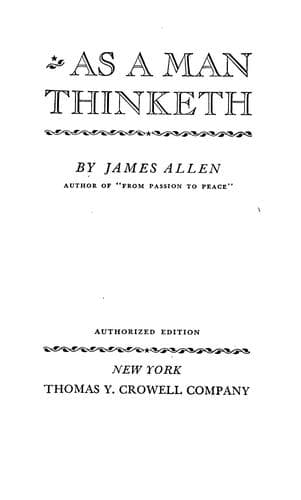
As a Man Thinketh
James Allen
Free download · 500+ book summaries
What is As a Man Thinketh about?
Your thoughts shape your character, your character shapes your circumstances, and your circumstances shape your life. James Allen's 1903 classic is a quiet meditation on the power of mind over destiny. Short enough to read in an hour, deep enough to return to for decades. The book that quietly influenced every modern self-help bestseller.
Key ideas of As a Man Thinketh
Mind Shapes Character
The thoughts you habitually entertain build your character, and your character determines the quality of your actions and choices over time.
Purpose Over Idle Wishing
A clear, committed central aim directs mental energy into disciplined action, producing results that vague desires and daydreaming never can.
Serenity Through Inner Work
Lasting calm is not a gift from favorable circumstances but a skill earned by long, deliberate practice in managing your own mind.
Read an excerpt from the summary
As a Man Thinketh
In the winter of 1879, a fifteen-year-old boy in Leicester, England received news that his father was dead. William Allen had traveled alone to New York to find work after the textile trade collapsed. Within two days of landing he was found at a city hospital, robbed and killed. James Allen -- the eldest son -- left school the next morning and found a factory job. The family needed money. The family needed him to stop being a child.
He would spend the next twenty-three years in offices and factories, working as a knitter's assistant, then a manufacturer's secretary, then a private secretary to businessmen who gave orders and never once asked about the books he was reading on lunch breaks. He read everything: the Bhagavad Gita, Buddhist scripture, Tolstoy, Emerson, the Bible. He read with the focused desperation of someone who suspects that the way out of a life is through a different set of ideas about what a life is for.
What Allen was looking for, across all that reading, was a principle of causation that he could trust. Not fate. Not class. Not the accident of birth or the violence that had taken his father. He wanted a principle that placed the determinative factor inside the person rather than outside. The Eastern texts gave him karma -- the moral law of action and consequence. Emerson gave him the over-soul, the correspondence between inner and outer. Tolstoy gave him the example of a man who had rejected wealth and status in favor of something harder to name: integrity with his own convictions. Allen synthesized all of this into a position that was functionally his own: the mind is the prime mover, and everything else follows from it.
Like it?
Continue in the appWho is it for?
- Anyone who wants to understand how habitual thinking shapes long-term outcomes.
- Anyone who feels buffeted by circumstances and wants to reclaim a sense of agency.
- Anyone drawn to the philosophical roots behind modern self-help and positive thinking culture.
- Anyone looking for a short, serious read on character, purpose, and mental discipline.
About the author: James Allen
James Allen (1864-1912) was a British philosophical writer who spent his early years working in factories and offices in Leicester, England, reading voraciously on his lunch breaks. He drew on Eastern philosophy, Emerson's transcendentalism, and Stoic thought to develop a personal framework centered on the power of the mind over circumstance.
In 1902 he left office work and moved with his family to a cottage in Ilfracombe, Devon, where he gardened, meditated, and wrote before dawn each day. He produced nineteen books in nine years before dying of tuberculosis at forty-seven. He died largely obscure, his wife Lily pushed him to publish "As a Man Thinketh," which he considered minor work, and it became one of the most influential short books of the twentieth century.
Read it in 46 minutes
The summary of As a Man Thinketh and 500+ more books await in the BookBase app.