 English
 Magyar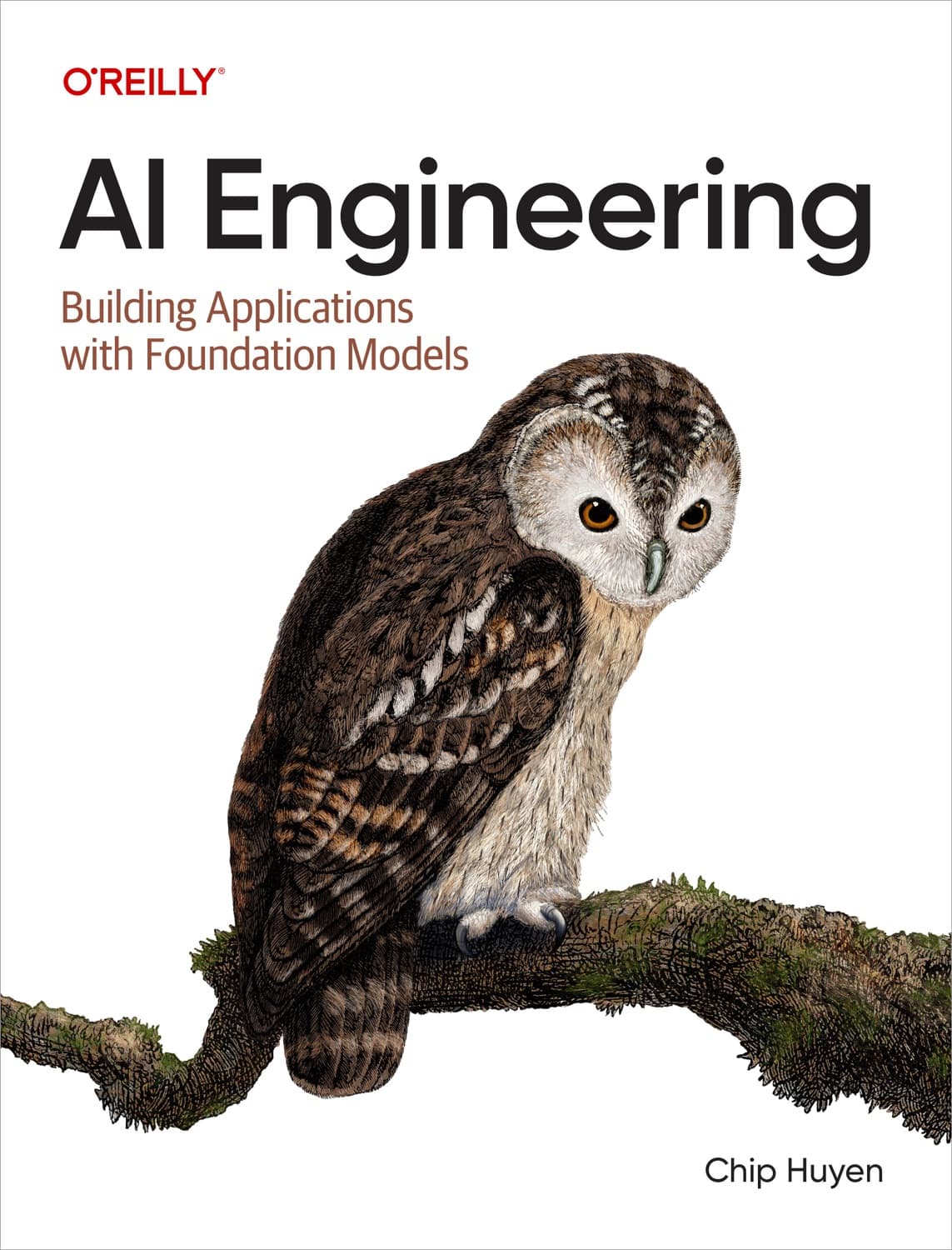
AI Engineering
Chip Huyen
Free download · 500+ book summaries
What is AI Engineering about?
Building an impressive demo takes hours; building a reliable product takes months. This book skips the theory of training models from scratch and focuses on how to take an existing AI model and turn it into something that actually solves a real problem, consistently. You'll learn how to measure whether your system truly works, why those final improvements take disproportionate time, and why your real advantage won't be the model: it will be your data.
Key ideas of AI Engineering
Evaluation Is the Real Bottleneck
Measuring whether an AI system actually works is harder than building it, and most teams handle this step the most carelessly.
Data Beats Model Advantage
Your users' behavioral data is the moat competitors cannot cross, because the underlying models are available to everyone.
The Demo-to-Product Gap
Getting a system to sixty percent quality takes hours, but the final forty percent takes months and is where most AI products fail.
Read an excerpt from the summary
AI Engineering: Summary
The magic that takes five minutes, and the product that never ships
Picture this. You sit down at your computer on a Saturday afternoon, type three sentences into a chatbot, and ten minutes later something is staring back at you that five years ago would have taken an engineering team half a year to build. It works. It is genuinely impressive. You show your friends, and everyone says the same thing: ship this, you could get rich off it. So you set out to turn it into a real product. And that is when the nightmare begins.
Chip Huyen, who taught machine learning at Stanford and worked at NVIDIA and Snorkel AI, wrote an entire book about exactly this split. She interviewed more than a hundred engineers from OpenAI, Google, and Anthropic, and studied over two hundred public AI applications. Her conclusion fits in a single sentence, and it is worth taping to your wall: it is easy to build a cool demo with foundation models, but it is hard to create a profitable product. The gap between the two is not a technical footnote. The gap is the entire job.
This book is not about how to train a model from scratch. It is about how you take a finished, gigantic language model that other people built and turn it into something that actually solves a real person's problem, reliably, day after day. When a good instruction is enough, and when you need more. How you measure whether your machine is genuinely doing good work, or only sounds like it. And why your competitive edge will come from the place you would least expect: not the model, but the data your own users leave behind.
Like it?
Continue in the appWho is it for?
- Anyone who wants to ship a reliable AI product and not just an impressive demo.
- Anyone who manages or builds software teams now expected to integrate large language models.
- Anyone who wants to understand prompt engineering, retrieval-augmented generation, and finetuning well enough to choose between them.
- Anyone who needs to make a business case for AI investment and wants realistic expectations about cost and timelines.
About the author: Chip Huyen
Chip Huyen is a machine learning engineer and writer who taught ML systems at Stanford University. She has worked at NVIDIA and Snorkel AI, and is known for making complex ML infrastructure topics accessible to a broad engineering audience.
She is also the author of Designing Machine Learning Systems, which covers traditional ML pipelines. AI Engineering extends that work into the era of large foundation models, drawing on interviews with engineers from OpenAI, Google, Anthropic, and over two hundred public AI applications.
Read it in 50 minutes
The summary of AI Engineering and 500+ more books await in the BookBase app.