 English
 Magyar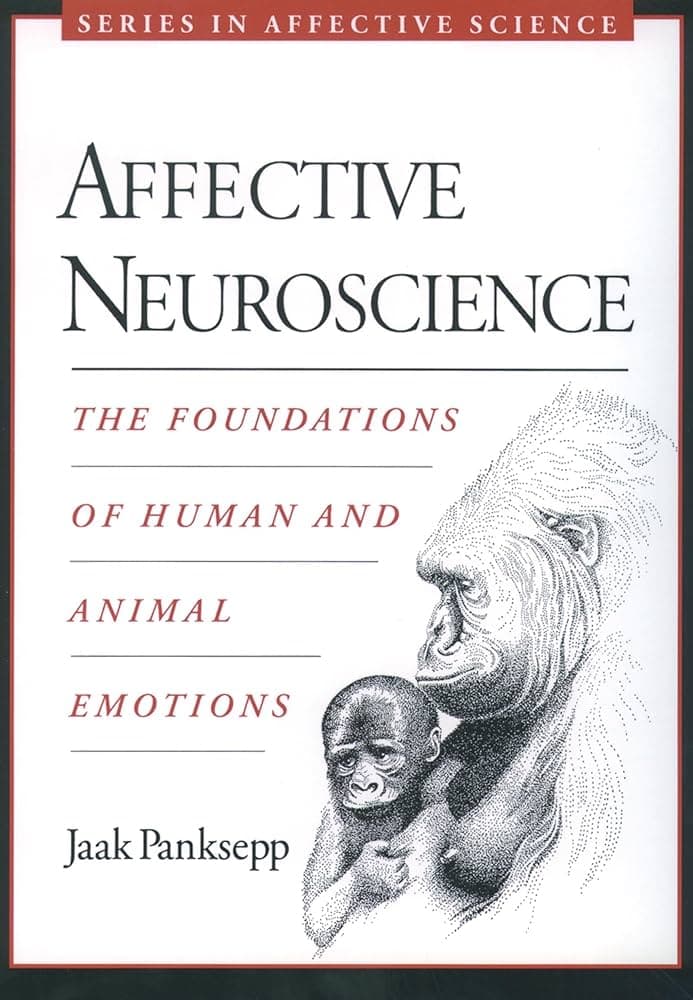
Affective Neuroscience
Jaak Panksepp
Free download · 500+ book summaries
What is Affective Neuroscience about?
In this groundbreaking book, Panksepp combines rigorous scientific research with profound insights to unravel its mysteries. He then explores how brain systems generate human behavior and the emotions that shape experiences.
Key ideas of Affective Neuroscience
Seven Primary Emotional Systems
Panksepp maps seven conserved brain circuits, SEEKING, FEAR, RAGE, PANIC, LUST, CARE, and PLAY, each with distinct neurochemistry and behavioral outputs shared across all mammals.
Subcortical Origins of Feeling
Emotions are generated by ancient brain structures beneath the cortex, not constructed by it, meaning raw felt experience does not require language, thought, or higher consciousness.
SEEKING as the Engine of Mind
The dopamine-driven SEEKING circuit powers curiosity, motivation, and drive, and its dysregulation explains depression, addiction, and mania better than symptom-based diagnostic categories.
Read an excerpt from the summary
The Laughing Rats
In a windowless lab at Bowling Green State University sometime in the mid-1990s, a serious neuroscientist named Jaak Panksepp was flipping young rats onto their backs and tickling their bellies with his fingertips. He had a microphone running, but not the kind you would use to record speech. This one was tuned to fifty kilohertz, far above the range of human hearing. What he caught on tape was something most of his colleagues would have called impossible. The rats were chirping. Not squeaking in distress, not vocalizing for some social signal he could trace to mating or alarm. Chirping in a specific, repeatable pattern that lit up the same brain regions linked to joy in humans. The rats, Panksepp eventually said out loud, were laughing.
That sentence cost him. It got him quietly mocked at conferences, blocked from a few journals, and treated for years as the slightly eccentric uncle of modern neuroscience. But it also turned out to be the most concise way to summarize the argument of his 1998 textbook, "Affective Neuroscience," a book that has slowly become one of the foundational works on how brains feel. The argument runs like this. Emotions are not stories your cortex makes up after the fact. They are not cultural inventions, not labels you apply to bodily commotion, not the residue of childhood. They are ancient neural circuits, conserved across every mammal, sitting beneath the cortex in machinery older than language, older than thought, older even than the cleverness needed to recognize your own mother. And once you accept that, a rat tickled in the belly is not a metaphor for joy. It is joy, in the only sense the word ever meant anything.
Like it?
Continue in the appWho is it for?
- Anyone who wants to understand where emotions actually come from in the brain rather than just how they feel.
- Anyone who is curious about the neuroscience of depression, addiction, anxiety, or trauma and wants a systems-level explanation.
- Anyone who works with or studies animals and wants a rigorous scientific argument for mammalian sentience.
- Anyone drawn to the deep history of neuroscience and how the field moved beyond behaviorism to take inner life seriously.
About the author: Jaak Panksepp
Jaak Panksepp (1943-2017) was an Estonian-American neuroscientist who spent decades at Bowling Green State University and later Washington State University studying the emotional brain. He coined the term affective neuroscience and dedicated much of his career to demonstrating that primary emotional systems are biological circuits shared across all mammals, not cultural constructs.
He is best known for his discovery of rat laughter and his taxonomy of seven primary emotional systems. His work was controversial during much of his lifetime but has gained wide recognition as neuroscience has caught up with his core arguments about the subcortical origins of felt experience.
Read it in 44 minutes
The summary of Affective Neuroscience and 500+ more books await in the BookBase app.