 English
 Magyar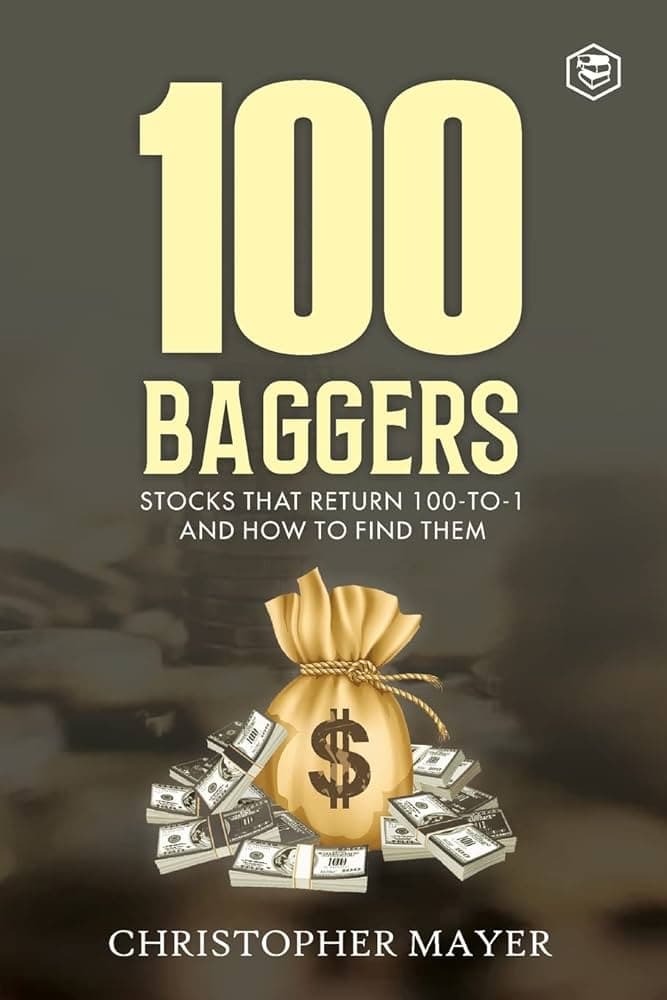
100 Baggers
Christopher Mayer
Free download · 500+ book summaries
What is 100 Baggers about?
From 100 Baggers, you will learn how to find and hold onto stocks that will grow 100 times their value over time.
Key ideas of 100 Baggers
Patience as the Core Edge
Most investors sell long before the final doublings arrive, and those last doublings are where nearly all of a 100-bagger's wealth is actually created.
Twin Engines of Price Growth
Every great 100-bagger combines rising earnings per share with an expanding valuation multiple, and a reasonable starting price lets both engines work in your favor.
Owner-Operators and Moats
Founders with personal wealth tied to the stock and businesses with durable competitive advantages are the most common traits among history's biggest stock winners.
Read an excerpt from the summary
A hundred-to-one. One dollar turns into a hundred. Ten thousand turns into a million. That is the kind of return Christopher Mayer set out to study when he sat down with a database of every U.S. stock that traded between 1962 and 2014. He found three hundred and sixty-five of them — companies whose share prices multiplied by a hundred or more — and spent the rest of the book trying to figure out what they had in common, what an ordinary investor could have noticed in advance, and why almost nobody who owned them stayed long enough to actually collect the money.
The math alone is worth a minute. A stock compounding at twenty percent a year becomes a 100-bagger in roughly twenty-five years. At fourteen percent it takes a little over thirty-five. At ten percent it takes nearly fifty. So the door is open: a steady, unglamorous compounder held for a working lifetime gets you there. The catch is the lifetime part. The median time-to-100x in Mayer's study was sixteen years. Twenty was common. Thirty was not unusual. And if you sold somewhere in year twenty for a forty-bagger, you didn't get sixty percent of the prize — you got a fraction of it, because the last few doublings are where the real money is. Patience is the price of admission, and almost nobody pays it.
That is the book in a sentence: rare and patient. The work is figuring out the rare part well enough to deserve the patient part.
The Setup: Why a Book About 100-Baggers Even Makes Sense
Mayer is following in the footsteps of Thomas Phelps, whose 1972 book *100 to 1 in the Stock Market* did the same exercise for an earlier generation. Phelps was a financial writer at Barron's who got tired of chasing thirty and fifty percent winners and went looking for much bigger fish. Mayer's contribution is to redo the analysis with modern data, push the case studies forward into the smartphone era, and translate Phelps's old-fashioned advice into a framework that lines up with what investors like Warren Buffett, Charlie Munger, Chuck Akre, and Phil Fisher have been saying for decades.
Like it?
Continue in the appWho is it for?
- Anyone who wants to understand how ordinary stocks quietly compounded into life-changing fortunes over decades.
- Anyone who struggles to hold winning positions and keeps selling too early for the wrong reasons.
- Anyone who wants a practical framework for identifying small, high-quality growth companies before they become giants.
- Anyone who is tired of chasing short-term trades and wants a research-backed case for long-term buy-and-hold investing.
About the author: Christopher Mayer
Christopher Mayer is an investor and financial writer known for his focus on long-term, buy-and-hold equity investing. He spent years writing an investment newsletter before managing money professionally, and his work draws heavily on the traditions of Philip Fisher, Warren Buffett, and Thomas Phelps.
He is closely associated with the idea of finding compounding businesses early and holding them through volatility. 100 Baggers is his most widely read book and draws on a systematic study of every U.S. stock that returned 100 times or more between 1962 and 2014.
Read it in 44 minutes
The summary of 100 Baggers and 500+ more books await in the BookBase app.