Ch. 1free to read
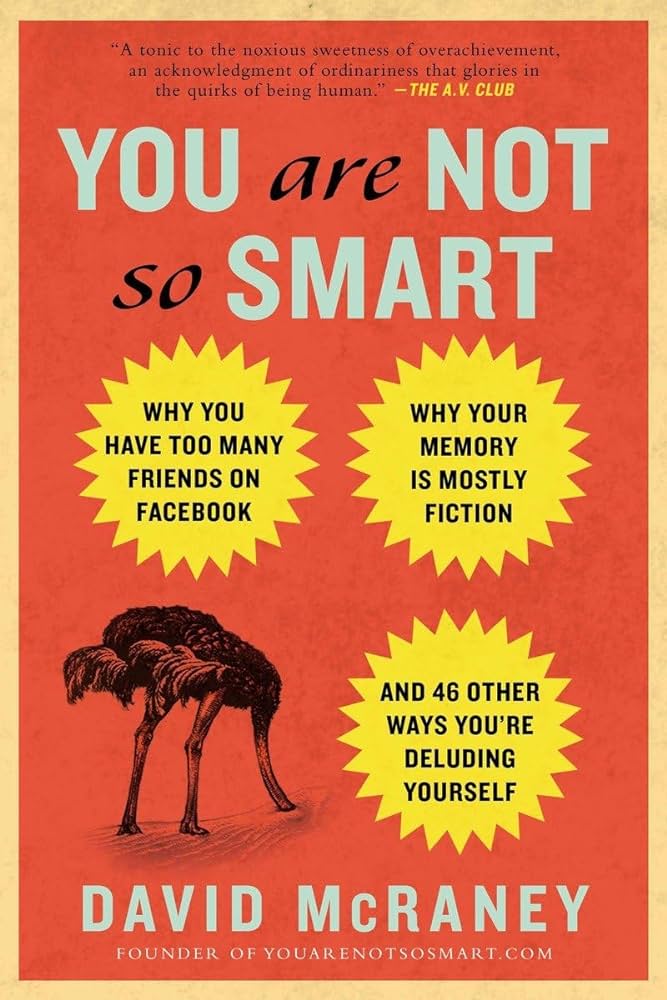
You are Not so Smart
What It’s About
A fun illumination of the silly beliefs that make us feel smart. Whether you're deciding which smartphone to buy or which politician to believe, you think you're a rational being whose every decision is based on loose, unbiased logic. But here's the truth: you're not that smart. You're just as deceived as everyone else—but that's okay because being deceived is part of being human.
Three Key Ideas
Systematic Self-Deception
Your brain fills in gaps, invents reasons, and edits memories without telling you, producing a smooth but partly fictional inner life.
Invisible Environmental Influence
Priming, anchors, and situational cues steer your behavior from below awareness, long before conscious reasoning begins.
Building Around Your Biases
You cannot overcome these tendencies by willpower alone, but you can design habits and environments that work with your wiring instead of against it.
Read a Sample
The Comforting Lie at the Center of Your Mind
Here is the misconception you carry around all day: you are a rational, logical person who sees the world as it really is. You weigh evidence. You reach conclusions. You know why you do what you do.
Here is the truth David McRaney spends an entire book proving. You are about as deluded as everyone else, and the only good news is that the delusion is what keeps you sane.
That is the whole argument in two sentences, and McRaney repeats the shape of it forty-eight times, once for every bias, shortcut, and broken piece of reasoning he examines. Each chapter opens with a misconception, the flattering thing you believe about yourself, and then knocks it over with the truth, the unflattering thing the research keeps finding. The book grew out of a blog, and it reads like one in the best way: forty-eight short, sharp essays, each one a small mugging of your self-image.
Start with a card trick that isn't a trick. Psychologist Peter Wason laid out four cards. Each has a number on one face and a color on the other. You see a three, an eight, a red card, and a brown card. The rule to test is simple: if a card shows an even number, the opposite side must be red. Which cards do you have to flip? Most people say the eight, and maybe the red one. Fewer than one in ten get it right. You need to flip the eight and the brown card, because a brown card hiding an even number would break the rule, while the red card can't break anything no matter what it hides.
Who It’s For
- Anyone who wants to understand why smart people consistently make predictable, avoidable mistakes.
- Anyone who has ever wondered why their best intentions rarely survive contact with the actual day.
- Anyone interested in psychology, behavioral economics, or the science of how decisions really get made.
- Anyone who wants practical strategies for outsmarting their own impulses rather than just feeling bad about them.
About the Author: David McRaney
David McRaney is an American journalist and science communicator who built a large audience with his blog "You Are Not So Smart," which explored cognitive biases and self-delusion. He later expanded it into this book and a podcast of the same name.
McRaney is not a research psychologist but a skilled translator of academic findings for general readers. His strength is making the experimental literature feel immediate and personally relevant through vivid storytelling.