Ch. 1free to read
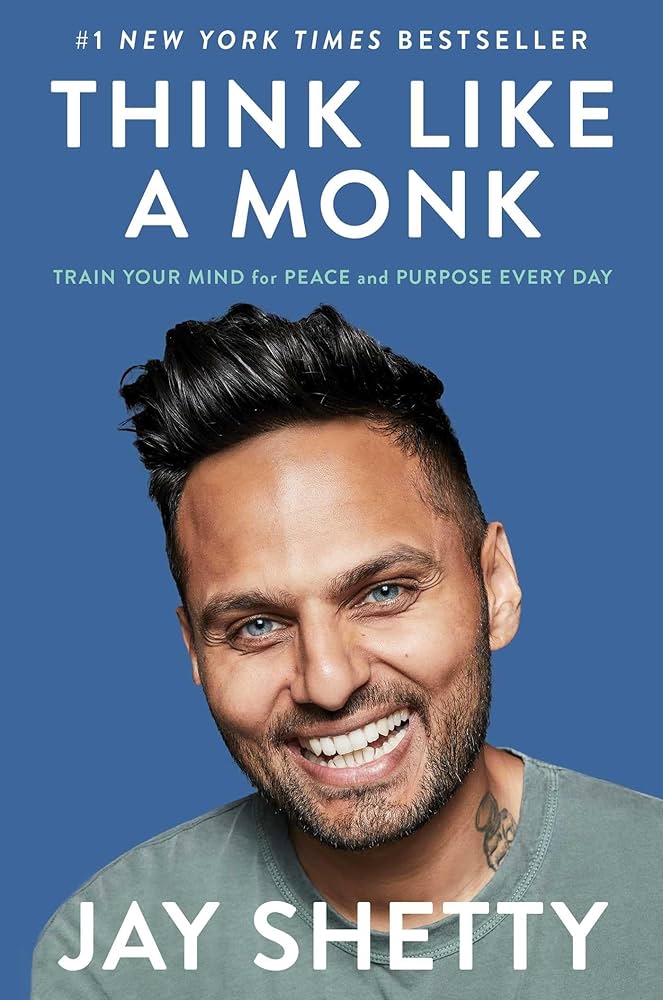
Think Like a Monk
What It’s About
Jay Shetty, a social media superstar and host of the #1 podcast On Purpose, distills the timeless wisdom he learned as a monk into practical steps that anyone can take every day to live a less anxious, more meaningful life.
Three Key Ideas
Values Over Borrowed Identity
True identity emerges only after stripping away the opinions, expectations, and obligations others project onto you.
Dharma as Purpose
Your dharma is the overlap of passion, expertise, and usefulness, and it guides you toward work that feels alive rather than draining.
Trained Mind, Calmer Life
The mind is not fixed, daily practices like breathwork, gratitude, and single-tasking gradually rewire reactive patterns into deliberate ones.
Read a Sample
A Monk Walks Into a Business School
In 2002, a Tibetan monk named Yongey Mingyur Rinpoche sat in a lab at the University of Wisconsin-Madison with more than two hundred electrodes glued to his scalp. The researchers asked him to begin a compassion meditation. Most people, even seasoned meditators, take time to warm up. The EEG output should have ramped slowly. Instead, the instruments registered a massive spike the instant Mingyur shifted attention, like flipping a switch. Shetty puts his lifetime practice at sixty-two thousand hours of meditation. More than ten years later, scans taken at forty-one showed his brain aging more slowly than his peers'; a 2020 study estimated it resembled a thirty-three-year-old's.
That experiment is the dare at the heart of Jay Shetty's *Think Like a Monk*. If a Tibetan monk can rewire his nervous system that decisively, can the rest of us, distracted and anxious and scrolling, borrow any of the technology? Shetty argues we can. He spent three years living in an ashram outside Mumbai, sleeping on a thin mat over a stone floor packed with cow dung, waking at four to chant. Then he came back to London with twenty-five thousand dollars of college debt and the idea that what he had learned was portable. The book is his attempt to make that portability concrete: not enlightenment, not robes, but a working manual for swapping a monkey mind for a monk mind.
It is worth saying up front what the book is and isn't. Shetty did not invent any of the ideas. They come from the Vedas, the Bhagavad Gita, Buddhist suttas, and modern psychology. Critics have flagged sloppy attribution and noted the irony of a teacher of detachment commanding six-figure speaking fees. Both points are fair. What Shetty does well is translate. He takes Sanskrit concepts that scare most Westerners off, words like dharma, sankalpa, and anartha, and lays them next to commuter problems, awkward family dinners, and the urge to check your phone before you have fully opened your eyes. Read in that spirit, it works.
Who It’s For
- Anyone who feels their daily routine is driven by anxiety rather than intention.
- Anyone who struggles to separate their own goals from the expectations of family or peers.
- Anyone who wants practical, science-backed techniques drawn from ancient contemplative traditions.
- Anyone who is searching for meaningful work and wonders whether they are in the right career.
About the Author: Jay Shetty
Jay Shetty is a British-Indian author, podcast host, and former monk. He spent three years living in an ashram near Mumbai before returning to the West to translate what he learned into accessible tools for modern life.
He hosts the podcast On Purpose, one of the most-listened-to interview shows on personal development, where he draws on Vedic philosophy, Buddhist thought, and contemporary psychology.