Ch. 1free to read
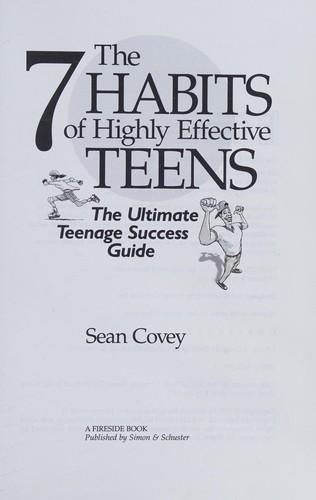
The 7 Habits of Highly Effective Teens
What It’s About
A practical guide for teenagers built on the principles that made Stephen R. Covey's classic a global phenomenon. Sean Covey turns the seven habits into language teens actually listen to: making smart choices, building friendships that last, and navigating school, family, and self-doubt. The handbook for becoming the kind of adult you want to be.
Three Key Ideas
Personal Bank Account
Self-confidence is built through small acts of personal integrity, kept promises, and honest choices that accumulate like deposits in an internal account.
Proactive Agency
Between any stimulus and your response is a space only you control, and consistently choosing to act within your circle of influence expands what you can change.
Urgency vs. Importance
The most valuable activities in a life rarely feel urgent, so protecting non-urgent but important work from constant displacement is the core discipline of effective time management.
Read a Sample
The 7 Habits of Highly Effective Teens
Sean Covey's "The 7 Habits of Highly Effective Teens" has sold more than eight million copies, been translated into over twenty languages, and been widely assigned in middle schools, high schools, and youth programs. It sits in a peculiar category: too earnest to be cool, too practical to be dismissed, too well-structured to be forgotten. Adults who read it at sixteen often describe it the same way: not as a book they loved at the time, but as a book whose ideas surfaced again and again over the following decades, unexpectedly, during a difficult negotiation, a friendship that fell apart, a goal they kept failing to start.
This summary is written for the adult looking back. For the professional in their thirties who wants to understand what that book actually contained, why it endured, and what it has to offer now that the adolescent urgency is gone and the real tests of character have begun.
The Son, the Framework, and the Gap He Tried to Fill
Sean Covey was born into a particular kind of intellectual inheritance. His father, Stephen R. Covey, published "The 7 Habits of Highly Effective People" in 1989, a book that became one of the best-selling nonfiction titles of the twentieth century, with over thirty million copies sold. Stephen's framework was already a fixture in corporate training programs, executive coaching, and graduate school curricula by the time Sean began thinking about adapting it. The question Sean asked was specific: what does this framework mean to someone who cannot yet vote, who is trying to survive cafeteria politics, whose most important decisions involve weekend plans and whether to tell the truth to a parent?
Who It’s For
- Anyone who feels swept along by daily urgency and wants a clearer framework for deciding what actually deserves their time.
- Anyone who tends to put others' needs first at the cost of their own goals and wants concrete language for healthier boundaries.
- Anyone who struggles to feel genuinely confident and wants to understand how self-respect is built through daily decisions rather than external validation.
- Anyone who wants to become a better listener and build relationships with more trust and less recurring conflict.
About the Author: Sean Covey
Sean Covey is the son of Stephen R. Covey, author of the bestselling "The 7 Habits of Highly Effective People." He played quarterback at Brigham Young University, earned an MBA from Harvard Business School, and went on to work at FranklinCovey, the organization built around his father's work, where he eventually served as President of FranklinCovey Education.
His adaptation of the seven habits for teenagers, first published in 1998, was not a simple rewrite. Covey added original concepts including the Personal Bank Account and the Relationship Bank Account, and addressed topics specific to adolescent life that the original had no reason to cover. The book has sold over eight million copies and been translated into more than twenty languages.