Ch. 1free to read
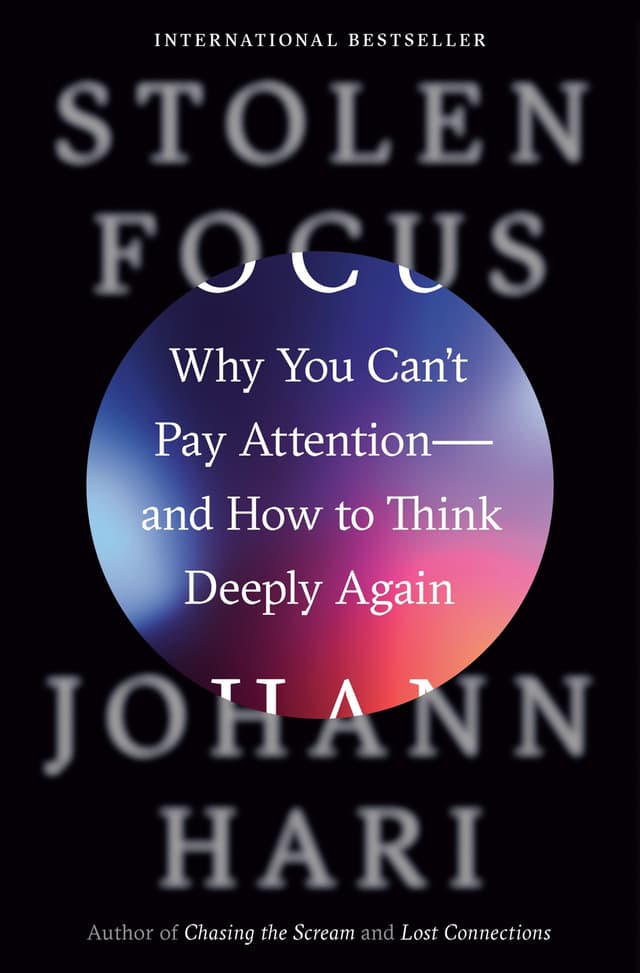
Stolen Focus
What It’s About
You live in a system designed to pour acid on your attention every single day, then tell you to blame yourself for it. After eight years of research, Johann Hari reveals that your crumbling focus isn't a personal failing but the result of twelve deep forces working against you. Learn what's actually stealing your attention and how to reclaim your mind from those engineering your distraction.
Three Key Ideas
Attention Is Designed to Fail
Technology platforms are deliberately built to fragment focus because your distraction generates their revenue, not because of any personal weakness.
Flow States Restore the Mind
Deep, uninterrupted engagement in meaningful work at the edge of your abilities rebuilds the focused attention that constant switching destroys.
Systemic Change, Not Willpower
Individual habits help modestly, but lasting recovery of attention requires collective action to change the economic incentives behind distraction.
Read a Sample
Stolen Focus: Summary
A boy who wanted Elvis, and then wanted nothing
There was once a little boy named Adam. When he was nine, only one thing on earth interested him: Elvis. He sang "Jailhouse Rock" in the living room and wanted to know everything about the King. Everything. His godfather, a journalist named Johann Hari, made him a promise that one day he'd take him to Graceland, Elvis's home. Ten years later, Adam had dropped out of school at fifteen and was spending almost every waking hour on his phone, bouncing back and forth between WhatsApp, YouTube and porn. He couldn't stick with a single topic of conversation for more than a few minutes. Hari grabbed the old promise like a lifeline, hoping it might pull the boy back.
When they got to Graceland, Hari noticed something strange. The tourists weren't looking at the house. They clutched tablets, earbuds in, and toured rooms that were an arm's length away by staring at a screen. In the Jungle Room, Elvis's favorite spot, a middle-aged couple swiped the iPad to switch between two camera angles instead of just turning their heads. Hari pointed out that there was an old-fashioned way to swipe, called turning your head, because we are HERE, physically, in this room. The couple backed away from him as if he were a lunatic. Hari turned to share the irony with Adam. Adam was standing in a corner, secretly checking Snapchat under his jacket.
And Adam isn't the only one. At the Louvre, Hari watched the crowd that now surrounds the Mona Lisa shove its way forward, only to turn its back right away and take a selfie. Nobody looked at the painting for more than a few seconds. The Mona Lisa's smile seems to ask: why won't you look at me the way you used to? Hari suggests the motto of our age could be this: I tried to live, but I got distracted.
Who It’s For
- Anyone who feels guilty about being unable to concentrate or finish a book.
- Anyone who wants to understand the business model behind social media addiction.
- Anyone curious about how sleep, diet, and childhood shape the ability to focus.
- Anyone interested in what policy changes could realistically reclaim public attention.
About the Author: Johann Hari
Johann Hari is a British journalist and author known for writing deeply researched books that challenge conventional wisdom about mental health, addiction, and society. He spent years traveling and interviewing scientists, designers, and policymakers to build each book's argument from primary sources.
Hari has written about depression, addiction, and now attention, consistently arguing that personal struggles are rooted in social and systemic conditions more than individual character.