Ch. 1free to read
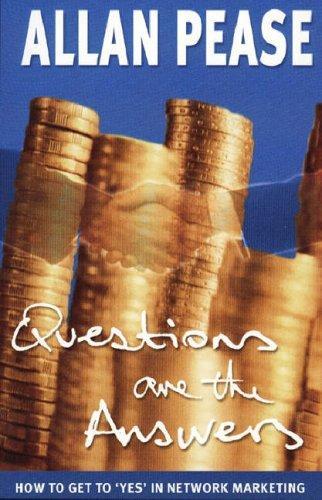
Questions Are the Answers
What It’s About
Why the right question changes the conversation. Body-language expert Allan Pease distills decades of sales and persuasion training into a simple system for getting what you want without pressure. Open questions, listening rituals, and the small verbal moves that turn cold prospects into committed yeses. Practical and refreshingly low on hype.
Three Key Ideas
The Five Solid Gold Questions
A fixed five-question sequence guides any person to articulate their own motivations, making self-persuasion far more effective than any external pitch.
Hot Button Discovery Before Pitching
Finding what the other person actually wants before presenting your offer prevents objections and ensures every benefit lands in their own words.
Silence and Listening as Technique
Staying quiet after each question is the core discipline, most persuasion fails because the speaker fills the space and removes the prospect's thinking room.
Read a Sample
Questions Are the Answers Allan Pease, 2000
A coffee shop in suburban Australia. Allan Pease bumps into his dentist, Frank. Frank is forty-four, owns a beachfront house and drives a luxury car, and he looks miserable. The two of them sit down, and Allan asks how business is going. Frank says, "It's a living, I suppose." Allan doesn't pitch him a network marketing business. He doesn't explain the compensation plan or list features and benefits. He asks one question, then another, then another. Within five minutes Frank is talking about the prison he feels dentistry has built around him and about his marriage straining under his stress. He talks about the kids who are growing up without him, because he gets home at seven too worn out to play. His face goes pale and his eyes water. He can't answer the last question because he's too overwhelmed to speak. Allan doesn't press. He gets up, says he was supposed to be buying cornflakes, and leaves.
Three months later, Frank quits his practice. A year after that, he's in America selling motels on commission and having the time of his life.
Pease didn't sell Frank anything. He just asked five questions, in order, and stopped talking. That's the whole premise of this book. You can't argue people into change, and you can't inspire them into it either. They'll only walk through a door they've described themselves. In any situation where you need to persuade, your job is to hand them the words for that door, then stay quiet long enough for them to find the handle.
The book comes inside a specific frame. Pease wrote it for the network marketing industry, the multi-level distribution model that exploded in the eighties and nineties on the back of vitamins, cleaning products, and home goods. Every example in it uses MLM language, and every transcript ends with the prospect joining the business. If that frame puts you off, push past it. The mechanics work in B2B sales calls, executive coaching, hiring conversations, partnership negotiations, parenting, dating, and any moment when you need another person to want what you're offering rather than merely put up with it. The dentist scene gives it away. Pease didn't even try to recruit Frank into network marketing. He simply showed the technique working in the wild, then watched a man's life rearrange itself around what the questions brought to the surface.
Who It’s For
- Anyone who wants to get better at sales, negotiation, or any conversation where they need someone else to commit to a change.
- Anyone who keeps losing deals or partnerships because their pitch is enthusiastic but the other side stays lukewarm.
- Anyone who manages people and wants their team to follow through rather than nod politely and ignore advice.
- Anyone who is curious about body language and rapport and wants practical moves they can use in the next meeting.
About the Author: Allan Pease
Allan Pease is an Australian author and speaker best known for his 1976 book on body language, which sold over four million copies in dozens of languages. He and his wife Barbara co-wrote Why Men Don't Listen and Women Can't Read Maps, one of the best-selling relationship books of its era.
Before body language made him famous, Pease built his career in sales. He sold door-to-door as a child, then moved into life insurance and became one of the youngest salespeople to qualify for the Million Dollar Round Table. That background in practical sales training, rather than academic research, shapes everything in this book.