Ch. 1free to read
Nexus
What It’s About
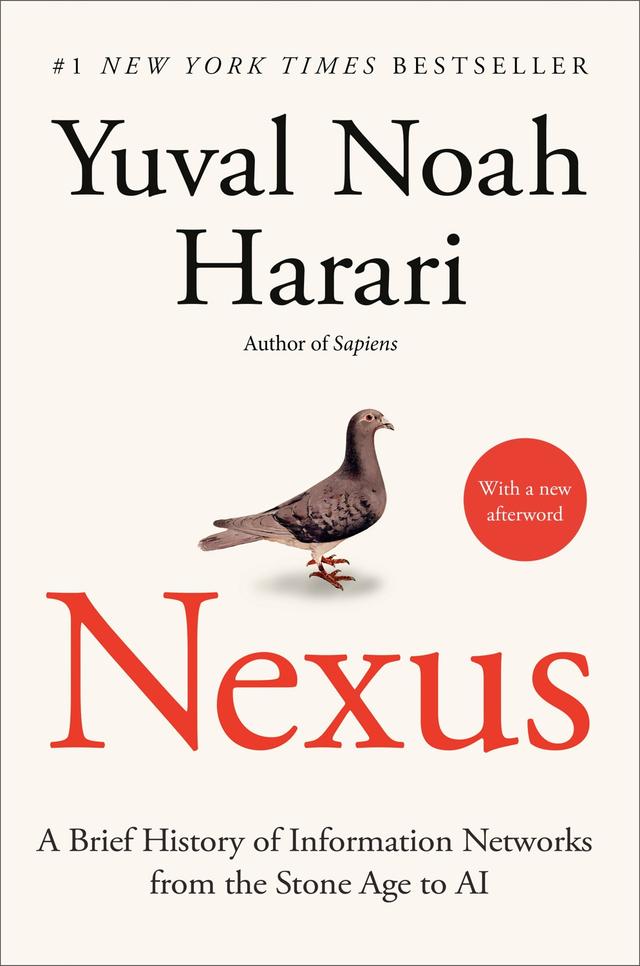
How information networks have shaped human civilization, from stone tablets to large language models. Yuval Noah Harari argues we built each new medium without understanding what we were unleashing, and the AI era is no different. A sweeping, unsettling look at the systems that decide what we believe and who holds power.
Three Key Ideas
Information Connects, Not Describes
The primary function of information across history has been to weave people into cooperative networks, not to deliver accurate pictures of reality.
Self-Correcting Mechanisms Are Fragile
Societies survive their own mistakes only when they build institutional feedback loops that let errors surface and get fixed without destroying the whole system.
AI as Unaccountable Agent
Unlike all previous media, AI algorithms make consequential decisions through opaque optimization processes that no single human designs, understands, or controls.
Read a Sample
Nexus
Yuval Noah Harari published Nexus in September 2024, and it opens with a deceptively simple question: what is information? Not what does it contain. Not whether it is true. Just: what is it, fundamentally, for? His answer overturns the assumption most people carry without examining it. We tend to believe that information is a description of reality. That good information brings us closer to the truth and bad information pulls us away. Harari calls this the naive view. It is flattering to our intelligence, and it is almost entirely wrong.
The real function of information, across the full span of human history, has never been primarily to describe reality. It has been to connect people. To weave individuals into networks. To make cooperation possible at scales that biology alone cannot support. A species that can share stories (stories about gods, nations, corporations, laws) can coordinate the behavior of millions of strangers who have never met and never will. The story does not need to be accurate. It needs to be shared. This is the network view of information, and once you adopt it, the history of humanity looks entirely different.
Nexus is the fourth of Harari's big-history books, following Sapiens, Homo Deus, and 21 Lessons for the 21st Century. It is his most focused and, in some ways, his most urgent. Sapiens asked how we got here. Homo Deus asked where we might be going. Nexus asks something more immediate: how do the information networks we build determine whether our societies can correct their own mistakes, and what happens when the most powerful network ever created cannot be corrected at all?
Who It’s For
- Anyone who wants to understand why democracies struggle to manage disinformation and algorithmic manipulation.
- Anyone who is curious about the deep historical patterns connecting ancient scripture, Soviet bureaucracy, and social media feeds.
- Anyone who works in technology policy, journalism, or civic institutions and needs a rigorous framework for thinking about AI governance.
- Anyone who felt unsettled by the role Facebook played in the Rohingya genocide and wants a structural explanation, not just a moral one.
About the Author: Yuval Noah Harari
Yuval Noah Harari is an Israeli historian and public intellectual best known for his sweeping big-history books that connect archaeology, evolutionary biology, economics, and philosophy into a single narrative arc. He teaches history at the Hebrew University of Jerusalem.
Nexus is his fourth major book for general audiences, following Sapiens, Homo Deus, and 21 Lessons for the 21st Century. He is one of the most widely read nonfiction authors of the past decade, with his books translated into dozens of languages.