Ch. 1free to read
Brave new world
What It’s About
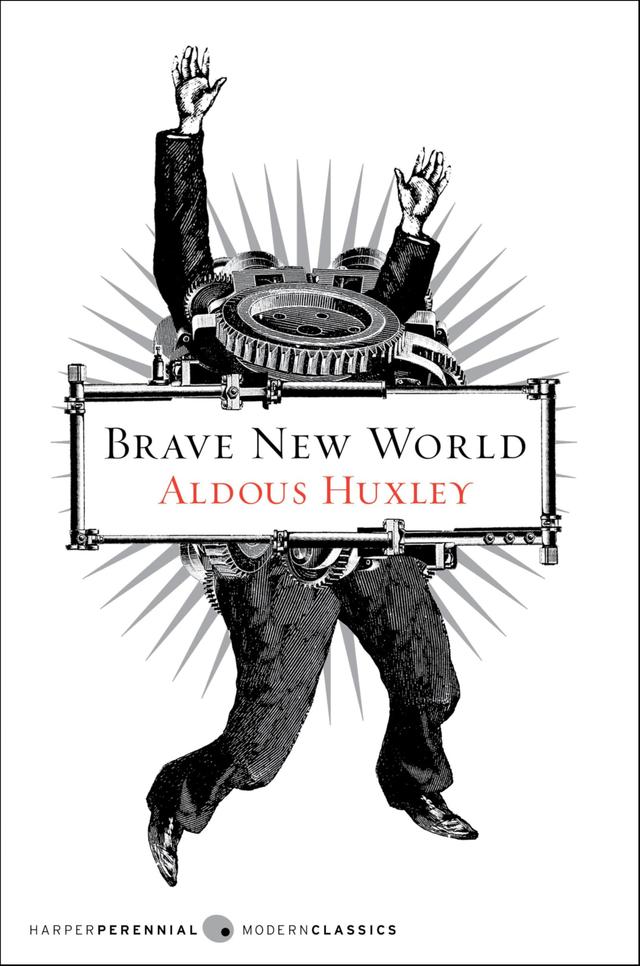
Brave New World, Aldous Huxley’s iconic literary work, paints a chilling picture of a dystopian future where genetic engineering, social indoctrination, and drug-induced sedation force people to passively sustain the authoritarian regime – sacrificing our freedom, humanity, and perhaps even our souls.
Three Key Ideas
Conditioning Replaces Freedom
The World State engineers citizens from birth through sleep-teaching and electric shocks, making obedience feel like personal desire.
Pleasure as Social Control
Soma, the State's distributed narcotic, eliminates grief, religion, and dissent by chemically replacing every reason to rebel.
The Right to Be Unhappy
John the Savage's demand to suffer, age, and feel is the novel's moral core, framing happiness-by-design as a betrayal of human dignity.
Read a Sample
The World That Loves Its Chains
Picture a regime so total it doesn't bother with prisons. It hands out free drugs instead. It abolishes mothers, manufactures babies in batches of ninety-six identical siblings, and whispers slogans into your ears while you sleep until you can't tell your own thoughts from the State's. No soldiers patrol the streets. There's no need. Everyone is too happy to rebel, and the few who aren't get sent to remote islands where they can be miserable in peace.
This is the future Aldous Huxley imagined in 1932, set six hundred years from his present, in the year of stability A.F. 632 — after Ford, the new messiah, whose Model T launched the assembly line and, by extension, the assembly-line human. Huxley wrote it as satire and as warning, and almost a century later the warning has aged in a way that should make us uncomfortable. Orwell's nightmare was a boot stamping on a human face forever. Huxley's was subtler and meaner: a face smiling because it had been taught from before birth that being stamped on felt good.
The book has no real protagonist for the first third. It opens, instead, with a tour of the factory where people are made. That choice tells you what the novel is about. Before any character can act, you have to see the conditions under which acting is no longer possible — the way pleasure, predestined and metered out, has eaten everything that used to make a person a person. What follows is the story of three misfits who notice the cage, and one outsider who breaks himself trying to live without it.
The Hatchery
Who It’s For
- Anyone who wonders whether comfort and freedom can coexist in a modern society.
- Anyone who wants to understand why Huxley's dystopia feels more relevant than Orwell's today.
- Anyone who is curious about how advertising, pharmaceuticals, and screens quietly shape desire.
- Anyone who enjoys classic literary fiction that doubles as sharp political philosophy.
About the Author: Aldous Huxley
Aldous Huxley (1894-1963) was a British novelist, essayist, and social critic best known for Brave New World and the philosophical memoir The Doors of Perception. He came from a family of prominent scientists and intellectuals, and his writing consistently explored the tension between scientific progress and humanist values.
Huxley spent much of his later life in California and became deeply interested in mysticism, consciousness, and the ethics of pharmacology. Brave New World, published in 1932, drew on his concern that technological efficiency and mass consumerism posed a subtler threat to human dignity than outright political tyranny.