Ch. 1free to read
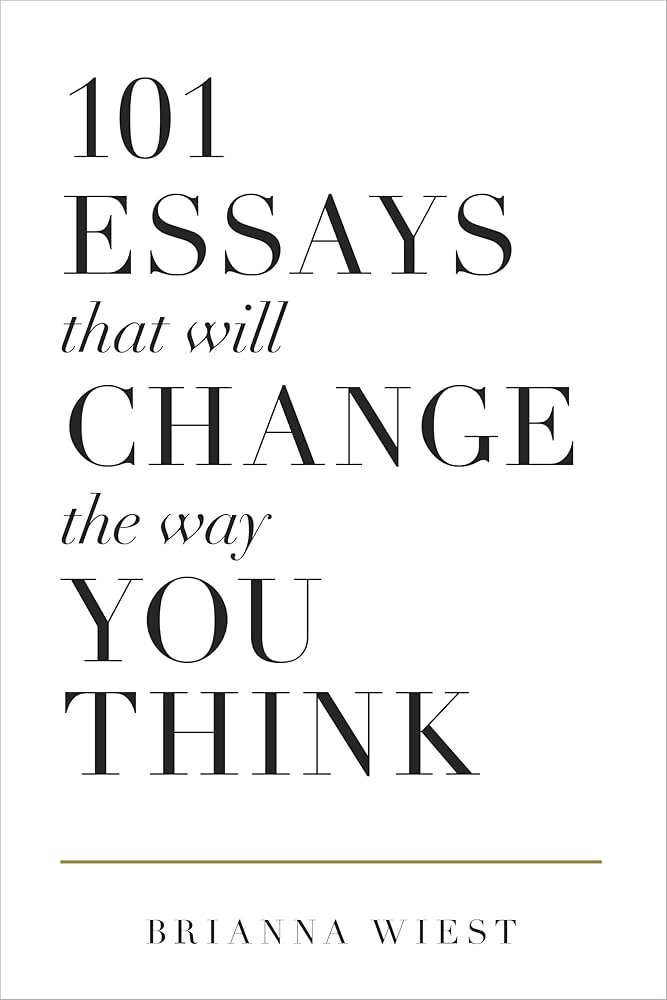
101 Essays that will change the way you think
What It’s About
101 Essays That Will Change the Way You Think is the antidote to anxiety, but not in the way you might think. Instead of setting up obstacles against your darkest feelings, it encourages you to use them as tools for personal growth. By mastering your thoughts, you will develop everyday habits that bring fulfillment.
Three Key Ideas
Thoughts shape your reality
Cognitive biases like extrapolation and naive realism filter every experience, and seeing those filters is the first step to changing your life.
Discomfort signals growth
Feelings of fear, anxiety, and emotional pain are usually messages pointing toward unfinished business, not signs you are on the wrong path.
Action precedes belief
You cannot think your way into a new life, because clarity and confidence only arrive after you begin acting, not before.
Read a Sample
The Argument Underneath the Aphorisms
Brianna Wiest's book wants you to stop trying to fix your life. That sounds like the opposite of a self-help promise, but it is the promise. Across 101 essays, most of them first published online and arranged here as a kind of cumulative argument, Wiest works toward one stubborn idea. What stands between you and the life you say you want isn't your circumstances. It's the way you think about them. Change that, and the rest follows. Refuse to change it, and no number of new jobs, new partners or new addresses will move the needle.
The idea isn't new. The Stoics held it, and cognitive behavioral therapy is built on it. Marcus Aurelius wrote, "The impediment to action advances action. What stands in the way becomes the way," and Wiest quotes him directly more than once. What she adds is volume and a fresh angle. She writes the way a friend texts you after two years of therapy, having read every book on the shelf, finally ready to tell you what she's figured out. The essays are short and the claims are aphoristic. The structure repeats itself on purpose. One of her core claims about how change works is that beliefs only shift when experience makes the new thinking self-evident. Reading the same idea fifteen different ways, she believes, is one way to manufacture that experience.
The book has flaws, and any honest summary has to name them. It repeats itself past the point of usefulness. It almost never cites research. It can slide into a soft mysticism that treats every uncomfortable feeling as a profound signal from the universe. Some essays are sharper than others, and some read like web articles that never quite got rewritten for the page. But the through-line holds. Read the book as a single argument rather than a hundred separate ones, and what you find is a working philosophy of attention. So this summary takes that argument apart and rebuilds it in roughly the order Wiest builds it herself, with the strongest essays carrying the structural weight.
Who It’s For
- Anyone who keeps waiting to feel ready before making a major life change.
- Anyone who struggles with anxiety, low self-esteem, or repeating the same destructive patterns.
- Anyone who suspects their thinking is holding them back more than their circumstances are.
- Anyone who wants a practical philosophy for daily emotional and social intelligence.
About the Author: Brianna Wiest
Brianna Wiest is an American writer and essayist known for her work on psychology, self-development, and emotional wellbeing. She built a large following through online writing before publishing several books, and her essays are recognized for translating therapeutic and philosophical ideas into accessible, direct language.
Her approach draws on cognitive behavioral therapy, Stoic philosophy, and thinkers like Nathaniel Branden and Mihaly Csikszentmihalyi, grounding self-help topics in established psychological frameworks rather than pure motivation.